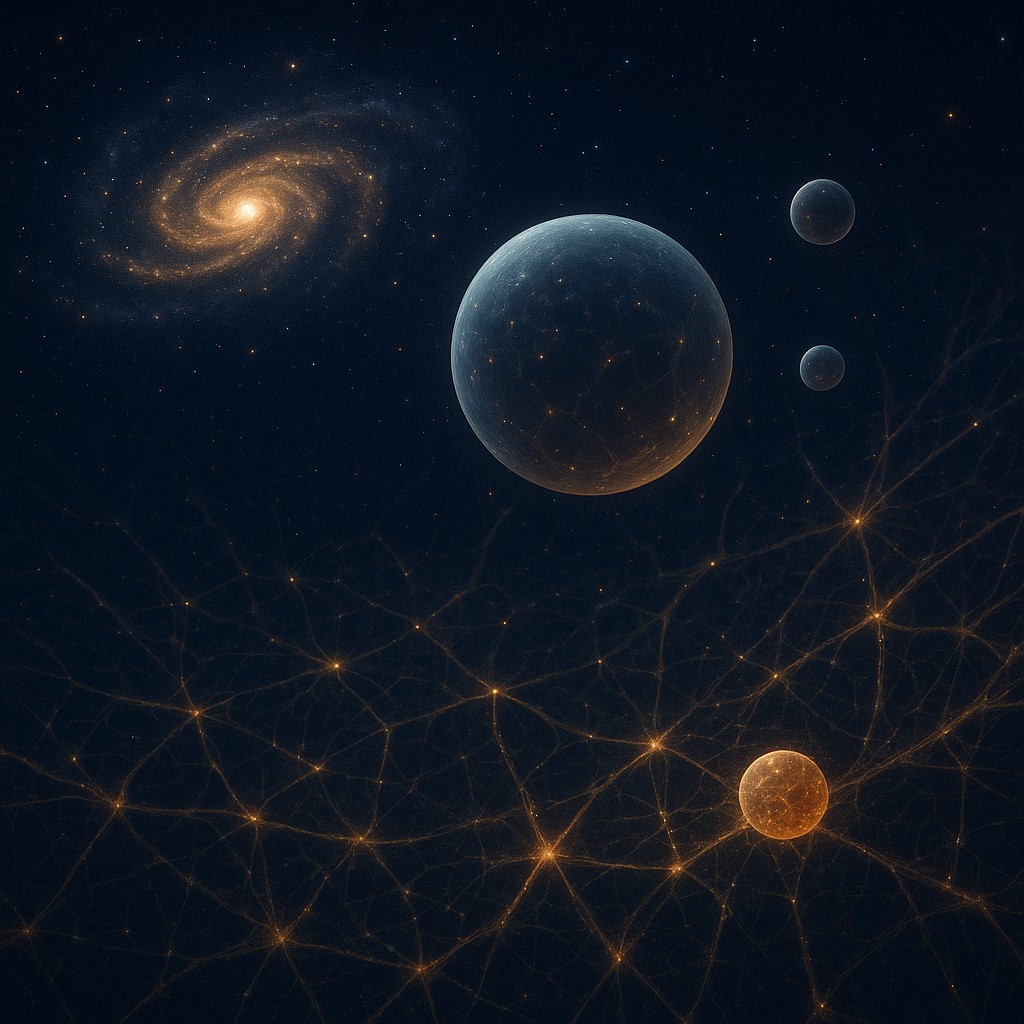
Look up at the night sky on a clear evening, far from the glowing neon of the city, and you will see a breathtaking tapestry of stars, planets, and the hazy light of the Milky Way. It feels vast, solid, and eternal. However, the most startling discovery of modern science is that everything you see, everything you have ever touched, and every atom in every star makes up only about five percent of the actual universe. The rest is made of shadows and mysteries that do not reflect, emit, or absorb light. We are, quite literally, living in a ghost story written in the language of physics.
To understand how the universe stays glued together, we have to look for the invisible architect behind the scenes. Astronomers realized decades ago that galaxies are spinning way too fast for their own good. Based on the amount of visible matter, these celestial carousels should be flying apart, flinging stars into the void like mud off a spinning bicycle tire. Since they stay perfectly intact, there must be a massive, unseen anchor keeping them stable. This led us to the Cold Dark Matter (CDM) theory. This is the leading explanation for the cosmic scaffolding that holds stars in place and dictates how the entire universe evolved from a hot soup into the majestic structure we live in today.
The Invisible Glue Holding Galaxies Together
The story of Cold Dark Matter begins with a cosmic math problem. In the 1970s, astronomers like Vera Rubin observed that stars at the outer edges of spiral galaxies were orbiting just as fast as the stars near the center. According to the laws of gravity established by Isaac Newton and later updated by Albert Einstein, this should not happen. If the only mass in a galaxy were the visible stuff, gravity would get weaker as you moved further from the center, causing the outer stars to move much slower. The fact that they moved quickly suggested that the galaxy was actually tucked inside a giant, invisible sphere of matter that provided extra gravitational pull.
Scientists labeled this mysterious substance "dark" because it simply does not interact with light or radiation. It does not glow like a star, reflect light like a moon, or block light like a cloud of soot. It is essentially transparent. However, "dark" is only half the name. The "cold" part of the theory refers to how fast these particles move. In physics, the temperature of a particle is basically a measure of its speed. If dark matter were "hot," its particles would be zipping around at nearly the speed of light. Because it is "cold," the particles move much more sluggishly, allowing gravity to clump them together into structures.
Because Cold Dark Matter moves relatively slowly, it was able to settle down in the early universe and form "halos." These halos acted like gravitational sinks, pulling in ordinary hydrogen gas that eventually cooled and ignited to become the first stars. Without the slow, heavy presence of Cold Dark Matter, the universe would likely be a thin, boring mist of gas rather than a glittering collection of galaxies. It is the silent partner in every cosmic transaction, providing the mass needed to build the massive structures we see through our telescopes.
Distinguishing Between Hot and Cold Cosmic Ingredients
You might wonder why scientists are so certain that dark matter is "cold" rather than "hot." To understand this, imagine trying to build a sandcastle with dry sand versus damp sand. If the particles move too fast (hot), they have too much energy to stay together. They would simply fly right through each other, preventing the formation of small, dense objects like individual galaxies. If the universe were ruled by Hot Dark Matter, such as neutrinos (ghostly particles that rarely interact with matter), we would see "top-down" structures where huge clusters formed first and then slowly broke into smaller galaxies over billions of years.
Instead, our observations of the deep universe show a "bottom-up" approach. We see small galaxies forming early and then merging over time to create larger ones. This process only works if the dark matter is cold and slow enough to clump into small pockets first. Cold Dark Matter acts like the steel rebar in a concrete building, providing a rigid framework that allows ordinary matter to settle and take shape. This distinction is vital because it matches the snapshots of the early universe we get from the Cosmic Microwave Background, which is the leftover heat signature from the Big Bang.
| Feature |
Hot Dark Matter |
Cold Dark Matter |
| Particle Speed |
Near the speed of light |
Much slower than light |
| Structure Formation |
Top-down (giant clusters first) |
Bottom-up (small galaxies first) |
| Galaxy Clustering |
Weak and spread out |
Strong and concentrated |
| Leading Candidate |
Neutrinos |
WIMPs (Weakly Interacting Massive Particles) |
| Agreement with Observations |
Disagrees with small-scale data |
Matches galaxy maps very well |
The table above shows why the "Cold" part of the name is the gold standard for modern astronomy. While Hot Dark Matter was a popular idea for a while, it simply could not explain why we see so many small, well-defined galaxies early in the history of the universe. Cold Dark Matter, despite being invisible, provides the perfect recipe for the star-filled universe we see today. It is the ultimate cosmic stabilizer, ensuring that matter stays where it belongs rather than dissolving into a chaotic blur.
The Search for the WIMP in the Machine
If the universe is filled with this invisible, heavy stuff, why haven't we found it yet? Scientists have a primary suspect called a WIMP, or a Weakly Interacting Massive Particle. The name is a bit of a joke among physicists, but the science is serious. These particles are "massive" because they have weight, but they are "weakly interacting" because they only respond to two of the four fundamental forces of nature: gravity and the weak nuclear force. They completely ignore electromagnetism, which is why they pass through your body, your house, and the entire Earth as if nothing were there.
Right now, billions of dark matter particles are likely streaming through you every second. You don't feel them because they don't "bump" into your atoms in any meaningful way. To catch a WIMP, scientists have built incredible detectors deep underground in abandoned mines. They bury these sensors thousands of feet below the surface to shield them from cosmic rays and other interference from the surface. The hope is that, once in a long while, a dark matter particle will happen to smack directly into the center of an atom in the detector, creating a tiny flash of light or a microscopic vibration we can measure.
Despite decades of searching with some of the most sensitive equipment ever made, we have yet to confirm a direct hit. This has led some skeptics to wonder if the theory is wrong, but the indirect evidence is so strong that most scientists are sticking to their guns. We can see the gravitational effects of dark matter everywhere. We see it in "gravitational lensing," where the gravity of invisible mass bends light from distant galaxies like a magnifying glass. Even if we haven't touched the particle yet, we can see its fingerprints all over the universe.
Mapping the Cosmic Web and the Large-Scale Structure
One of the most beautiful aspects of the Cold Dark Matter theory is the way it explains the "Cosmic Web." If you were to zoom out so far that entire galaxies looked like tiny dots, you would see that they aren't scattered randomly. Instead, they are arranged in a vast network of strands and knots, looking remarkably like the pathways in a human brain or a giant spiderweb. These strands are made of dark matter, and the galaxies we see are just the bright "dew drops" caught on those invisible threads.
This structure is a direct result of the "cold" nature of dark matter. Because the particles move slowly, they were able to collapse into these long, thin strings under the pull of gravity shortly after the Big Bang. Ordinary matter was then pulled into these dark matter valleys, pooling where the gravity was strongest. This is why we find huge clusters of galaxies located at the hubs where multiple strands meet. The Cold Dark Matter theory allows us to run computer simulations of the birth of the universe. When we use the rules of CDM, the resulting digital universe looks almost exactly like the real one we see through our telescopes.
This consistency is what makes the theory so solid. It isn't just a guess; it is a mathematical model that correctly predicts how galaxies are spread across billions of light-years. When we look at the Cosmic Microwave Background, which is the "baby picture" of the universe from 380,000 years after the Big Bang, we see tiny ripples in temperature. These ripples are the seeds of the Cosmic Web, representing areas where dark matter was just a little bit thicker than elsewhere. Over 13.8 billion years, those tiny ripples grew into the massive filaments and empty voids we see today, all thanks to the patient, slow-moving pull of Cold Dark Matter.
Correcting Common Myths and Misconceptions
Whenever a topic is as mysterious as dark matter, myths and misunderstandings tend to grow. One common mistake is thinking that dark matter is just "regular matter that is dark," such as dead stars, black holes, or rogue planets drifting in the shadows. While these things exist and are technically dark, they cannot account for the massive amount of weight we observe. We call these objects MACHOs (Massive Compact Halo Objects), but deep-space surveys have shown there aren't nearly enough of them to explain the gravity in galaxies. Dark matter must be something entirely new, a type of particle not found on the Periodic Table.
Another myth is that dark matter is the same thing as dark energy. While they share a name because we don't fully understand either one, they are actually opposites. Dark matter is an attractive force; it acts like a cosmic glue that pulls things together and helps galaxies form. Dark energy, on the other hand, is a repulsive force that is causing the universe to expand faster and faster. It acts like "anti-gravity" that pushes galaxies away from each other. If the universe were a movie, dark matter would be the cast and the set staying together, while dark energy would be the theater expanding so fast that the audience can no longer see the screen.
Finally, some people think dark matter is just a "math trick" used by scientists to fix broken theories. While it is true that we started using it to explain missing mass, it has since passed every test. From the way light bends around galaxy clusters to the way the early universe vibrated, the Cold Dark Matter model explains dozens of different mysteries. It is not a temporary patch; it is the most successful framework we have for understanding how the massive universe works.
The Future of Our Invisible Universe
As we move into a new era of astronomy with tools like the James Webb Space Telescope and the Vera C. Rubin Observatory, we are on the verge of finally unmasking this invisible giant. We are looking back further in time than ever before, watching the very first galaxies build themselves within their dark matter cradles. Each new observation is a chance to see if our theory holds up or if we need to change our understanding of what "cold" really means in space. The hunt for the dark matter particle continues in laboratories deep beneath the Earth and in particle accelerators like the Large Hadron Collider, where we hope to create dark matter ourselves by smashing atoms together at incredible speeds.
Understanding Cold Dark Matter is more than just a physics project; it is a search for our origins. Without this invisible scaffolding, stars would never have gathered, the Earth would never have formed, and we would not be here to ask these questions. We are made of the "bright" stuff, but we owe our existence to the "dark" stuff. Embracing this mystery reminds us that the universe is far more complex and wonderful than our eyes can see. It invites us to keep searching, to keep doubting, and to keep marveling at the fact that we are small pieces of a vast, invisible puzzle that is still waiting to be solved. There is a certain magic in knowing that the most important part of the universe is the part we cannot see, and that the greatest discoveries are likely still hiding in the shadows just out of reach.