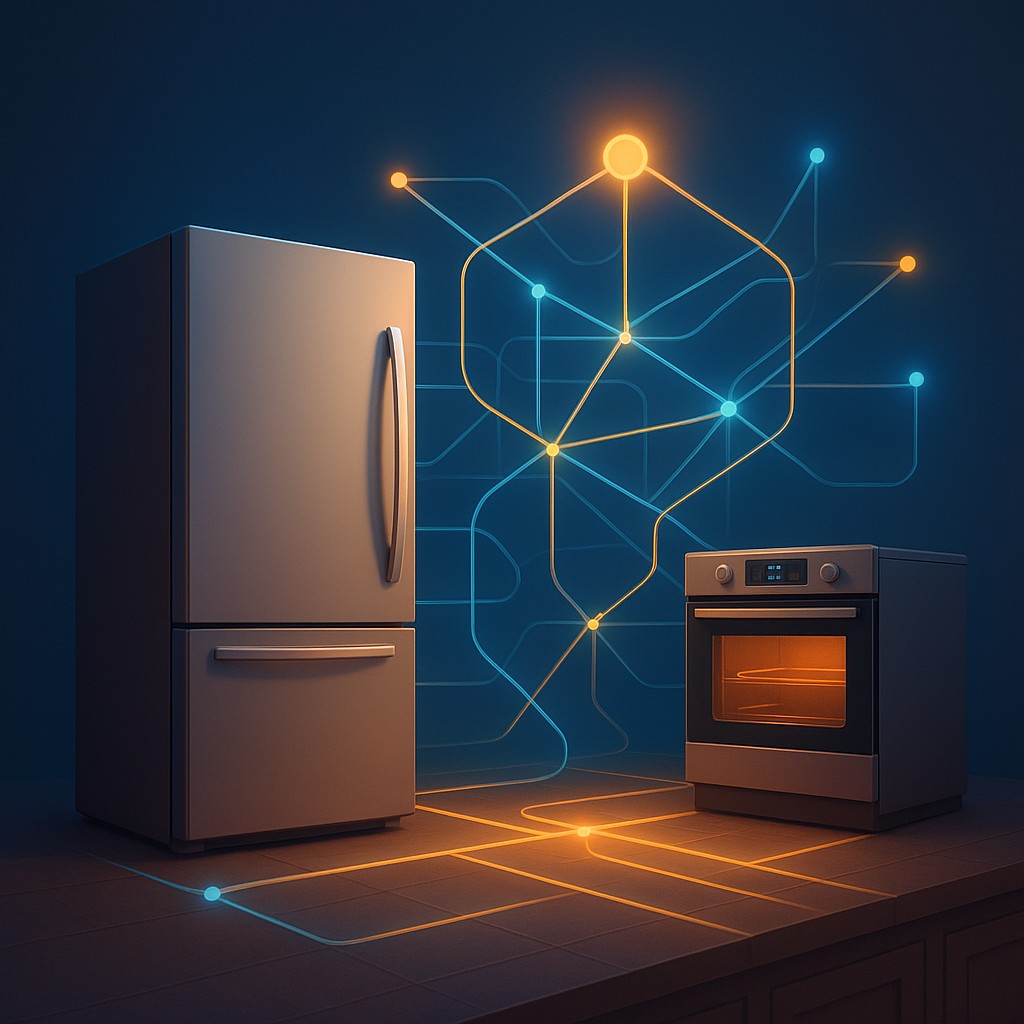
You likely view your refrigerator as a simple, cold metal box that exists solely to keep your milk from turning into a science experiment. In reality, that hum you hear in the kitchen is actually part of a massive, silent, and invisible dance happening across the entire continent. When the power grid faces a sudden surge in demand or a dip in supply, it does not just politely ask for more energy. It experiences a physical change that ripples through every wire in your home. By treating common household appliances as tiny, autonomous guardians of the grid, engineers have discovered a way to prevent the cascading failures that once turned entire cities dark for days on end.
This transition from massive, centralized control rooms to an internet of thousands of small, smart participants marks one of the most significant shifts in electrical engineering history. We are effectively crowdsourcing the stability of our civilization, offloading the most stressful moments of power management from expensive, slow-acting mechanical breakers to software algorithms living inside your dishwasher or heat pump. Understanding this mechanism is not just an exercise in technical trivia. It is an entry point into seeing the world behind your light switch, where billions of devices are constantly negotiating the health of the entire nation in real time.
The Invisible Pulse of Our Electrical System
To grasp why your smart appliances are suddenly acting like miniature grid operators, you first have to understand the heartbeat of the electrical system. In almost every country, the power grid operates at a rigid, specific frequency, such as 60 Hertz in the United States or 50 Hertz in Europe. This frequency is the mechanical pulse of the system, tied directly to the rotation speed of the massive turbines in our power plants. If the balance between how much power we create and how much we consume is perfect, that frequency stays exactly where it belongs, humming along with unwavering precision.
However, the laws of physics are unforgiving when that balance shifts. If a sudden cloud cover reduces solar output or a major transmission line trips offline, the grid experiences a temporary deficit, causing those massive spinning turbines to slow down ever so slightly. As the turbines drag, the electrical frequency drops. This dip is not just a digital signal, it is a physical measurement that you can detect at any wall outlet in the region. If the frequency stays low for too long, mechanical equipment can overheat, protection systems may trip, and the entire house of cards can come tumbling down into a regional blackout.
Historically, we fought this problem by keeping giant power plants running in reserve, essentially burning expensive fuel just to be ready to kick in at a moment's notice. This is like keeping a fleet of dragsters idling in your driveway just in case you suddenly decide to run to the grocery store. It is wasteful, carbon-intensive, and fundamentally reactive. Today, we are moving toward a more elegant model where the grid does not need a massive reserve of spinning metal. Instead, it uses the cumulative power of millions of small devices to blink for a few seconds to restore the equilibrium.
Decentralizing the Burden of Grid Safety
The brilliance of modern frequency-responsive technology lies in its total lack of central leadership. Imagine a stadium full of people where the lights suddenly start to flicker. Instead of waiting for a single person at the front to shout instructions, every attendee is programmed to immediately stand up for exactly five seconds if they feel a specific vibration in their seat. When thousands of people act independently based on the same local sensor data, the entire stadium stabilizes instantly without anyone ever needing to speak. This is exactly how your smart refrigerator, water heater, or heat pump operates during an energy shortfall.
These devices are equipped with internal sensors that monitor the line frequency thousands of times per second. If the frequency drops below a safety threshold, the device does not call a central server to ask for permission to turn off. It simply pauses its cooling cycle or heating element for a, usually imperceptible, duration of ten to thirty seconds. Because the device is acting locally, it can react in the blink of an eye, much faster than any human operator could perceive an issue, let alone hit a switch. By the time a central control room would have even processed the initial alarm, thousands of these devices have already performed their duty and allowed the grid frequency to drift back to its healthy baseline.
This shift moves grid safety away from "brute force" infrastructure, which involves heavy-duty mechanical switches that take time to charge and deploy. Instead, it relies on the quiet persistence of software. The hardware required to add this capability to an appliance is remarkably cheap, often just a modest microcontroller and a few lines of code added during the manufacturing phase. For the consumer, the impact is effectively zero, as a refrigerator turning off for twenty seconds is unlikely to cause your ice cream to melt or your milk to spoil. It is a win-win scenario that turns the largest vulnerability of the grid into its greatest strength.
Comparing Traditional and Modern Grid Stabilization
Understanding the difference between the old way of maintaining power and this new, distributed approach helps clarify why we are seeing fewer major outages despite an increasingly complex energy landscape. The following table highlights how moving from centralized, rigid infrastructure to distributed, flexible response changes the mission profile of the grid.
| Feature |
Centralized Mechanical Control |
Distributed Appliance Response |
| Response Speed |
Seconds to Minutes (slow) |
Milliseconds (instant) |
| Asset Usage |
Requires costly standby generators |
Uses existing, idle appliance cycles |
| Hierarchy |
Top-down command chain |
Autonomous individual action |
| Failure Risk |
Cascading, single-point failure |
Self-healing, resilient network |
| Cost Basis |
High capital expenditure |
Low software and sensor overhead |
As shown above, the move toward distributed response creates a system that is fundamentally harder to break because there is no master switch to target or fail. When you have a single large source of protection, if that source fails, you have an outage. When you have millions of small, autonomous sensors, the system becomes incredibly robust. If half of the appliances in a neighborhood fail to respond, the other half still perform their duty, and the frequency is still stabilized. It is the transition from a brittle, monolithic wall to a flexible, self-organizing forest that bends with the wind rather than snapping.
Correcting Common Misconceptions About Local Control
One of the most persistent myths surrounding this technology is the fear that "local control" means "loss of control." There is a natural human apprehension regarding the idea that a utility company or an algorithm inside your kitchen appliance has the power to turn off your electronics at will. People visualize their lights cutting out during a dinner party or their heat failing in the middle of a winter storm because an algorithm decided it was a good time to save power. We must distinguish between the "load shedding" of the past and the "load shifting" of the future.
Modern grid-responsive appliances are not being turned off by an external actor snooping on your home life. They are reacting to an objective, physical reality of the electricity grid itself. The appliance is not "following orders" from a utility executive, it is reading the frequency of the power line and making a logical choice to prevent a physical collapse of the system. This distinction matters because it reframes the appliance from an instrument of external surveillance into a participant in local survival. The goal is not to starve your home of energy. The goal is to prevent the grid from collapsing entirely, which would inevitably result in a much longer and more inconvenient blackout.
Furthermore, these systems are designed with strict boundaries that prioritize the user over the grid. A smart device will never trigger a load-shed cycle if it determines that doing so would compromise the safety or integrity of its primary function. If your heat pump is the only thing standing between your water pipes and a freeze, or if your refrigerator is in the middle of a critical chilling phase, the software logic prioritizes those vital tasks. The grid only pulls from the "slack" in systems that can afford a very short grace period, ensuring that the comfort and safety of the human occupants remain the primary directive regardless of the grid's immediate needs.
Designing the Future of Energy Resilience
We are entering an era where our homes are no longer just passive consumers of power but active cells in a giant, living organism. Every time you purchase a modern, connected appliance, you are effectively buying a micro-stabilizer for your neighborhood. As this technology scales, the cumulative effect of these small sacrifices - tiny, ephemeral pauses in power usage - will render the concept of the widespread, regional blackout a historical artifact. We are trading the old strategy of building bigger pipes and more massive generators for a strategy of sophistication, intelligence, and collective, tiny adjustments.
This evolution is a testament to the power of systems thinking. We have learned that we do not necessarily need more power to keep the lights on; we just need smarter ways of managing the power we already have. By burying the intelligence of the grid beneath the surface of our everyday lives, we have created a future where stability is a natural consequence of the system design itself. So the next time your dishwasher makes a soft, clicking sound, do not worry - it is just doing its part to keep the modern world spinning, one millisecond at a time. The quiet, invisible effort of these machines is what gives us the luxury of never having to worry about our power until it is gone, and now, thanks to them, that "until" is becoming increasingly rare.