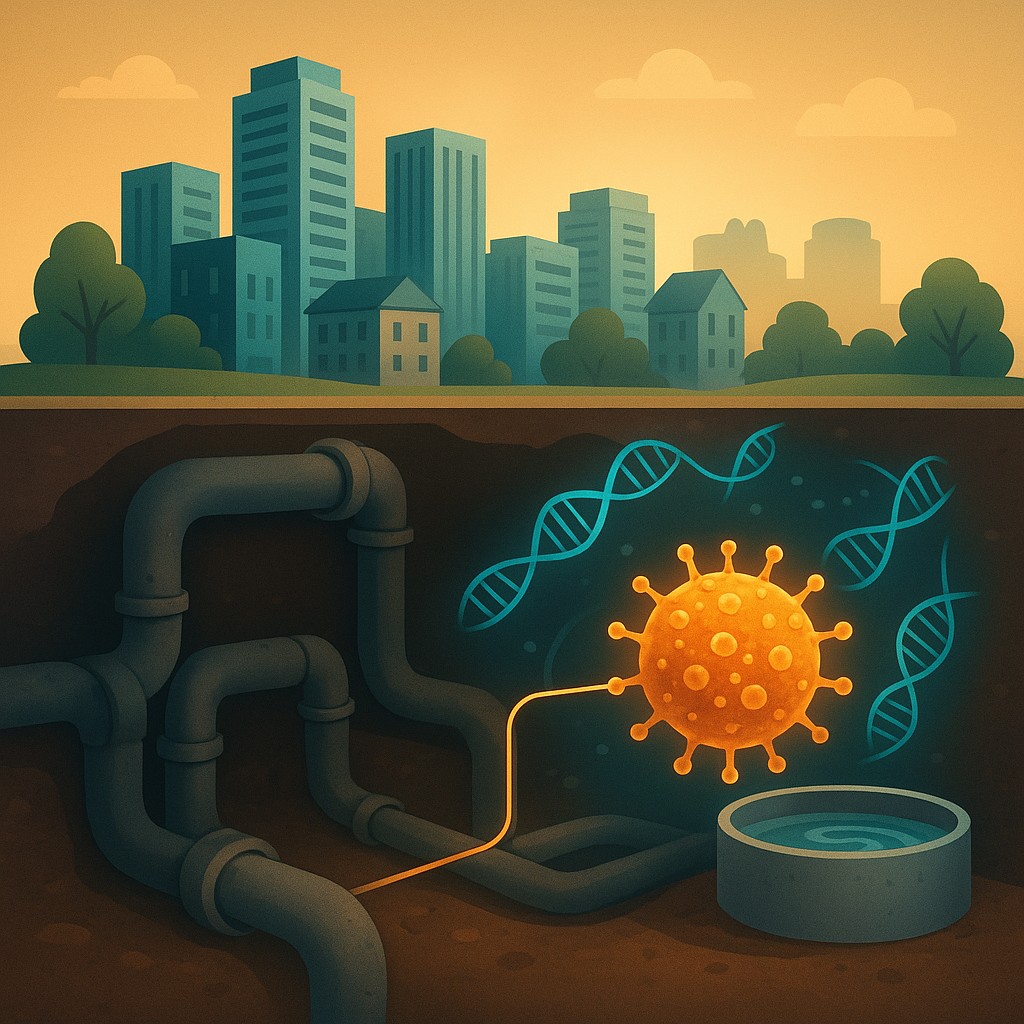
The city beneath our feet is often seen as a graveyard for things we no longer want, a web of tunnels built to carry away the messy leftovers of human life. We rarely consider the constant stream of data flowing through those pipes, but to a modern disease expert, every flush serves as a biological status report. When you are infected with a virus, your body sheds genetic evidence long before you run a fever or feel a scratchy throat. This microscopic trail travels through the local plumbing and gathers in the massive basins of treatment plants, waiting to tell the story of a community’s health.
Traditionally, tracking a viral outbreak was like trying to map a forest fire by waiting for people to call 911 from their living rooms. By the time a patient feels sick enough to visit a clinic, gets a checkup, and receives their lab results, the virus has likely already spread to their family, coworkers, and neighbors. It is a reactive system that always lags behind. Wastewater genomics flips this script. By monitoring the combined biological output of thousands of people at once, health officials can spot the fire while it is still just a few sparks in the grass.
Microscopic Evidence in the City Sewers
To understand how we can find a single virus in a sea of city waste, we have to look at how genetic material survives. Viruses are essentially tiny packages of instructions, written in the languages of DNA or RNA and wrapped in a protective shell. Even after these viruses are defeated by our immune systems or broken apart by the harsh environment of a sewer pipe, those instructions remain. They are like torn pages from a book; you do not need the entire book to know which story is being told. Using a process called genomic sequencing, scientists can "read" these fragments to identify exactly which germs are circulating in a specific zip code.
The process starts with a simple sample, usually just a liter of liquid pulled from the intake line of a treatment plant. This liquid is a chaotic soup of bacteria, human cells, chemicals, and viral bits. To find the "signal" in all that noise, technicians use specialized filters and high-speed spinners called centrifuges to concentrate the viral particles. Once isolated, the genetic material is amplified using a lab technique called Polymerase Chain Reaction (PCR). This creates millions of copies of the specific genetic sequences so they are large enough for high-tech machines to analyze.
This genomic approach is far more sophisticated than older methods that merely checked if a virus was present. By mapping the entire genetic code of a germ found in the waste, scientists can track "variants of concern." They can see if a flu virus has mutated to become more contagious or if a traveler has brought a new strain of a respiratory illness into the city. It is the difference between knowing that "someone in the building is playing music" and being able to name the specific song, the artist, and the fact that the guitar is slightly out of tune.
Moving From Constant Crisis to Early Warning
The most important part of this technology is the gift of time. In public health, time is the only currency that really matters. When a hospital knows a massive wave of RSV or flu is coming three weeks before patients start filling the hallways, the entire strategy changes. Managers can adjust staff schedules, postpone minor surgeries to free up beds, and make sure they have plenty of oxygen and medicine on hand. It turns a chaotic emergency into a manageable logistics problem.
In the past, we relied on "syndromic surveillance," which is a technical way of saying we watched for people buying more cough syrup or Googling "how to break a fever." While helpful, these clues only appear after people are already miserable. Wastewater data provides a head start because the virus usually peaks in the body during the "incubation period," the time before symptoms show up. For several days, an infected person is a walking transmitter, unaware they are sick but contributing data to the sewer system. This allows the city to issue specific warnings, like "cases are rising in the North District; now is a good time to wear a mask," before local clinics are overwhelmed.
| Feature |
Clinical Testing (Individual) |
Wastewater Genomics (Community) |
| Detection Timing |
After symptoms appear |
Days or weeks before symptoms |
| Participation |
Requires effort and cost |
Automatic and passive |
| Detail |
Pinpoints the exact person |
Identifies neighborhood trends |
| Bias |
Only counts those with a doctor |
Captures everyone using a toilet |
| Cost |
High cost per person |
Extremely low cost per person |
The Ethics of Staying Anonymous
Whenever we talk about tracking biological data, the conversation naturally turns to privacy. How much does the city know about what happens behind your front door? The strength of wastewater genomics is its built-in anonymity. By the time waste reaches a neighborhood pumping station or a central plant, the biological signatures of thousands of residents have been blended into a single statistical average. It is mathematically impossible to trace a specific viral fragment back to a specific bathroom.
This creates a "privacy-first" model for public health. During a pandemic, individual contact tracing can feel like an invasion of privacy, as it requires people to list their movements and friends. Wastewater monitoring, however, protects the group without intruding on the individual. It views the city as a single organism rather than a collection of suspects. Scientists aren't looking for "Subject A," they are looking for "Area 42." This shift toward monitoring the environment allows the city to help specific neighborhoods, such as by sending mobile vaccine clinics to one area, without ever seeing an individual’s medical records.
There is also the benefit of closing the "access gap." In many healthcare systems, people without insurance or those who live far from a clinic are often invisible. They might recover at home or only go to the hospital when they are in critical condition. Because everyone uses the city’s plumbing regardless of their wealth, wastewater genomics provides the most inclusive health data we have ever had. It ensures that overlooked communities are not ignored simply because they aren't appearing in official lab results.
Myths Versus the Reality of the "Genome Soup"
A common myth is that wastewater monitoring is only useful for major global pandemics. In reality, its uses are expanding into every corner of medicine. We are now using these tools to track "superbugs," which are bacteria that have evolved to survive our strongest medicines. By spotting these bacteria in the sewage of a specific hospital wing or a city block, doctors can change the medicines they prescribe before an infection becomes untreatable.
Another myth is that the "noise" of the sewer, like chemicals or rainwater, makes the data wrong. While a heavy storm can thin out the samples, scientists use "normalization" to fix the data. For example, they might measure a harmless virus that only lives in pepper plants (which humans eat in steady amounts) or check for creatinine, a waste product from human muscles. By comparing the germ count to these steady human markers, they can tell if a drop in the virus level is because people are getting healthier or just because it rained on Tuesday.
Finally, some worry about a "Big Brother" world where the government can see everything we eat or drink. While looking for drugs or chemicals is technically possible, the focus remains strictly on germs that threaten public health. The equipment needed to read genomes is expensive and requires a lot of work, so it is aimed at the biggest threats. The goal is not to judge individuals, but to protect the public, much like how we monitor the air we breathe or the water we drink.
The Future of the Living City
As we move forward, the "Smart City" of the future won't just have timed traffic lights and fast Wi-Fi; it will have an immune system. We are entering an era where our infrastructure is as much about biology as it is about concrete and steel. Imagine a world where a local outbreak of food poisoning can be traced to a specific warehouse in hours rather than weeks, or where the arrival of the flu is as predictable as the morning commute.
This shift moves us from "hunting" diseases after they have already started to being guards watching from the walls. We are learning to listen to the city’s biological exhaust, turning what was once waste into life-saving information. By paying attention to the microscopic stories flowing beneath our feet, we are giving our healthcare systems the foresight they need to stay one step ahead of the next invisible threat.
The next time you hear about a new virus, remember that our most powerful weapon is not just a new pill or vaccine. It is the intelligence we gather before the first person even sneezes. We are finally learning to read the DNA of the city itself, building a future where outbreaks are stopped before they start, and where the health of one person is linked to the data of everyone.