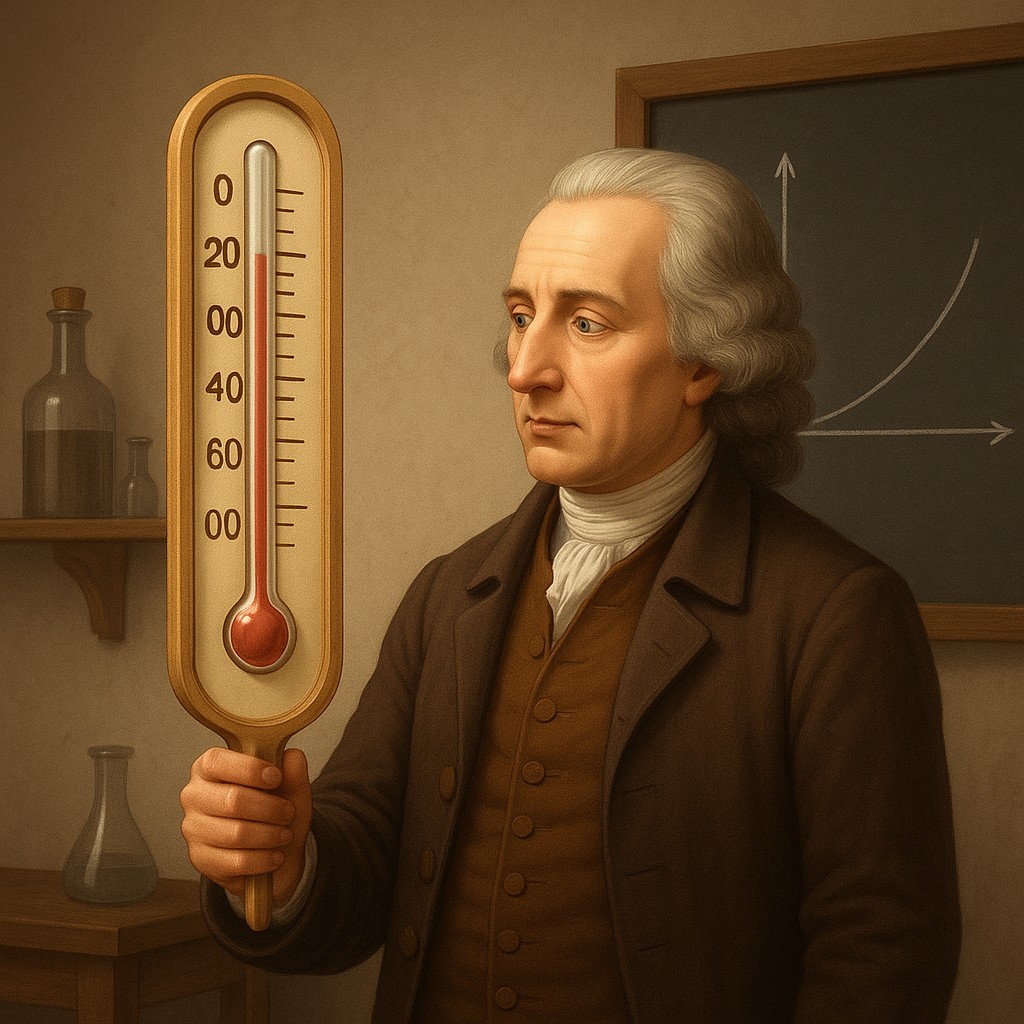
Imagine standing in a laboratory in 1742, holding a thermometer you just perfected, only to decide that the hottest summer day should be marked with a tiny, humble number like zero. To the modern mind, this feels like navigating a map where the peak of a mountain is labeled as the deepest valley. You might assume such a choice was a mistake, a momentary lapse of logic, or perhaps an early form of scientific mischief intended to confuse students centuries later.
In reality, the inverse nature of the original Celsius scale was a deliberate attempt to align the tool with a very specific, albeit flawed, mental model of how the physical world operates. Anders Celsius, the Swedish astronomer who gave us this scale, viewed the world through the lens of density rather than energy. He firmly believed that since substances tended to expand and become less dense when heated, the numerical scale should reflect that phenomenon by decreasing as it reached higher states of thermal activity. It is a striking reminder that even the most brilliant minds can build systems that work perfectly in theory while remaining fundamentally mismatched with human intuition.
The Architecture of Misguided Logic
To understand why Celsius started with zero at boiling and one hundred at freezing, we have to step inside the mind of an 18th-century scientist. During this era, much of physics was built on observational heuristics, or rules of thumb, that favored the visible behavior of matter. Celsius observed that when air or water grew hotter, it occupied more space per unit of mass, a process we now know as thermal expansion. Because the substance was taking up more room, or becoming less dense, he concluded that a decreasing numerical value was the most logical way to track the thinning of the material.
This is a classic example of a design trap where the creator prioritizes a theoretical mechanism over the user experience. By tethering his scale to the density of the substance, Celsius created a system that demanded a constant mental effort from the user. Every time a person wanted to describe a hot day, they had to perform a mental inversion, associating a small number or a zero with intense heat. Humans, however, are wired to view magnitude in an additive way. We prefer scales that go up alongside the intensity of the event, which is why we find clocks, speedometers, and fuel gauges so intuitive. Celsius had built a machine that mirrored his private logic, but it lacked a social interface.
The Friction of Inverted Mental Models
When we talk about design, we often assume that as long as a system is internally consistent, it should work for everyone. Anders Celsius’s scale was technically sound; if you flipped the values, the intervals were correct, and the math remained accurate. The problem, however, was what experts call cognitive friction. Whenever someone had to convert his scale into a measurement of heat, they were forced to reverse the sequence in their head. That extra step of mental labor acts as a barrier to adoption, slow but steady, which eventually leads to the system being abandoned or, in this case, modified.
The shift that occurred after his death was not just a scientific correction, but a social one. Peers and later scientists realized that for a tool to be useful, it must align with how we perceive reality, not just how we observe particles. By flipping the scale to align with the accumulation of thermal energy rather than the thinning of particle density, the scientific community essentially performed a user experience audit. They recognized that the objective reality of the scale, the measured distance between two points, was less important than the ability of the average person to look at a number and immediately understand the intensity of the environment.
Social Consensus as a Laboratory Tool
One of the most fascinating aspects of this transition is that it moved the definition of a degree from the realm of individual discovery to the realm of social agreement. Science is often romanticized as a solitary pursuit of truth, but the Celsius scale stands as a perfect testament to the fact that science is also a consensus-building game. We use the updated Celsius format today because it is a shared language. If every researcher stubbornly stuck to their own preferred orientation of scale, we would be unable to share data, discuss climates, or even bake a consistent loaf of bread.
This mirrors how we handle many other systems in our lives, from the QWERTY keyboard layout to the way we drive on specific sides of the road. These designs are not necessarily the absolute peak of logical perfection, but they are the standard. Once a community reaches an agreement on a standard, that standard becomes a foundational piece of our collective reality. Even though Anders Celsius provided the anchor points, the society that adopted his work refined the interface to make it usable. It is a humbling lesson for any designer or innovator: your invention belongs to the people who use it, and they will ultimately reshape it to suit their own mental models.
Comparing Thermal Perspectives
The evolution of temperature scales is a story about moving from intuitive, ego-centric designs toward universal, energy-centric ones. To see how these shifts work in practice, we can categorize how different scales bridge the gap between human observation and physical reality. Notice how each approach tells a different story about the relationship between heat and numbers.
| Measurement Concept |
The Celsius Intent |
The Human Reality |
Outcome |
| Density Model |
Less heat = Higher density |
Humans see growth as "more" |
Scale was inverted for logic |
| Energy Model |
More heat = Higher energy |
Humans see rise as "more" |
Scale was flipped to current |
| Operational Ease |
Internal consistency only |
Intuitive for daily tracking |
Standardized for global use |
| Scientific Utility |
Metric correlation |
Predictability across systems |
Fixed points set at 0 and 100 |
Breaking the Trap of Initial Conditions
Because Celsius began with an inverted scale, it serves as a powerful cautionary tale about path dependency. Path dependency occurs when the first choice made in a system determines the future of that system, regardless of whether a better alternative exists. We often stick with original, inefficient designs simply because that is how things were when we arrived. We assume the inventor had a reason, and in many cases they did, but the world changes and our reliance on those original assumptions can prevent us from seeing the more obvious solution.
Think about the software interfaces you use, the organization of your digital files, or even the way you manage your daily schedule. How many of those systems are built on Celsius assumptions, where you keep doing something in a particular way just because it started that way? By questioning the logic behind your own habits, you can often find that a small, deliberate shift in your perspective makes a massive difference in efficiency. We do not have to be bound by the mental models inherited from others. Like the scientists who corrected the scale, we have the power to redefine our surroundings to better fit our actual needs.
When you look at a thermometer today, do not just see a line of numbers. See the persistence of progress, the triumph of user-centered design, and the quiet, collective power of humanity refining its tools to match the way we think. You possess the same capacity to audit your own life, identifying systems in your workflow that might be inverted, where you are working against your natural inclinations rather than with them. Seek out the friction in your daily tasks, identify the outdated models you are still relying on, and have the courage to flip the scale. When you align your environment with your internal intuition, you stop fighting against the system and finally start letting the measurement work for you.