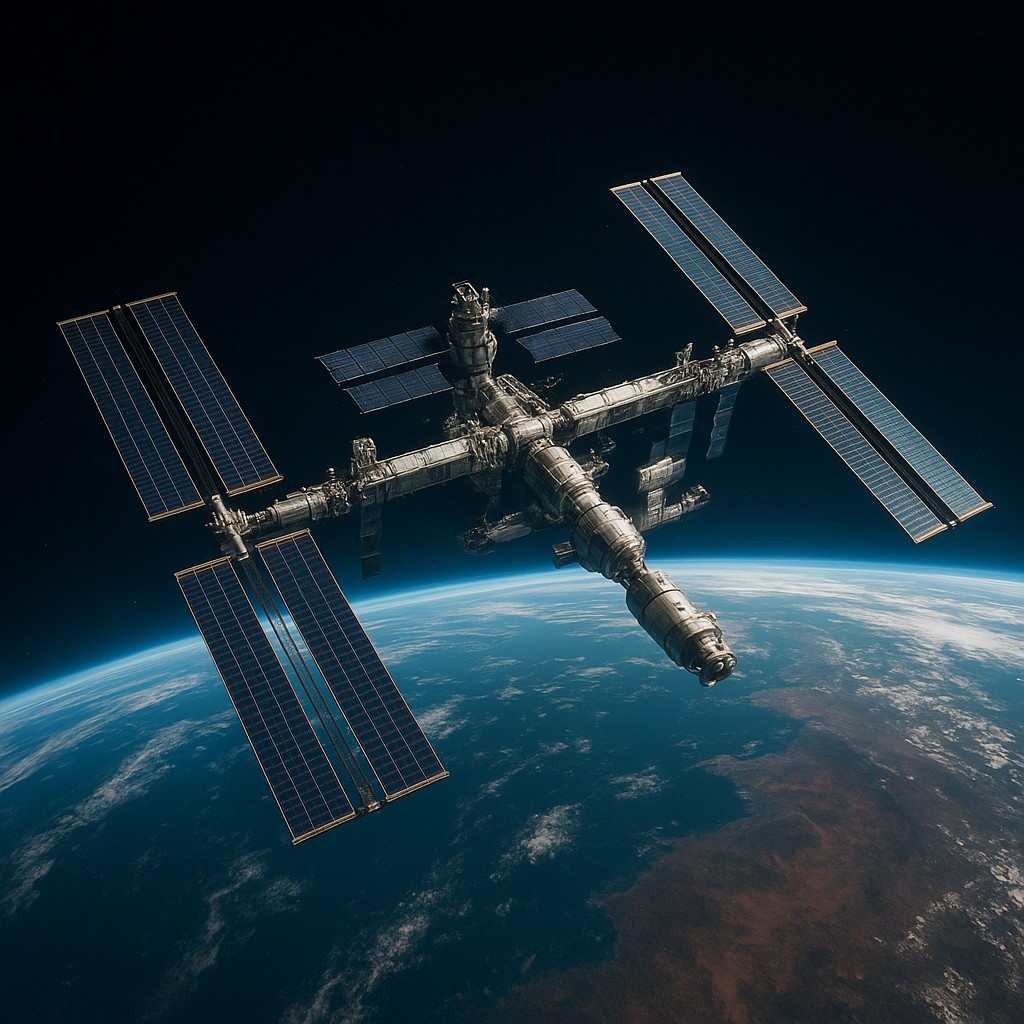
Imagine, for a moment, you’re sitting in a dark room, staring out a window at a scene that defies belief. Below you, Earth spins like a radiant marble - swirls of sapphire and cream glowing against the blackness of space. You’re not looking at a photo. You’re floating. Your hair drifts toward the ceiling. You’re moving at 17,500 miles per hour. This is everyday life for the few people living on the International Space Station, or ISS. It’s the most expensive thing humans have ever built: a feat of science, diplomacy, and a lab where gravity barely matters.
The ISS isn’t just a pile of metal stitched together in space. It’s a testament to human grit and teamwork. While countries on Earth argue over borders and trade, space agencies from fifteen nations joined forces to build a home in the vacuum. It’s a bridge between our planet and the vast, icy void beyond. To understand the ISS is to glimpse our future. If we can cook, sleep, and clean in a tin can the size of a football field orbiting Earth, then one day we might do the same on Mars - or farther.
A Massive Jigsaw Puzzle in the Sky
When we think of building a house, we picture trucks hauling bricks to one spot. Building the ISS was nothing like that. You can’t just launch a finished skyscraper into space. Instead, the station was sent up piece by piece from 1998 to 2011. Picture assembling a complex Lego set while riding a rollercoaster. Every part arrived from a different place. Drop a screw, and it’s gone forever - flung off at thousands of miles per hour. That’s the challenge NASA, Roscosmos, ESA, JAXA, and CSA faced.
The first piece was Zarya, a Russian module that supplied power and propulsion. Soon after came the American module Unity - the first handshake in space between two nations’ hardware. Over the next decade, dozens of missions delivered labs, solar panels, and living quarters using the Space Shuttle and Russian rockets. Each piece had to fit perfectly, using standard docking ports that let the station grow like a mechanical coral reef. Today, the ISS stretches as long as a football field, including the end zones - an impressive amount of space kept aloft by nothing but physics.
The scale is hard to fathom. The station weighs nearly a million pounds. But since it’s constantly falling, it feels weightless inside. The pressurized living area is about the size of a Boeing 747. There’s room to move, but it’s packed with wires, computers, and experiments. Every inch serves a purpose - survival or discovery. It’s a tight, high-tech jungle where nothing is wasted.
The Physics of Falling and Staying Up
Many people think there’s no gravity on the ISS. Not true. At 250 miles up, gravity is still about 90 percent as strong as it is on Earth. If you stood on a tower that tall, you’d weigh almost the same as you do now. So why do astronauts float? Because they’re in orbit. Orbiting means falling toward Earth but moving sideways so fast that the planet curves away beneath you at the same rate.
This freefall is called microgravity. It’s a dream for scientists - it lets them study things without the weight we feel on Earth. On the ground, lighting a candle makes the flame rise in a teardrop shape. On the ISS, there’s no “up,” so the flame burns as a small blue ball. Liquids act strange too. Water doesn’t stay in a glass. It clumps into wobbling spheres that can be batted around like tiny balloons.
Staying in orbit takes constant effort. Even at that height, there’s a thin trace of atmosphere that creates drag. Over time, this slows the station, causing it to sink. To fix it, the ISS fires its engines - or uses the engines of a docked cargo ship - to climb back up. It’s a never-ending tug-of-war against air resistance, keeping the station from turning into a high-priced shooting star.
Life Inside a High-Tech Research Hive
Living on the ISS is both a privilege and a physical grind. There’s no up or down. You can sleep on the floor, wall, or ceiling. Astronauts use sleeping bags strapped to surfaces so they don’t drift off during the night and bump into controls. Every morning, they wake up in a world where nothing stays put. Set your glasses down for a moment, and the airflow might carry them away.
Days are planned in five-minute blocks. Scientists on Earth want no second wasted. Astronauts spend their time growing space lettuce, testing how fire spreads in weightlessness, or studying cell growth. They’re also the station’s janitors, plumbers, and electricians. If the toilet clogs or a computer crashes, help isn’t coming. They fix it themselves, often guided by experts on the ground through radio calls.
Exercise is non-negotiable. Without gravity, the body doesn’t need strong muscles or dense bones. In just months, astronauts can lose a lot of both. To fight it, they work out two hours a day using special gear - a treadmill with bungee cords to hold them down or a weight machine that uses air pressure to simulate resistance.
| Feature |
International Space Station Detail |
| Average Altitude |
Approximately 250 miles (400 kilometers) |
| Orbit Velocity |
17,500 mph (28,000 kph) |
| Orbits Per Day |
15.5 (One orbit every 90 minutes) |
| Power Source |
One acre of solar arrays (8 wings) |
| Living Space |
Comparable to a six-bedroom house |
| Primary Agencies |
NASA, Roscosmos, JAXA, ESA, CSA |
| Continuous Occupation |
Since November 2, 2000 |
The Masterpiece of Life Support Systems
If the ISS were a body, its life support systems would be the heart and lungs. There’s no air in space and no grocery store nearby, so the station must recycle nearly everything. The Environmental Control and Life Support System (ECLSS) is an engineering marvel - it manages air, water, and temperature. The station faces extremes: the sunny side heats up to 250°F, while the dark side drops to -250°F. Large white radiators release extra heat into space, keeping the interior at a comfortable room temperature.
One of the most talked-about - and maybe least glamorous - features is water recycling. Launching water into space is costly, so the ISS reclaims about 93 percent of it. That includes sweat, moisture from breath, and yes, urine. Through advanced filters and chemical treatment, it’s cleaned into water purer than most tap water on Earth. As astronauts joke, “Yesterday’s coffee is tomorrow’s coffee.”
Oxygen is another puzzle. Some comes on supply ships, but most is made on board through electrolysis. Solar panels power electricity that splits water into hydrogen and oxygen. The oxygen goes into the air; the hydrogen is either released or combined with carbon dioxide to make more water. It’s a neat chemical loop that keeps the crew breathing in a place where life shouldn’t survive at all.
Science without the Shackles of Gravity
The real job of the ISS is science. Its constant weightlessness lets researchers study things impossible on Earth. One promising area is medicine. On the ground, cells grow flat in a dish, pulled down by gravity. In orbit, they grow in 3D - just like in the human body. This helps scientists test cancer drugs and study diseases with far better accuracy.
Materials science also gets a boost. On Earth, when you melt different metals, the heavier ones sink - a process called sedimentation. In microgravity, they mix evenly, creating new, stronger alloys. Another experiment focuses on optical fibers - the thin glass threads that carry internet and phone signals. On Earth, gravity creates tiny crystals in the glass that weaken signals. In space, the glass forms nearly perfectly clear, which could transform how we transmit information.
Beyond practical uses, the ISS is both a telescope and a mirror. Instruments on the outside study cosmic rays and dark matter, probing how the universe began. Others point down at Earth, tracking storms, measuring forests, and monitoring climate shifts. The station gives us a view no ground office can match - a real bird’s-eye look at our planet and our impact on it.
Busting Myths about the Giant Metal Bird
Even after decades in the news, myths about the ISS linger. One is that it’s far from Earth. It’s not. If you could drive straight up at highway speed, you’d reach it in about four hours. It’s not in deep space - it’s in low orbit, well within Earth’s neighborhood. That closeness makes it easier to study, but it also means the station still feels Earth’s gravity, magnetic field, and the thin outer edge of the atmosphere.
Another myth is that space is silent. Inside the ISS, it’s anything but. Fans and pumps run nonstop to move air. Without them, exhaled carbon dioxide would pool around an astronaut’s head and cause suffocation. The constant buzz makes it feel like a busy office or a running computer. People also think the station is spotless. In reality, where humans live, there’s dust, skin flakes, and bacteria. Staying clean is a daily battle - special filters keep mold and microbes in check.
Then there’s the idea that the ISS will last forever. It won’t. It’s a machine, and machines wear out. Radiation and wild temperature swings stress its metal frame. Plans are in motion to retire the station, likely in the early 2030s. When that happens, it will be guided into a remote stretch of ocean, closing one chapter and opening the next: a new era of commercial space stations.
The Future of Orbital Cooperation
The ISS’s legacy won’t just be the research it enabled. It’s what the station taught us about ourselves. It proved that, despite differences on Earth, people can come together to build something that helps everyone. When you see that bright light gliding across the night sky, you’re not just seeing a machine. You’re seeing a human outpost - our first permanent home beyond Earth. It’s a symbol of curiosity and our deep need to explore.
The lessons from the ISS prepare us for what’s next. As we aim for the Moon and, one day, Mars, we’ll lean on what we’ve learned in these cramped, noisy modules. We now know how to recycle water, keep our bodies strong in space, and work with people from every corner of the world. The ISS was our first real “starship.” It’s not just a lab in the sky - it’s the foundation of a future where humanity doesn’t live on one planet, but travels among the stars.