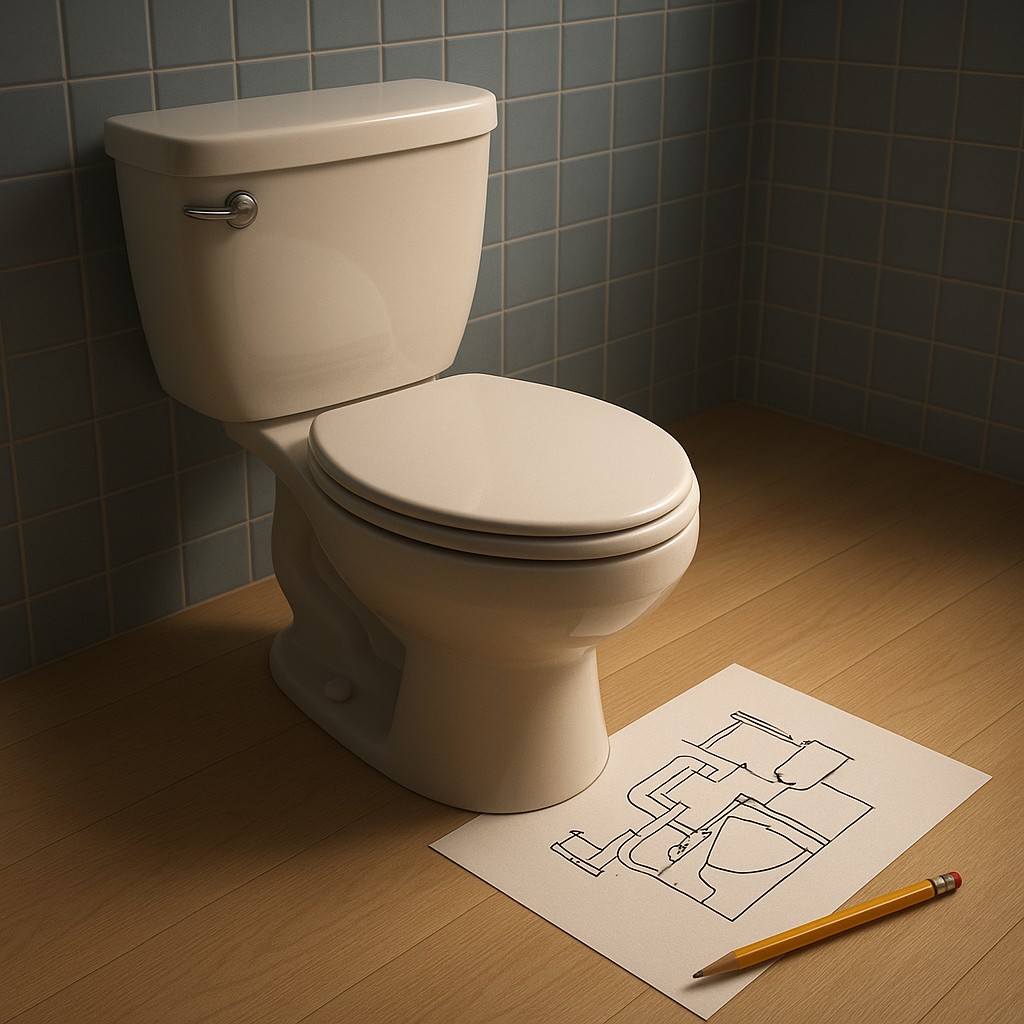
Imagine for a moment that you are standing in your bathroom, looking at the toilet. It is a humble, everyday object that you have likely used thousands of times without a second thought. If someone asked if you knew how it worked, you would probably nod with quiet confidence. You might think to yourself, "Of course I know how a toilet works; you push the handle, water rushes in, things disappear, and the tank refills." It feels like a complete story, a solid piece of practical knowledge tucked away in your brain.
Now, imagine that same person hands you a blank sheet of paper and a pen, asking you to draw a detailed diagram of the internal valves, the physics of the siphon effect, and the exact timing of the float. Suddenly, that warm glow of confidence begins to flicker. You might realize you aren't quite sure where the water goes first, or exactly how the seal breaks and reforms. This sudden, jarring realization that your "deep" understanding was actually just a thin layer of familiarity is a fascinating mental habit that shapes almost every part of our lives.
The Fragile Logic of Familiarity
Human beings are naturally gifted at skimming the surface of reality. We have evolved to be efficient tool users, which often means we mistake "knowing how to use something" for "knowing how it functions." This mental shortcut is known as the Illusion of Explanatory Depth. It was first identified by psychologists Leonid Rozenblit and Frank Keil in the early 2000s. They discovered that for many everyday objects, from zippers and ballpoint pens to crossbows and cylinder locks, people consistently rated their understanding as much higher than it actually was.
We fall into this trap because our brains are incredibly good at saving energy. If you can successfully use a zipper to close your jacket every morning, your brain checks a box that says "zipper knowledge: complete." Because you interact with the surface of the object so easily, your mind assumes it has downloaded the blueprint for the internal mechanics as well. We mistake our ability to use things for technical expertise, creating a mental model that is wide but incredibly shallow. This isn't a sign of low intelligence; rather, it is the result of a brain designed to navigate a complex world without getting stuck in the tiny details of every spring and gear it meets.
Testing Your Mental Blueprints
To see how deep this illusion goes, we have to look at what happens when it breaks. In clinical studies, researchers ask people to rate their knowledge of a system on a scale of one to seven. Most people start with a strong five or six. Then comes the "explanation phase," where they are asked to provide a step-by-step account of how the system works. As they struggle to describe how the parts interact, they quickly realize their explanation is full of holes. When asked to rate their knowledge again, their scores almost always crash.
This gap between what we think we know and what we can actually explain is not limited to machines. It extends to economics, climate science, and public policy. We might feel we have a firm grasp on how "inflation" or "tax brackets" work because we hear the terms every day. However, when pushed to explain the specific steps that link interest rates to consumer prices, many of us find that our "knowledge" is really just a collection of buzzwords and general impressions. The following table shows how this illusion appears in different areas.
| Category |
Initial Confidence |
The Reality of the Gap |
Common Trigger for Realization |
| Simple Machines |
High; we use them daily. |
Vague understanding of physical parts. |
Drawing a diagram of the object. |
| Digital Systems |
Medium; we use "the cloud." |
No grasp of server structures or rules. |
Explaining how an email travels. |
| Social Policies |
High; based on personal values. |
Lack of data on long-term effects. |
Outlining the specific steps of a law. |
| Biological Processes |
High; we know "how to breathe." |
Confusion over gas exchange and the diaphragm. |
Explaining the role of the alveoli (air sacs). |
The Social Bond of Shared Ignorance
You might wonder why we haven't evolved to be more honest with ourselves about what we don't know. The answer is that humans are deeply social creatures who rely on a "division of mental labor." We don't actually need to know how a toilet works as long as the plumber knows. We don't need to understand the engine as long as the mechanic does. Our brains treat the collective knowledge of our community as if it were stored in our own heads. This "community of knowledge" allows us to do incredible things, but it also makes us prone to overestimating our own individual brilliance.
When we are surrounded by people who use the same tools and talk about the same topics, we feel a sense of collective mastery. This is why political debates often become so heated; people feel they have a deep understanding of complex social systems because they are part of a group that discusses them. We lean on the expertise of others without realizing where our knowledge ends and theirs begins. This blurred boundary between "my knowledge" and "our knowledge" makes the Illusion of Explanatory Depth particularly hard to shake. We feel smart because we belong to a smart species, even if we couldn't personally build a toaster from scratch if our lives depended on it.
Humility as a Superpower
While discovering your own ignorance can be embarrassing, it actually triggers a very productive state called the "humility response." When a person is forced to admit they don't understand a mechanism as well as they thought, they often become more curious and less stubborn. In polarized debates, experiments have shown that asking people to explain the mechanics of a policy (how it would actually work) reduces their extremism more effectively than asking them for reasons why they support it.
When you ask someone for "reasons," they simply lean into their values and produce a list of justifications. But when you ask for "mechanics," they run into the Illusion of Explanatory Depth. That collision with their own lack of knowledge softens their certainty. This humility is not a sign of weakness; it is the starting point for all genuine learning. By recognizing that our first intuition is usually a rough sketch rather than a finished painting, we can approach new information with an open mind. It allows us to ask better questions and move from being mere users of the world to being informed participants in it.
Navigating a World of Complex Systems
So, how do we live with this tendency to overestimate ourselves? The goal is not to become an expert in everything, which is impossible. Instead, the goal is to better "calibrate" our sense of our own knowledge. We can do this by testing ourselves every now and then. Before you enter a heated argument about a new technology or a complex law, take thirty seconds to see if you can explain the core mechanics of the topic to a five-year-old. If you find yourself using vague filler words or getting stuck on the first step, take that as a sign that your "depth" is currently an illusion.
This intellectual caution actually makes you more effective. People who recognize the limits of their understanding are better at spotting real experts and are more likely to look for high-quality information. They are less likely to fall for "snake oil" solutions that promise simple fixes for complex problems. In a world that often rewards the loudest and most confident voices, there is a quiet power in being the person who says, "I realized I only understood the surface of this, so I decided to look deeper."
Embracing the gap between usage and understanding is the first step toward true growth. When you finally see the "illusion" for what it is, the world stops being a collection of magic boxes and starts becoming a giant, interconnected puzzle. You don't have to be intimidated by the things you don't know; you just have to be honest about them. Every time you admit that your understanding of a zipper or a social system is shallow, you clear the way for a deeper, more accurate, and far more interesting reality to take its place. Go ahead and look under the hood of your own assumptions - you might be surprised by how much there is to learn.