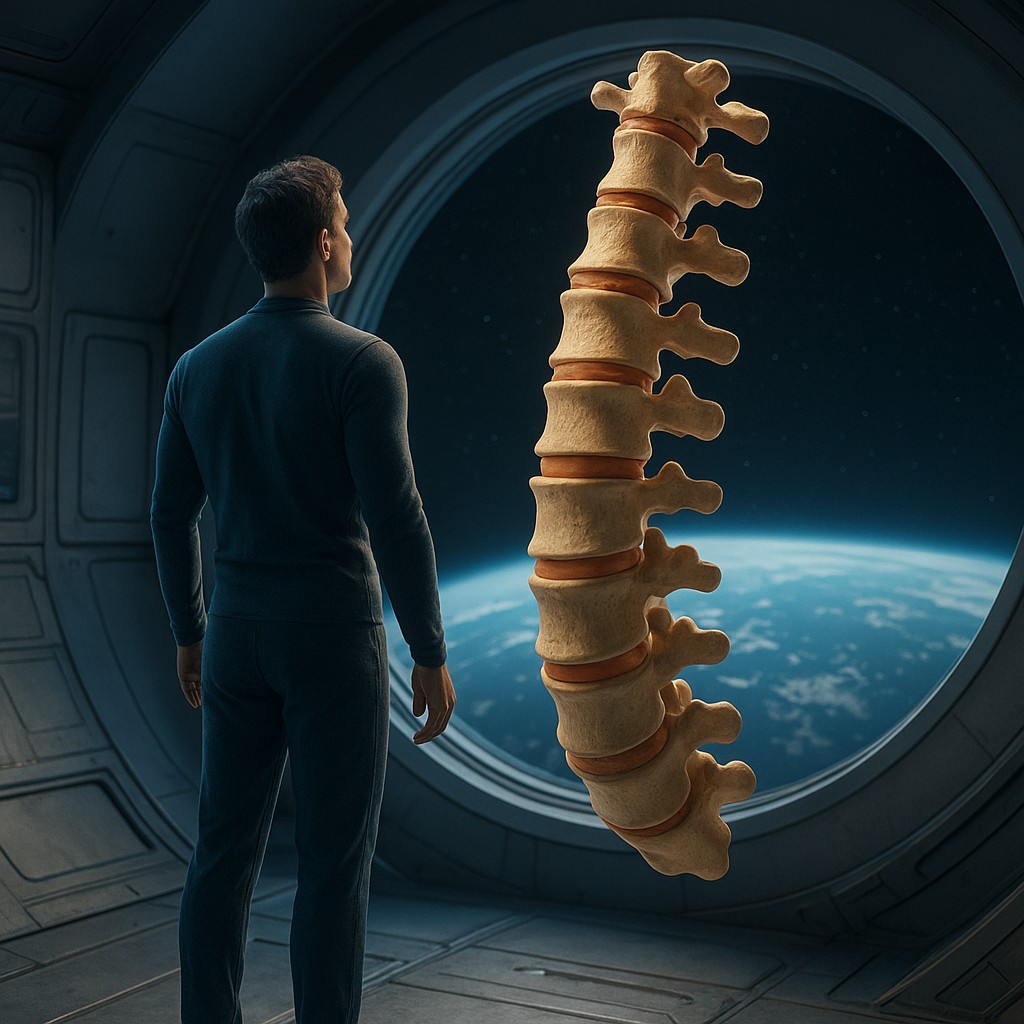
Imagine standing on the surface of the Earth, where a constant, invisible force is relentlessly tugging at every molecule of your body. From the moment you take your first steps in the morning to the second you collapse back into bed at night, gravity is hard at work, acting like a cosmic trash compactor for your skeleton. Your spine, a marvelous architectural feat of 33 interlocking bones, bears the brunt of this pressure. By the time you finish your day, you are actually a little shorter than when you woke up. This happens because the fleshy cushions between your vertebrae have been squeezed like wet sponges under the weight of your own existence.
Now, imagine stepping onto a space station where that heavy blanket of gravity is suddenly lifted. For an astronaut, the move to microgravity is not just a triumph of physics, but a radical biological overhaul. Within hours of entering orbit, the human body begins to shift its shape, stretching out like a coiled spring finally released from its box. This isn't just a trick of posture or a change in how someone carries their shoulders. It is a fundamental expansion of the human frame. This phenomenon turns space travel into a literal growth spurt that challenges our understanding of how the body holds itself together.
The Architecture of the Intervertebral Shock Absorber
To understand why astronauts gain up to two inches of height in space, we first have to look at the clever engineering of the human back. Between each vertebra sits an intervertebral disc, a small puck of tissue that acts as both a hinge and a shock absorber. These discs are made of two main parts: a tough, fibrous outer ring and a soft, jelly-like center. This center is remarkably high in water, making it the perfect hydraulic system for absorbing the impact of jumping, running, or simply walking down the street.
The magic of these discs lies in their "osmotic potential." Osmosis is the process where water moves through a membrane toward areas with a higher concentration of certain molecules. The jelly center of the disc is packed with specialized proteins called proteoglycans, which act like tiny, thirsty chemical magnets for water. On Earth, the pressure of gravity and muscle tension creates a force that pushes fluid out of the discs during the day. This creates a balance: gravity pushes water out, while the chemical thirst of the discs tries to pull it back in.
Escaping the Grip of Planetary Compression
In the microgravity environment of the International Space Station, the downward "push" of the environment effectively vanishes. Without the constant weight of the head and torso pressing down on the lower back, the internal pressure within the spinal discs drops significantly. This creates an opening for those thirsty chemical magnets to go on a hydration binge. Through osmosis, the discs begin to soak up nearby fluid, swelling in volume and thickness until they reach a state of full hydration that is almost impossible to achieve on Earth.
This swelling does not just happen in one or two spots; it occurs throughout the entire length of the spinal column. When you multiply a few millimeters of expansion across more than 20 discs, the result is a significant increase in total body length. Astronauts often report feeling "stretched," and their flight suits, which were tailored to fit perfectly on the ground, suddenly become uncomfortably short in the legs and torso. This expansion is a vivid reminder that the human body is not a static object made of stone, but a pressurized fluid system that is constantly responding to the physics of its surroundings.
The Physical Toll of Growing Taller
While gaining two inches of height might sound like a dream come true, the biological reality is far less pleasant. The human body is a tightly integrated system where bones provide support and muscles, tendons, and ligaments provide tension. When the spine stretches out rapidly in space, the surrounding soft tissues are not always ready for the ride. The muscles of the back and the long cables of the spinal nerves are stretched beyond their usual range, which can lead to significant discomfort.
Many astronauts experience a dull, persistent ache in their lower back during their first few weeks in orbit. This is often called "space backache." Because the nerves exiting the spinal column are being pulled as the vertebrae move further apart, some explorers even report symptoms similar to a pinched nerve. The body eventually adapts to this new "tall" state, but the transition period is a painful lesson in physical balance. The table below summarizes how the spine behaves in these two different environments.
| Feature |
Earth (Normal Gravity) |
Space (Microgravity) |
| Disc Pressure |
High due to body weight |
Extremely low |
| Fluid Movement |
Forced out (dehydration) |
Drawn in (osmosis) |
| Spinal Length |
Compressed/Normal |
Expanded/Elongated |
| Soft Tissue State |
Relaxed or contracted |
Stretched and tense |
| Common Symptoms |
Slight morning height loss |
Persistent back pain |
Structural Memory and the Return to Earth
The most fascinating aspect of this growth spurt is that it is temporary. The human body has a remarkable "structural memory" defined by the environment where it spent millions of years evolving. As soon as an astronaut’s capsule splashes down or touches the runway, Earth’s gravity immediately goes back to work. The "trash compactor" effect resumes, and the extra fluid that was soaked up by the spinal discs is squeezed back out into the surrounding tissues. Within a day or two, the extra two inches of height typically vanish, returning the traveler to their original measurements.
However, this rapid compression carries its own risks. Statistics from NASA and other space agencies show that returning astronauts are at a much higher risk for herniated discs, where the disc material bulges or ruptures, compared to the general population. Because the discs have been over-hydrated and the supporting back muscles have often weakened from disuse in space, the sudden return of Earth's weight can cause injury. This is why rehabilitation after a flight focuses heavily on core strength and spinal stability, ensuring the body can handle the weight of the world once again.
The Spine as a Living Liquid System
Seeing the human body as a dynamic, fluid-filled structure helps us appreciate how deeply we are connected to the physics of our planet. We often think of our skeletons as rigid scaffolding, but the "growing" phenomenon in space proves that we are more like a series of pressurized chambers. Our height, the way we walk, and even the health of our nervous system are all products of a delicate dance between the chemical pull of osmosis and the physical push of gravity.
This realization offers new ways to treat back pain here on Earth. If we know that relieving pressure on the spine allows it to recover fluid, we can better design therapies like aquatic exercises or decompression stretches that mimic the benefits of microgravity. By studying how humans change among the stars, we gain a better manual for how to take care of ourselves on the ground.
Every time you look up at the night sky, remember that the people living up there are literally outgrowing their clothes. Their journey is a testament to human adaptability and a reminder that our bodies are never truly finished products. We are constantly being shaped, stretched, and molded by the forces around us. Even something as simple as our height is a conversation between our biology and the universe. We are living, breathing hydraulic masterpieces, designed to hold our own against the weight of an entire planet.