Have you ever spent a long weekend in London and found yourself ending your sentences with a rising lilt? Or maybe you visited a friend in Texas and came home casually dropping a "y'all" at the dinner table? It is a strange, slightly embarrassing habit that makes many of us feel like accidental posers. You aren’t trying to be fake, and you certainly aren’t trying to mock the locals, yet your tongue seems to have a mind of its own. This curious linguistic shapeshifting happens to almost everyone. Far from being a sign of a weak personality, it is actually a highly sophisticated feat of brain engineering.
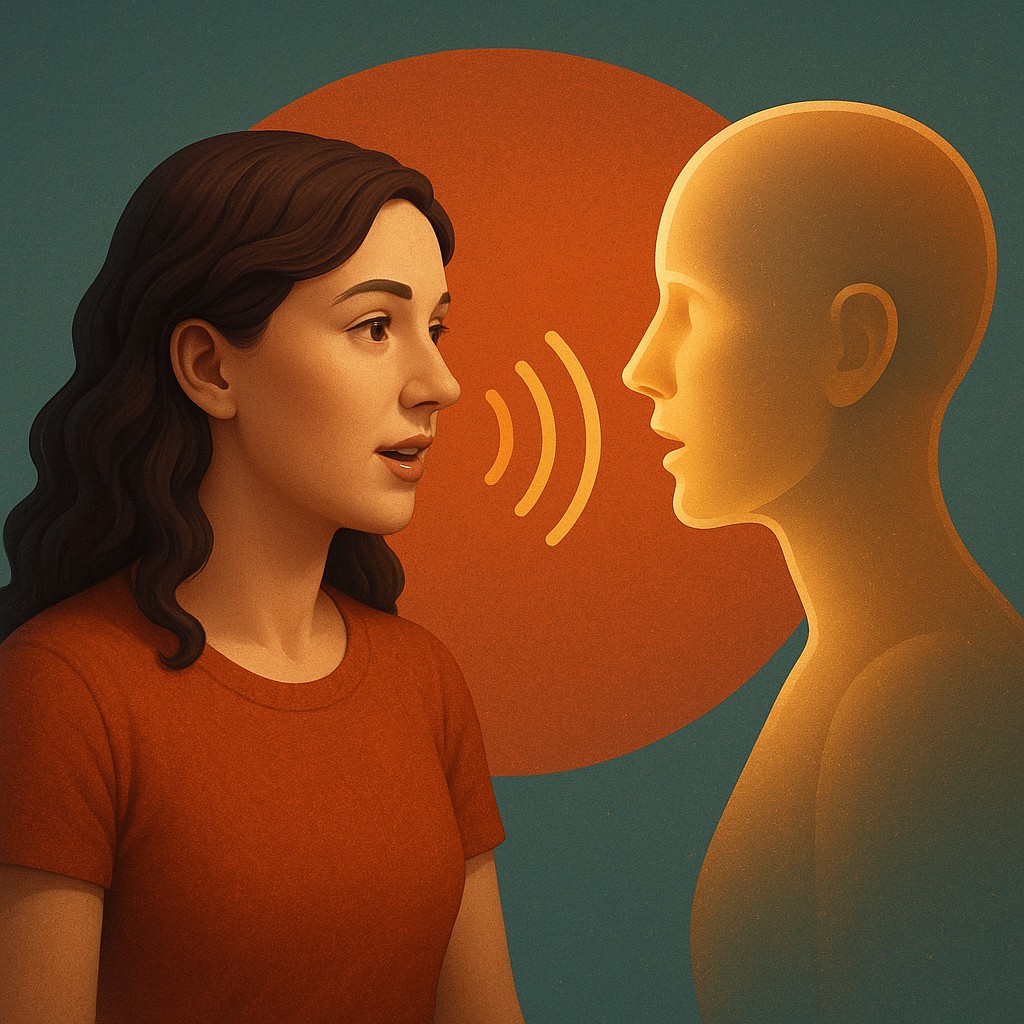
Linguists call this "verbal chameleoning" phonetic convergence. It is the unconscious process where two people in a conversation begin to sound more alike. They start matching each other’s pitch, rhythm, and even the specific way they pronounce vowels. It acts like an invisible bridge between minds, built one syllable at a time. By understanding how and why our brains do this, we get a fascinating look at how humans are biologically wired for connection and mutual understanding.
The Invisible Mirror in the Brain
At the heart of this habit lies a concept called the perception-production link. For a long time, scientists thought that hearing speech and producing speech were two entirely separate departments in the brain - like a radio that can either receive or broadcast, but not both at once. However, modern research suggests these systems are deeply intertwined. When you hear someone speak, your brain doesn't just process the sounds; it actually begins to map out the physical movements required to make those same sounds. It is as if your brain is "shadowing" the speaker in a silent rehearsal, prepping your own vocal cords to mirror what is coming in through your ears.
This mirroring effect is managed by the sensorimotor system, which coordinates what we sense with how we move. When we are engaged in an interesting or collaborative task, this link becomes even stronger. Study after study has shown that when people work together toward a common goal, their speech patterns align more quickly. This isn't a conscious choice to imitate. Instead, it is a biological "short-circuit" where the sounds we hear start to leak into our own speech. The brain loves efficiency, and it turns out that aligning your speech with your partner’s makes the whole process of communication run much more smoothly.
This mechanism is remarkably sensitive. It doesn't just copy broad accents; it captures tiny details, like the length of a pause before a consonant or the specific "breathiness" of a voice. Interestingly, this adaptation can happen in real-time. In experiments where people speak along with a recording, their voices shift almost instantly to match changes in the pitch or tone of the model voice. It is a testament to how fluid our identity is during a conversation. We aren't static statues of sound; we are more like jazz musicians constantly riffing and adjusting to the tempo of the person playing alongside us.
Building Rapport Through Vocal Harmony
While the "how" of this blending is rooted in brain chemistry, the "why" is deeply social. We are social animals, and survival throughout human history has depended on our ability to join groups and work together. Matching speech serves as a powerful "social glue." When we mirror someone’s speech, we are sending a subconscious signal that says, "I am like you, and I understand you." This reduces the social distance between speakers, creating a sense of familiarity and safety. It is empathy expressed through sound.
Psychologically, we tend to like people who are similar to us. When someone adopts our speech patterns, we often see them as more attractive, intelligent, and trustworthy, even if we can't quite explain why. This is why the shift is often more obvious in people who are naturally high in empathy. If you are someone who is deeply in tune with the feelings of others, your brain is more likely to turn up the volume on this mirroring to keep the interaction smooth. Conversely, if you dislike someone or feel a strong need to stand out, you might actually experience "phonetic divergence," where your accent becomes even more distinct to create distance.
The benefits of this synchronization go beyond just making friends; it actually makes us easier to understand. Recent research suggests that matching speech styles can significantly improve how clearly we hear one another. When two people align their vocal tones, they essentially tune their communication equipment to the same frequency. This reduces the mental effort required to decode what the other person is saying. In a noisy environment or a high-stress situation, this "vocal tuning" can be the difference between a clear exchange of information and a frustrating series of "What did you say?"
Navigating the Subtle Rules of Mimicry
Despite its benefits, this mirroring follows a delicate set of unwritten rules. The most important rule is that it must be unintentional. There is a "sweet spot" for matching: enough to build a connection, but not so much that it becomes obvious. When the mirroring becomes conscious or exaggerated, the social magic disappears and is replaced by suspicion. If you move from a subtle shift in vowels to a full-blown caricature of someone’s regional accent, the other person will likely feel mocked or looked down upon.
Linguists often distinguish between "alignment," which is the natural, healthy blending of styles, and "affectation," which is the forced adoption of a fake persona. Humans are remarkably good at detecting the difference. We have a "sincerity detector" in our brains that can usually tell when a shift in speech comes from a desire for connection rather than a desire to manipulate. This is why a politician adopting a fake "folksy" accent in a rural town often backfires; the audience senses the lack of a true brain-link and views the move as opportunistic rather than empathetic.
| Feature |
Natural Convergence |
Conscious Mimicry |
| Awareness |
Mostly unconscious and automatic. |
Highly conscious and intentional. |
| Pace |
Gradual shift over several minutes. |
Immediate and often over-the-top. |
| Social Goal |
Builds rapport and reduces distance. |
Can be seen as mocking or "fake." |
| Brain Link |
Strong link between hearing and doing. |
Reliance on stereotypes and memory. |
| Result |
Smoother, clearer communication. |
Increased social tension or offense. |
Another nuance involves the "power dynamic" of the conversation. Interestingly, studies have shown that the person with less social power in an interaction - such as an employee talking to a boss - is often the one who adapts more. We unconsciously change for the person we are trying to impress or please. The "dominant" speaker often sets the baseline, and the other person's brain does the work of meeting them there. This makes speech-matching not just a tool for empathy, but a subtle dipstick for social hierarchies and the invisible currents of influence in a room.
The Long-Term Impact of New Environments
Does this matching have a shelf life? If you spend a week in Australia, you might come home with a slight "twang" that fades by Tuesday. But what happens over months or years? The brain is plastic, meaning it is constantly rewriting its own software based on experience. Long-term exposure to a new environment can lead to semi-permanent shifts in your speech. This is why people who move to a new country often develop an accent that sounds like a hybrid of two worlds - a phenomenon sometimes called "the third accent."
This long-term shift is essentially a series of thousands of small moments of matching that eventually stick. Each time you align your speech with a neighbor or a coworker, you are slightly reinforcing a new movement pattern in your brain. Over time, these temporary adjustments become the new default. This is also why siblings or long-term couples often develop their own "mini-dialect" or "family-speak." They have mirrored each other for so long that they have created a unique, shared language that exists only between them.
This fluidity also explains why our accents can seem to "switch" depending on who we are calling on the phone. You might have a corporate, neutral accent all day at work, but the moment your mother calls from your hometown, your childhood dialect returns in full force. Your brain has multiple "saved profiles," and it automatically picks the profile most likely to build a connection in that specific moment. It is a beautiful, dynamic system that ensures we are never truly "locked" into one way of being.
Embracing Your Inner Linguistic Chameleon
Understanding how we match speech should change the way you think about your own voice. Instead of worrying that you are being "fake" when you pick up a bit of a local accent, you can celebrate it as a sign of a healthy, empathetic brain doing exactly what it was designed to do. Your voice is not a static trait like your thumbprint; it is a living, breathing instrument used to sync up with others. It is proof that we are built to bridge the gap between ourselves and the people around us, seeking common ground even in the way we shape the air coming out of our lungs.
The next time you find yourself mirroring a friend’s slang or catching a bit of their melody, take it as a compliment to your own social intelligence. Your brain is working behind the scenes to make that person feel heard, understood, and comfortable. Language is far more than a way to deliver facts and figures; it is a dance of sound that allows us to harmonize with the people around us. By leaning into this natural rhythm, we don't just communicate better - we connect deeper, proving that even in our basic biology, we are wired to find our way toward one another.