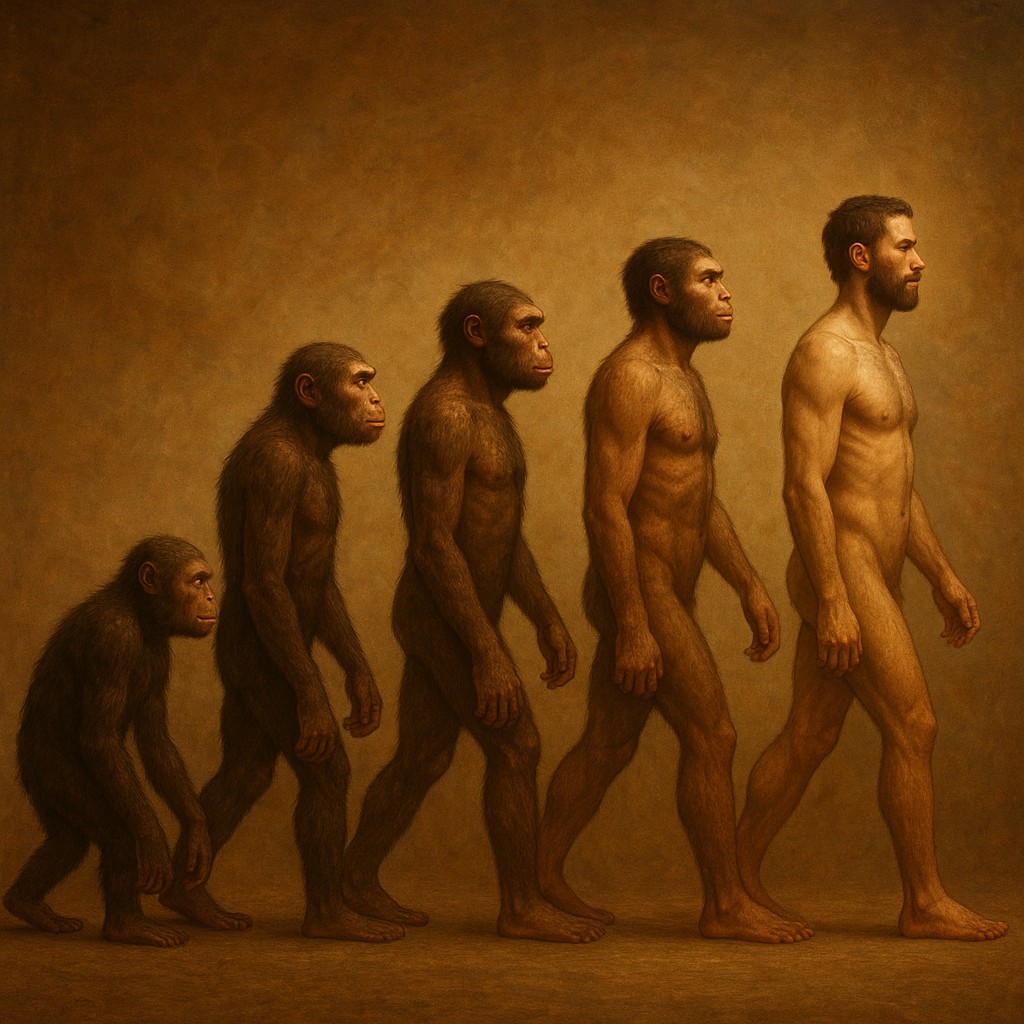
Imagine for a moment that you are holding an old family photograph, but as you trace the generations back, the faces begin to change dramatically. Your grandparents look like ordinary people, but after a few thousand ancestors, foreheads flatten, jaws lengthen, and body hair becomes much thicker. If you could go back far enough - say, a few million years - you would no longer be looking at humans. Instead, you would see fascinating creatures, both familiar and completely alien, trying to figure out how to walk on two legs across the savanna without falling over. Understanding evolution isn't just about studying dusty fossils in a museum; it is like reading the secret diary of life itself - a story of a lineage that, against all odds, refused to die out and chose to adapt instead.
Evolution is often misunderstood as a ladder of progress where every species is trying to become "better" or "smarter." In reality, it is much more like a massive, messy bush where every branch represents a different solution to the problem of survival. We do not descend from modern chimpanzees, just as you do not descend from your first cousin. We simply share a common ancestor, a very distant biological grandfather who lived about 6 or 7 million years ago. Since that split, each lineage has forged its own path. Exploring our origins means discovering how a small, hairy creature living in the shadow of the dinosaurs eventually built pyramids, invented the internet, and began to wonder, with restless curiosity, where it came from.
The Secret Mechanism Behind How Species Change
To understand how we went from a small primate to an astronaut, you first have to grasp the concept of natural selection. This idea is as simple as it is elegant, made famous by Charles Darwin. Imagine a group of creatures living in an environment where all the food is at the top of tall trees. By pure genetic luck, some individuals are born with slightly longer necks. These individuals eat better, live longer, and most importantly, have more babies to whom they pass on their "long-neck" genes. Meanwhile, those with shorter necks struggle to find food and leave fewer descendants. Over thousands of years, the entire population’s physical shape shifts. This isn't a magical transformation that happens during one lifetime; it is the buildup of small successes over thousands of generations.
Evolution doesn't work from an architect's blueprint; it tinkers with whatever is at hand. Every genetic mutation is like a typo in the great book of DNA. Most of these errors are useless or harmful, but every now and then, a "misprint" turns out to be an incredible advantage in a specific environment. This is what we call adaptation. If the climate turns freezing, those with a mutation for thicker fur become the masters of their domain. If an island has no predators, birds might lose the ability to fly to save energy. Evolution is a constant response to nature's challenges - an endless dance between genetic code and a changing world.
A crucial point to clarify is that evolution never creates perfection; it creates what is "good enough" to survive long enough to reproduce. Our eyes are incredible, but they have a blind spot and blood vessels positioned in front of the light sensors - a design no human engineer would ever approve. Similarly, our backs often ache because we straightened our spines a bit too quickly, geologically speaking, to move from four legs to two. We are quite literally biological machines made of recycled parts and compromises, which makes us all the more fascinating to study. Evolution is proof of resilience, not flawless design.
First Steps Toward Standing Tall
Before modern humans arrived on the scene, Africa was the site of a major biological experiment: the appearance of the Australopithecines. About 4 million years ago, these distant ancestors - the most famous being "Lucy" - began to do something revolutionary: they walked upright. It wasn't yet the confident stride of a marathon runner, but rather an efficient waddle. Why stand up? Theories abound. Some think it was to see over the tall savanna grass to spot predators; others suggest it allowed them to carry food or simple tools, freeing their hands from the chore of getting around.
Australopithecines still had brains the size of a grapefruit, much like a modern chimpanzee, but their teeth and hips told a different story. They no longer lived exclusively in the trees. This transition was vital because it opened up a new way of life. By being able to travel long distances under a scorching sun without overheating (thanks to better airflow around a vertical body), they could explore territories that their forest-dwelling cousins couldn't reach. It was during this era that the split between the great apes and our own lineage became permanent, marking the start of the human adventure.
It is worth noting that these creatures weren't alone. In those days, several species of hominids (early human relatives) lived side by side, much like there are different species of big cats today. Our ancestors' world wasn't a monologue, but a complex conversation between different versions of "almost-humans." Some were robust, with powerful jaws for grinding tough roots, while others were more slender. This diversity shows that evolution was testing several models at once. The survival of our specific line wasn't guaranteed; it was the result of a series of lucky breaks and clever adaptations to harsh climate changes.
The Rise of the Genus Homo and the Life-Saving Tool
The real turning point happened about 2.4 million years ago with the appearance of Homo habilis, often nicknamed "Handy Man." This is where evolution took a technological turn. For the first time, we find clear evidence of sharpened stone tools. These rock flakes might not look like much at first glance, but they changed everything. They allowed our ancestors to reach bone marrow - an extremely rich source of protein and fat that other animals couldn't get to. This dramatic improvement in diet provided the energy needed to power a very demanding organ: a growing brain.
Next came Homo erectus, a true globetrotter. Appearing about 1.9 million years ago, they were the first to have body proportions similar to ours, with long legs and shorter arms. Erectus was the one who mastered fire, an invention that literally "pre-digested" food by cooking it. This reduced the time needed for chewing and helped the body absorb more nutrients. Fire also offered protection from night predators and a source of warmth, allowing this species to leave Africa and conquer Asia and Europe. This was the first great human migration, proving we were already a species capable of adapting to radically different environments.
| Species |
Era (approximate) |
Key Characteristic |
Brain Size (average) |
| Australopithecus |
4 to 2 million years ago |
Early bipedalism, mixed habitat |
450 cm³ |
| Homo habilis |
2.4 to 1.4 million years ago |
Used stone tools |
600 cm³ |
| Homo erectus |
1.9 million to 110,000 years ago |
Mastered fire, migration |
900 cm³ |
| Homo neanderthalensis |
400,000 to 40,000 years ago |
Cold-adapted, complex culture |
1500 cm³ |
| Homo sapiens |
300,000 years ago to present |
Abstract language, art, technology |
1350 cm³ |
This progression shows a clear trend: a rise in brain capacity and increasingly complex social behavior. Homo erectus wasn't just a survivor; they were explorers. Their tools, called hand axes, remained virtually the same for over a million years. This might look like a long time to go without an upgrade, but the design was actually so effective it didn't need to change. Imagine an iPhone that stayed the top model for a million years! It shows that these ancestors had reached a remarkable balance with their environment.
Our Cousins in the Shadows and the Meeting of Worlds
As we move forward in time, we encounter one of the most fascinating characters in our story: the Neanderthals. Long depicted as dim-witted brutes, Neanderthals have been rehabilitated by modern science. They lived in Europe and Western Asia, perfectly suited to ice-age climates thanks to their stocky, powerful bodies. They weren't our direct ancestors but our cousins. Neanderthals buried their dead, cared for their injured, and likely possessed some form of language. On average, they even had slightly larger brains than we do, though they were structured differently.
The meeting between Homo sapiens (us, arriving later from Africa) and Neanderthals is one of the most dramatic moments in natural history. We didn't just cross paths or fight; we intermingled. Modern DNA analysis reveals that almost everyone of non-African descent carries between 1% and 4% Neanderthal DNA. We carry a part of their legacy within us, from genes linked to our immune systems to the texture of our skin. This cross-breeding proves that the line between species was much blurrier than we once thought.
While Neanderthals occupied Europe, other groups existed too, such as the Denisovans in Siberia or the "Hobbits" (Homo floresiensis) on an island in Indonesia. The world 50,000 years ago looked strangely like a fantasy novel, with several types of humans sharing the planet. Why we are the only survivors remains a matter of debate. Was it our ability for abstract communication, our larger social networks, or simply a bit of luck with the climate? Regardless, Homo sapiens became the last representative of a once-crowded family, carrying the genetic memory of its vanished cousins.
The Birth of Symbolic Thought and Culture
What truly sets modern humans apart from those who came before isn't physical strength or brain size, but what goes on inside that brain. Around 70,000 years ago, a "cognitive revolution" seems to have taken place. Sapiens began to create art, carve figurines, paint cave walls, and invent myths. For the first time, a creature was able to talk about things that didn't physically exist, like spirits, laws, or complex social structures. This ability to share stories allowed us to cooperate in groups of thousands, whereas other primates are limited to a few dozen.
Evolution gave us the biological tools, but culture gave us wings. By learning to store information outside our bodies - on cave walls, then clay tablets, and finally computer servers - we bypassed the slow pace of natural selection. We no longer have to wait ten thousand years for a mutation to give us a better brain; we learn and pass on our knowledge instantly. This is called cultural evolution, and it moves millions of times faster than biological evolution.
We are the result of a lineage of incredibly tough survivors. Every person alive today is the direct descendant of an unbroken chain of individuals who managed to find food, avoid predators, and reproduce, going back to the dawn of time. We carry within us the traces of the African savanna, the resilience of Ice Age hunter-gatherers, and the restless curiosity of the first explorers. Understanding this past isn't just a history lesson; it is a compass for our future.
Looking back at this epic journey, it’s hard not to feel a deep sense of humility mixed with wonder. We aren't separate beings perched at the top of a pyramid, but the temporary heirs of an adventure that began with simple molecules billions of years ago. This knowledge brings a heavy responsibility: to respect the biodiversity we came from and to keep using the curiosity that helped us survive. Evolution continues, even if we don't feel it happening over a single lifetime. Who knows what humans will become in another million years? Perhaps our descendants, looking at our remains, will find us just as strange and fascinating as we find the Australopithecines today. The great book of life is far from finished, and every action we take today writes a new line.