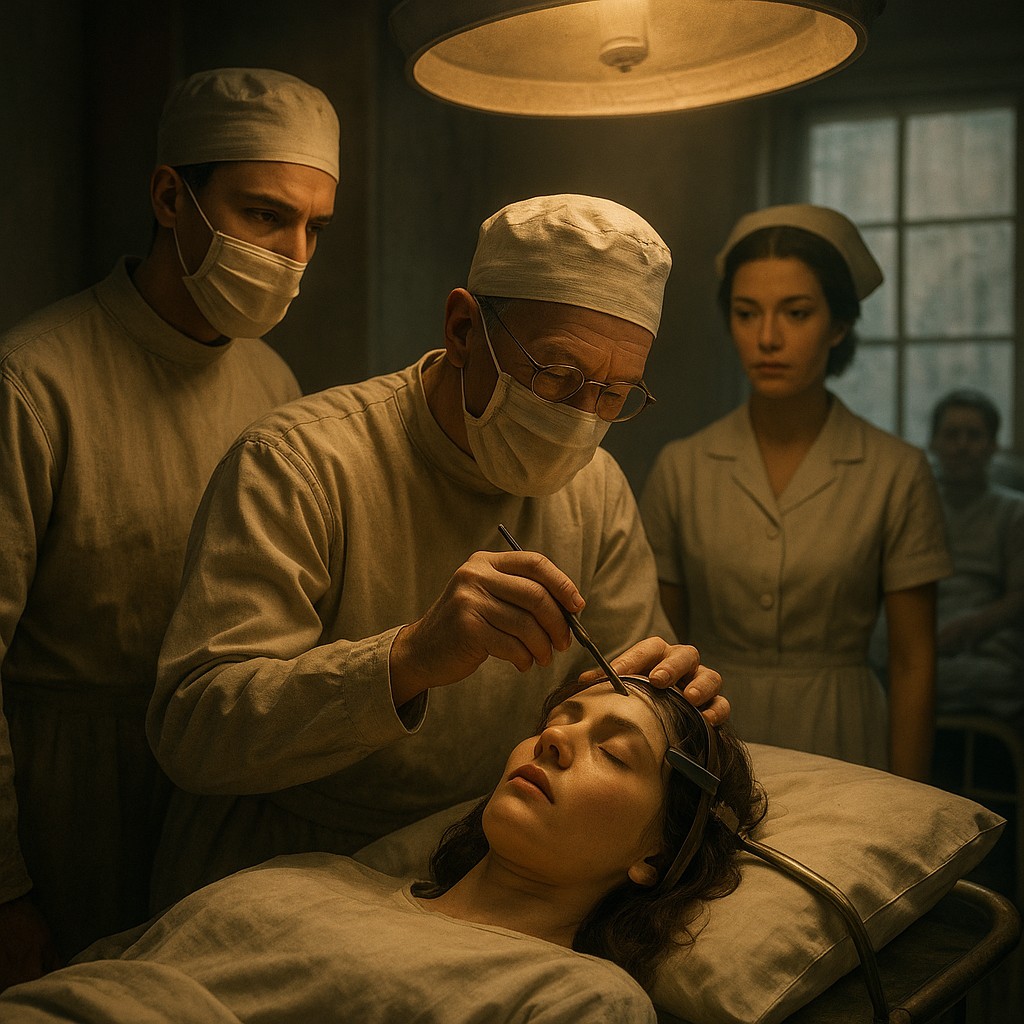
Imagine a world where doctors, feeling desperate and helpless against the struggles of the human mind, decided that the most elegant solution was to physically disconnect a part of your personality. It is the mid-20th century, and psychiatric hospitals are overflowing with patients suffering from schizophrenia, crippling depression, or paralyzing anxiety. At this time, there is no Prozac, no Xanax, and no modern antipsychotic drugs. Medical staff are overwhelmed, families are exhausted, and the only future in sight is the darkness of a padded cell or physical restraints. In this environment of deep distress, one of the most fascinating and terrifying ideas in medical history took root: the lobotomy.
This was not a fringe practice carried out by a "mad scientist" in a basement. It was a procedure celebrated by the highest scientific authorities and even honored with a Nobel Prize. The basic concept was disarmingly simple, almost mechanical. If a person is trapped in a loop of obsessive thoughts or violent emotions, why not just cut the wires connecting the seat of emotion to the seat of reason? This is the story of a journey where surgery became a permanent "sedative." It was an era when doctors sincerely believed they were doing good by stripping away a piece of a person's soul to give them, in exchange, the peace of inner silence.
The intellectual spark under the European scalpel
The story begins with a Portuguese neurologist named Egas Moniz. In the 1930s, Moniz attended a conference where researchers presented an experiment on a chimpanzee named Becky. By removing parts of her frontal lobes, the researchers noticed that Becky, previously prone to anger and frustration during tests, suddenly became incredibly calm. Moniz had an epiphany that would make any modern ethicist shudder: if this quieted a monkey, why not try it on humans suffering from extreme mental agitation? He called his method the frontal "leucotomy," from the Greek words leukos (white) and tomos (cut), because it involved severing the white matter of the brain.
Moniz’s theory was based on the idea that mental illnesses were caused by "fixed" or "unhealthy" neural connections in the frontal lobes. To him, pathological thoughts looped through these circuits like trains on a broken track. By cutting these circuits, he believed he could force the brain to create new, healthier pathways. In 1935, he performed his first operations by injecting pure alcohol into the brain or using a tool called a leucotome - a needle with a retractable wire loop - to cut the fibers. The early results were considered "promising" because patients who were once unmanageable became docile. For this work, Moniz was awarded the Nobel Prize in Medicine in 1949, a decision that remains one of the most controversial in the history of the award.
American ambition and the ice pick invention
While Moniz was the theoretical architect, Walter Freeman was the zealous promoter who turned the lobotomy into a mass phenomenon in the United States. Freeman was a neurologist, not a surgeon. Frustrated by the complexity of traditional surgery, which required an operating room and drilling holes in the skull, he looked for a faster method - an "express version" of the procedure. Inspired by an Italian technique, he developed the infamous transorbital lobotomy. The idea was to access the brain not through the skull bone, but through the tear duct just above the eye.
The tool Freeman used for his first demonstrations was a literal ice pick from his own kitchen. By inserting the point under the eyelid and tapping it with a mallet to break the thin layer of bone in the eye socket, he could reach the frontal lobes in seconds. Once inside, he simply swiveled the pick back and forth to sever the nerve connections. There was no need for long, expensive general anesthesia; Freeman often used electric shocks to knock the patient unconscious for the few minutes the surgery took. It was the ultimate "office procedure," and Freeman traveled the country in his "Lobotomobile" to perform hundreds of these operations a year.
A desperate solution for a system in crisis
To understand how such a practice became accepted, one must look at the state of psychiatric hospitals in the 1940s. They were overcrowded, underfunded, and looked more like prisons than care centers. Patients were often chained, kept in straitjackets, or held in ice-water baths to calm their outbursts. The lobotomy appeared as a "miracle cure," not just for the patients, but primarily for hospital administrators. A lobotomized patient no longer screamed, no longer attacked nurses, and could often manage their own basic hygiene.
The promise was seductive: turn a "loud and violent" patient into a "quiet and cooperative" one. At the time, the definition of a "cure" was very different from ours today. Doctors were not necessarily trying to restore a patient's full emotional or intellectual life, but simply trying to make them "manageable" in society or within the institution. Families, desperate to see their loved ones find relief from unbearable mental torment, saw the operation as a last hope, even if it meant sacrificing a part of the person's personality.
| Feature |
Leucotomy (Moniz) |
Transorbital Lobotomy (Freeman) |
| Access Point |
Holes drilled in the skull |
Through the eye socket |
| Tool Used |
Leucotome (retractable blade) |
Ice pick (orbital) and mallet |
| Setting |
Sterile operating room |
Doctor's office or hospital bed |
| Procedure Time |
Several hours |
About 10 minutes |
| Anesthesia |
Standard general anesthesia |
Electric shocks or local numbing |
The devastating cost to the human spark
So, what actually happened inside the minds of these patients after the mallet struck? The results varied wildly, ranging from "apparent calm" to turning into a human "vegetable." While some patients were able to return home and lead simplified lives, many lost the very essence of what makes us human. The frontal lobes are the center for planning, initiative, complex personality, and thinking about the future. By disconnecting them, doctors often removed anxiety, but they also removed joy, creativity, and spontaneity.
Witnesses from that era often described lobotomized patients as having a vacant stare, a total lack of motivation, and deep apathy. They could sit in a chair for hours without asking for anything, answering questions with only one-word replies. Rosemary Kennedy, the sister of John F. Kennedy, is one of the most tragic examples. After Freeman performed a lobotomy on her at age 23 to manage her mood swings, she was left with the mental capacity of a two-year-old. She was unable to speak or walk properly and spent the rest of her life hidden away in an institution.
The end of a surgical nightmare
The decline of the lobotomy did not happen overnight because of a sudden moral awakening. Instead, it was pushed out by chemistry. In 1952, the discovery of chlorpromazine (the first antipsychotic, marketed as Thorazine) changed everything. It was called a "chemical lobotomy." Unlike the ice pick, the effects of the medication were reversible and did not require breaking bones or slicing brain tissue. Almost overnight, doctors could calm patients in a much more humane and safer way.
At the same time, the medical community began to gather data on the massive failures and horrific side effects of the procedure. Studies showed high death rates and revealed that "improvements" were often just the loss of basic human functions disguised as medical success. Public opinion eventually turned against the promoters of the lobotomy. Walter Freeman himself finally lost his operating privileges after a patient died during one of his procedures. By the 1970s, the practice had almost vanished in most developed countries, relegated to a status as a barbaric curiosity in the history of medicine.
Learning from the past to protect the future
The history of the lobotomy leaves us with a complex legacy and a vital warning about the temptation of quick fixes for deep human problems. It reminds us that in medicine, innovation must always be balanced by ethics and a strict understanding of what "healing" really means. These were not the works of monsters, but of doctors who, in their desire to solve an impossible problem with the tools of their time, forgot the fundamental dignity of their patients. The human brain remains the most complex object in the known universe, and this dark period teaches us humility in the face of how it works.
Today, we are fortunate to live in a time where mental health is approached with much greater nuance and compassion. We use behavioral therapies, precise medications, and advanced neurological steps like deep brain stimulation, which respect the integrity of the person. By studying these past mistakes, we become more vigilant guardians of scientific ethics. This history encourages us to ask the right questions when new technologies emerge, ensuring that every advancement serves to lift the human spirit rather than diminish it for our collective convenience.