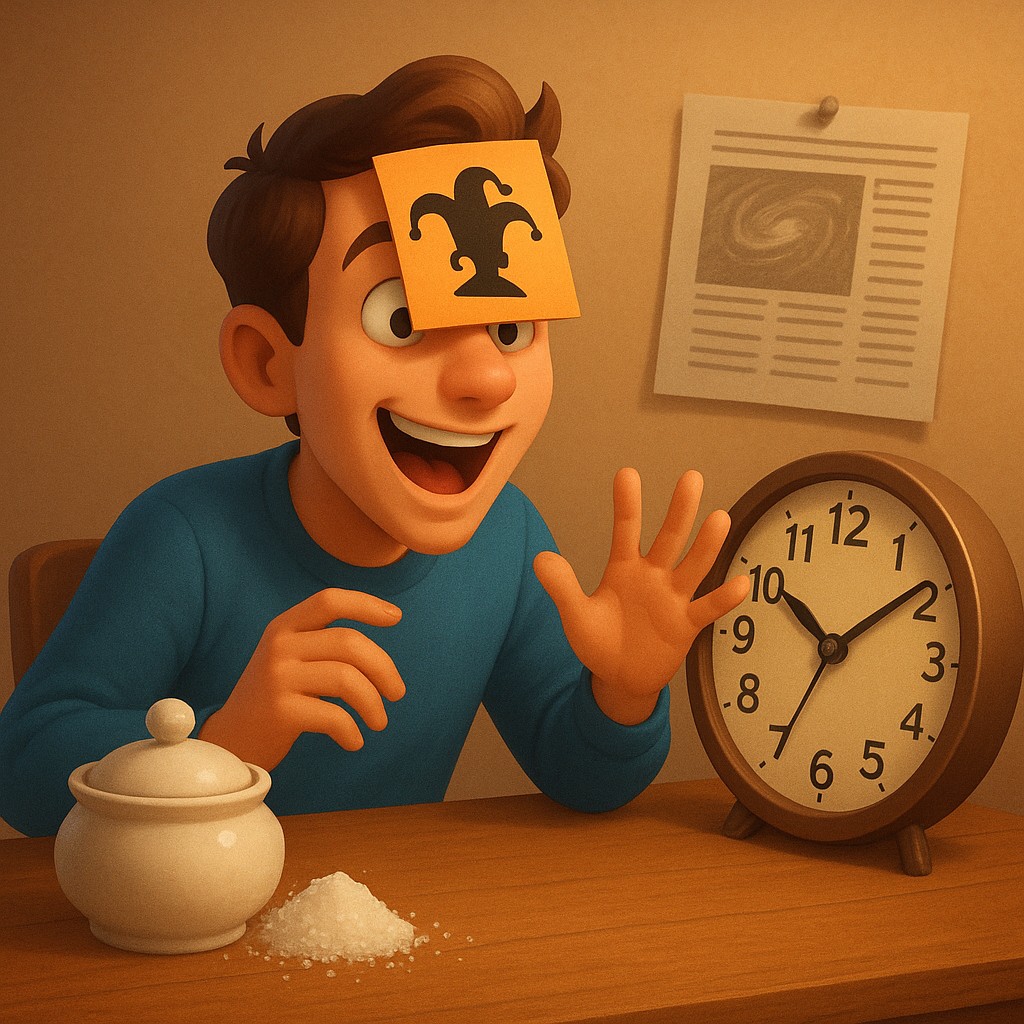
Imagine waking up on a crisp spring morning to find the world tilted slightly on its axis. Your sugar bowl has been filled with salt, the news is reporting a gravity-defying breakthrough in physics, and your best friend insists they just won the lottery. For twenty-four hours, the social contract that usually governs our interactions - the assumption that people are telling the truth - is effectively suspended. This is the peculiar magic of April 1st, a day when the common currency is playful deception and the goal is to make someone else "play the fool."
Beyond plastic wrap on toilet seats or sophisticated corporate hoaxes, there is a deep historical curiosity about why we do this. Why did humanity decide that a day in early spring should be reserved for nonsense? It is a global phenomenon that transcends borders, yet its origins are lost in a fog of myth, calendar confusion, and the basic human need to let off steam after a long, cold winter. To understand why we prank, we have to look past the "Kick Me" signs and dive into the chaotic history of how we measure time and manage our social bonds.
The Great Calendar Mix-Up of the Sixteenth Century
One of the most persistent theories regarding the birth of April Fools' Day takes us back to late 16th-century France. Before 1582, much of Europe followed the Julian calendar, where the new year arrived around the spring equinox, reaching its peak on April 1st. However, when Pope Gregory XIII introduced the Gregorian calendar to more accurately reflect the solar year, the new year was officially moved to January 1st. In an era without high-speed internet or a reliable postal service, news traveled at the speed of a horse, and many people were slow to get the memo.
Those who continued to celebrate in late March and early April were often ridiculed by those who had adopted the new calendar. These traditionalists were called "April fools" and became the butt of jokes, such as having paper fish stuck to their backs. In France, this remains a tradition known as Poisson d’Avril, or "April Fish." The idea was that a young, easily caught fish represented a gullible person. While this theory is charming and provides a neat explanation for the date, many historians note that springtime pranking likely predates the Gregorian shift, suggesting the calendar change may have simply provided a new excuse for an old habit.
Spring Fever and the Chaos of the Equinox
Looking further back than the 1500s, April Fools' Day might not be about a specific date at all, but about the changing of the seasons. Ancient civilizations often held festivals of renewal and misrule during the transition from winter to spring. The Romans, for example, celebrated Hilaria at the end of March. During this festival, people wore disguises and imitated high-ranking officials to mock them without fear of punishment. It was a time of "controlled chaos" where the normal social hierarchy was flipped upside down, allowing everyone to vent their frustrations through laughter.
There is also a biological element to this timing. As the days grow longer and the weather becomes unpredictable, humans often experience a shift in mood. This "spring fever" makes us feel energetic, restless, and perhaps a bit more prone to mischief. The natural world itself seems to play tricks on us during this time, with one day feeling like mid-summer and the next bringing a sudden frost. By pranking one another, we mimic the fickle nature of the seasons, acknowledging that the world is a beautiful, confusing, and unpredictable place.
The Evolutionary Purpose of Playing Pranks
You might wonder why evolution would preserve the urge to trick your neighbor. However, psychologists suggest that playfulness and pranking serve a vital social function. Pranks are a form of "social testing" that allow us to bond with our peers. When performed correctly, a prank creates a shared moment of tension followed by a massive release of laughter. This release floods the brain with dopamine and oxytocin, the chemicals responsible for happiness and social bonding.
| Type of Prank |
Primary Goal |
Psychological Effect |
| The Classic "Gullibility" Test |
To see how much someone trusts you. |
Reinforces the need for critical thinking and skepticism. |
| The Physical Surprise |
To startle and then amuse. |
Provides a quick adrenaline spike followed by laughter. |
| The Elaborate Hoax |
To create a shared fictional reality. |
Builds a sense of community among those "in on the joke." |
| The Role Reversal |
To poke fun at authority or status. |
Relieves social pressure and equalizes the group. |
In many ways, a harmless prank is a sign of intimacy. You generally don't prank people you dislike or strangers, because the risk of offending them is too high. Instead, we prank the people we love and trust. It is a way of saying, "I know you well enough to know how you will react, and I trust you enough to know you will forgive me." This "benign violation" theory suggests that humor arises when something seems like a threat but turns out to be safe. By creating these harmless shocks, we strengthen the resilience of our relationships.
Correcting Common Myths and Misunderstandings
When discussing April Fools' Day, it is easy to get caught up in legends that sound true but lack evidence. One common myth is that the day originated from the medieval "Feast of Fools," where a mock pope was elected and church rituals were parodied. While this feast did exist and involved plenty of subversion, it usually took place around January, not April. Another popular story links the day to the biblical Noah sending out a dove too early - a "fool's errand." While imaginative, there is very little proof to connect these religious narratives directly to modern traditions.
Another misconception is that April Fools' Day is and always has been a "mean" holiday. In reality, the most successful pranks are those where the victim can laugh at themselves. In 18th-century Scotland, a common prank was "hunting the gowk" (the cuckoo bird). People were sent on fake errands with a sealed letter that asked the recipient to send the messenger on yet another errand. While it was a "fool's errand," it was rarely malicious. The evolution of the holiday has always leaned toward wit rather than malice, emphasizing lightheartedness over deception.
The Era of the Global Hoax and Media Trickery
As we moved into the 20th and 21st centuries, the scale of April Fools' jokes expanded from households to the entire world. This shift began with newspapers and moved into radio and television. One of the most famous examples occurred in 1957, when the BBC program Panorama aired a segment about the "spaghetti harvest" in Switzerland. Because the BBC was a highly trusted source, thousands of people believed that spaghetti actually grew on trees. Many even called the station to ask how they could grow their own, to which the BBC reportedly replied, "Place a sprig of spaghetti in a tin of tomato sauce and hope for the best."
This era of the "Mega-Prank" taught us a valuable lesson about authority and media literacy. When Google announced "Google Gulp" (a drink that supposedly increased intelligence) or a fast-food chain claimed to have invented a "Left-Handed Whopper," they were leaning into a cultural tradition of joyful skepticism. These pranks remind us to keep our wits about us, even when the information comes from a giant corporation or a respected news anchor. In a world full of "fake news," the harmless absurdity of an April Fools' prank serves as a yearly training exercise for our internal "baloney detectors."
Navigating the Ethics of a Good Prank
Not all pranks are created equal, and as our understanding of psychology has evolved, so has our etiquette. The best pranks follow the "punching up" rule or the "no harm, no foul" principle. A prank should never involve destroying property, causing physical pain, or preying on someone’s genuine fears. If the victim doesn't laugh, the prank has failed. The goal is to celebrate the absurdity of life, not to make someone feel humiliated.
In modern workplaces and schools, there is an increasing emphasis on "inclusive humor." This means ensuring the joke doesn't rely on stereotypes or exclusion. Instead, the most clever pranks are self-deprecating or surreal. Think of the office worker who covers their coworker’s desk in colorful sticky notes, or the teacher who gives a "pop quiz" in a fictional language like Klingon. These moments break the monotony and remind everyone that even in serious settings, there is room for a little wonder and play.
Embracing the Spirit of the Fool
As we look at the long, winding history of April Fools' Day, we see that it is more than just a day for "gotcha" moments. It is a celebration of the human imagination and a reminder that we shouldn't take ourselves too seriously. Life is often rigid, filled with schedules, rules, and expectations. We are expected to be productive and rational for 364 days a year. April 1st serves as a much-needed pressure valve, a day where we have permission to be slightly ridiculous and invite others into our silliness.
The next time you find yourself carefully peeling the cream out of an Oreo to replace it with toothpaste, or the next time you see a headline that seems a bit too strange to be true, remember that you are participating in a tradition that spans centuries. You are part of a global lineage of tricksters and poets who believe that laughter is the best way to welcome spring. Embrace the spirit of the fool, sharpen your wit, and remember that the world is always a little more interesting when you’re looking for the joke hiding just beneath the surface.