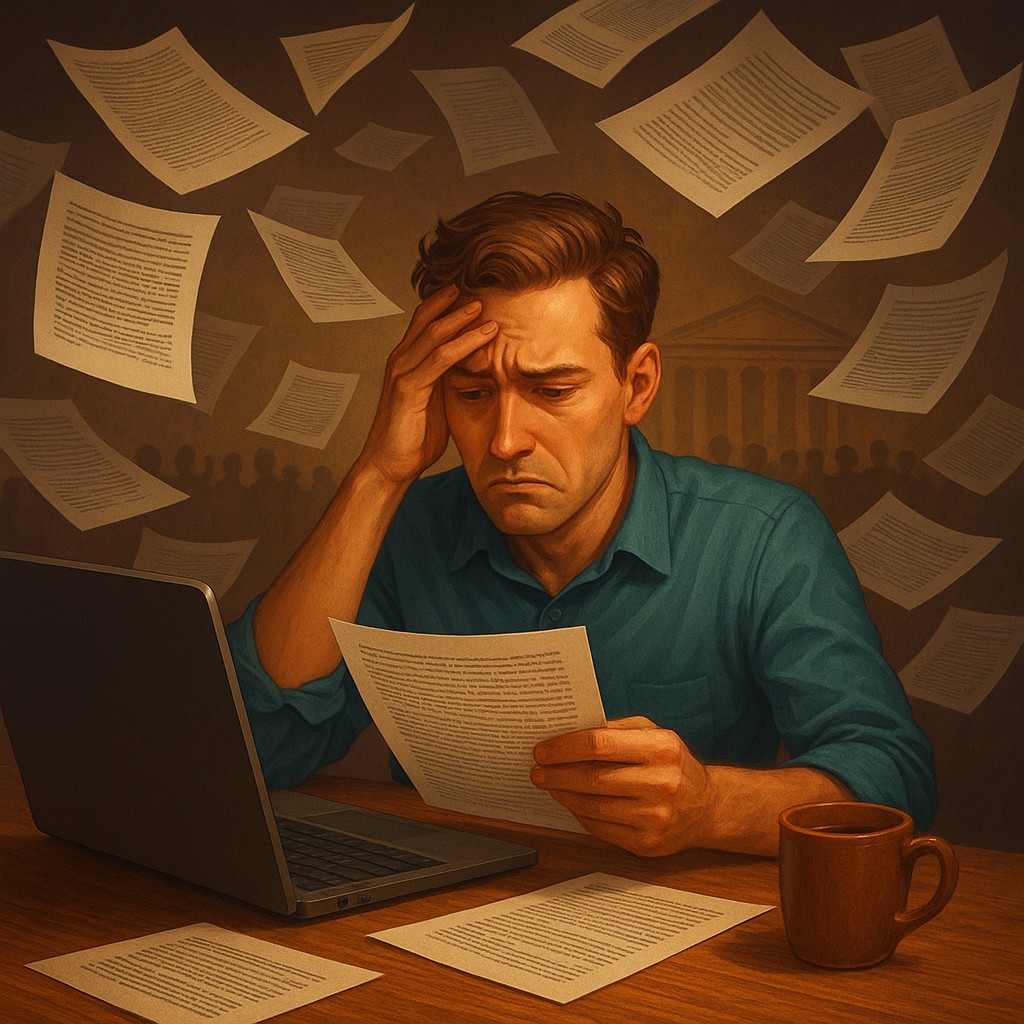
Imagine you are invited to a neighborhood meeting to plan a new local park. The mood is upbeat and the choice is simple: do we want a playground or a dog run? You listen for twenty minutes, cast your vote, and head home feeling like a model citizen. Now, imagine that same meeting happens every single night. On Monday, you must decide on the exact chemical makeup of the city’s asphalt. On Tuesday, you are voting on the structural load requirements for a bridge three towns away. By Wednesday, you are staring at a 400 page document regarding trade tariffs on semi-conductors. Suddenly, "power to the people" feels less like a right and more like a grueling, unpaid second job that requires three PhDs and an infinite supply of coffee.
This shift from a simple park vote to the crushing weight of technical governance reveals a major friction point in how we run society. We are often told that the purest form of fairness is for every person to have a direct say in every decision. It is an egalitarian dream that dates back to the sun-drenched plazas of ancient Athens. However, as societies grow from small tribes into interconnected global nations, this dream hits a massive, invisible wall. This wall is not built of corruption or bad intentions, but of biology and time. Our human brains simply do not have the mental bandwidth to process the sheer volume of data needed to make informed decisions on every facet of modern life.
The Invisible Tax on Every Choice
When we think about democracy, we usually think about rights and values. We rarely view it as an information processing problem. Yet, every vote carries a "cognitive cost," the mental energy required to understand an issue. Before you can responsibly click a button or pull a lever, you have to gather information, verify it, weigh the long-term consequences, and compare it against other options. In a small village, this cost is low because the issues are visible and immediate. You know if the well is running dry because you can see the water level. You know if the fence needs fixing because you walk past it every morning. The information is essentially "free" because it is part of your daily life.
As a society grows, the distance between the voter and the issue increases. Suddenly, problems become "non-obvious." You cannot "see" the fluctuations in the interest rates set by a central bank, nor can you "see" the subtle ecological impact a specific pesticide has on a rare species of bee. To understand these things, you have to study. This creates a mental bottleneck. If a government passes ten laws a day, and each law takes five hours of research to truly understand, a citizen would need to spend 50 hours a day just to be a "responsible" voter. Since time is limited, something has to give. This is where the idealism of direct participation meets the cold reality of math.
The Logic of Staying Uninformed
In economics, there is a concept known as "rational ignorance." It sounds like an insult, but it is actually a logical survival strategy. Rational ignorance happens when the cost of gaining enough knowledge to make an informed decision is higher than the benefit the decision could actually bring to the individual. Think of it this way: if you spend 40 hours researching the nuances of a municipal sewage bond, your single vote is still only one of thousands. The odds that your specific, highly informed vote will change the final outcome are statistically near zero. From a purely mathematical standpoint, the "cost" of your research is high (your time and effort), while the "benefit" (the likelihood of changing the result) is incredibly low.
Most people instinctively perform this cost-benefit analysis without realizing it. They see that becoming an expert on every ballot measure is a losing game, so they stop trying. This is not because they are lazy or unintelligent; they are simply being efficient with their limited mental energy. The problem, of course, is that when an entire population becomes "rationally ignorant," the quality of collective decisions drops. People start voting based on catchy slogans, tribal loyalties, or the "vibes" of a social media post. When the technical cost of being right becomes too high, people switch to the cheapest available mental shortcuts.
Specialists and the Labor of Thinking
To solve this information overload, almost every large society eventually moves toward a representative system. This is essentially the "division of labor," but applied to thinking. Just as we do not expect everyone to be their own doctor, lawyer, and plumber, representative democracy assumes we should not have to be our own full-time policy analysts. We delegate the research to a smaller group of people: our representatives. Their entire job is to sit in the meetings, read the 400 page documents, and consult with experts so the rest of us can get back to our actual jobs and families.
This delegation is a powerful tool for growth. It allows a society to tackle incredibly complex problems without grinding the lives of its citizens to a halt. Representatives are meant to act as filters and synthesizers. They take the raw, chaotic input of what society needs and refine it into workable policy because they have the luxury of time. This system acknowledges that while everyone’s interests are equal, not everyone has the same availability to study tax codes. By hiring specialists (politicians and their staff), a society buys back its collective time, ensuring the lights stay on and the bridges stay standing while the average person focuses on their own life.
The Drift of the Delegated Will
While delegation solves the problem of mental cost, it introduces a new and perhaps more dangerous issue: the Principal-Agent Problem. In this scenario, the "principals" (the voters) hire "agents" (the representatives) to act on their behalf. In a perfect world, the agent does exactly what the principal wants. However, in the real world, the agent has their own interests. Once a representative is in power, they might prioritize their own re-election, the desires of wealthy donors, or the interests of their political party over the needs of the people who put them there.
This creates a "drift." Over time, the gap between what the public wants and what the representative actually does can grow wider. Because the voters are still "rationally ignorant" (since they delegated the thinking precisely to avoid the work), they might not even notice this drift until it results in a major crisis. The very mechanism that makes the system efficient - the fact that you do not have to pay attention to every detail - is the same mechanism that allows a representative to act against your interests without you noticing. It is the ultimate trade-off: you get your time back, but you lose a degree of control.
| Feature |
Direct Democracy |
Representative Democracy |
| Mental Load |
Extremely High - Every citizen must be an expert. |
Low - Research is delegated to specialists. |
| Scalability |
Poor - Becomes chaotic in large populations. |
High - Designed for large, complex nations. |
| Decision Speed |
Slow - Requires mass consensus or voting. |
Fast - Small groups can act decisively. |
| Primary Risk |
"Rational Ignorance" and oversimplification. |
"Agency Drift" and loss of voter alignment. |
| Fairness Type |
Process Fairness - Everyone has a direct hand. |
Outcome Fairness - Experts aim for best results. |
The Search for the Middle Ground
Is there a way to have the efficiency of a representative system without the risk of leaders wandering off to serve their own interests? Modern political theorists are experimenting with ways to "reduce the cost" of direct participation without overwhelming the public. One popular idea is "liquid democracy." In this system, you can vote on any issue you care about, but for issues you do not understand, you can digitally "delegate" your vote to someone you trust - such as a friend who is an environmental scientist or a local activist you admire. This creates a flexible web of expertise where the mental load is shared socially rather than being a burden on one person or a monopoly of the state.
Another approach involves "citizens' assemblies," where a random group of people is selected (like a jury) and given the time, resources, and access to experts to study a specific issue. Because they are paid for their time and provided with high-quality information, the mental cost is covered by the state. This allows a small, representative sample of the public to make a deeply informed decision without requiring the entire population to quit their jobs and study urban planning. These "mini-publics" act as a bridge between the raw passion of direct democracy and the technical expertise of representative systems.
The Duty of the Modern Mind
Understanding the "cognitive cost" of voting changes how we view our role as citizens. It suggests that while we cannot possibly know everything about every policy, we can be strategic about where we "spend" our limited attention. We can treat our attention as a precious currency. Instead of trying to have an opinion on every headline, we might choose two or three key areas where we commit to being "rationally informed," while holding our representatives accountable for the rest through regular check-ins rather than minute-by-minute micromanagement.
The struggle to scale democracy is ultimately a struggle to respect the limits of the human mind. We live in a world that is infinitely more complex than the one our ancestors inhabited, yet our brains have not received a hardware upgrade in 50,000 years. Recognizing the bottleneck of information processing does not mean giving up on the democratic ideal; it means designing a system smart enough to handle the data so that we are free to be human. By finding the balance between participating and delegating, we can build a society that is not only fair but also functional.
Your involvement in the world is not a choice between "knowing everything" and "knowing nothing." The goal is to find the "sweet spot" of engagement - to be the person who knows when to look at the map and when to trust the driver. As you navigate the complex systems around you, remember that your time and attention are your most valuable resources. When you use them wisely, you are not just a voter; you are the architect of a system that works for everyone, regardless of how complex the world becomes. Stay curious, keep questioning, and never forget that a healthy democracy requires both Use a sharp mind and a realistic sense of how much that mind can hold.