If you have ever walked through a modern parking garage or driven across a long highway overpass, you have likely stood on a material that is defying its own nature. At its core, concrete is a contradiction. It feels as solid as a mountain and is essentially a man-made rock, making it the perfect choice to carry the weight of a multi-ton SUV. However, concrete has a hidden structural weakness. While it can bear immense weight when squeezed (compression), it is surprisingly weak when stretched (tension). If you took a standard slab of concrete and pulled on both ends, it would snap as easily as a dry cracker. This creates a massive problem for architects who want to build long, elegant spans without cluttering the space below with dozens of support pillars.
The solution to this structural flaw is not to find a different material, but to trick the concrete into never feeling "stretched" at all. Engineers achieve this by keeping the concrete in a state of permanent, intense internal pressure. Think of it like holding a row of books together by squeezing them from both ends with your hands. As long as you keep pushing inward, the "bridge" of books stays rigid and can even support a weight placed on top. If you stop pushing, the books tumble. This is the basic magic of prestressing: we turn a passive building block into an active, spring-loaded system that fights back against gravity before the first car even drives over it.
The Raw Physics of a Simple Beam
To understand why prestressing is so revolutionary, we first have to look at how a regular beam acts under pressure. Imagine a simple rectangular plank of concrete supported at two ends. When you step into the middle of that plank, it wants to sag. As it bends, the top surface of the plank is being crushed together. Concrete loves this; it is built for compression. However, the bottom surface of that same plank is being pulled apart. This is the tension zone. Because concrete has almost zero stretching strength, tiny cracks begin to form at the bottom immediately. Eventually, these cracks race toward the top, and the beam snaps in half.
For decades, the standard fix was "reinforced concrete," where engineers buried steel bars (rebar) inside the bottom of the beam. The idea was that the concrete would handle the crushing at the top while the steel would handle the stretching at the bottom. This works, but it is a passive system. The concrete still has to crack slightly for the steel to "wake up" and start doing its job. This means the beam is always on the verge of failure or, at the very least, vulnerable to water seeping into those tiny cracks and rusting the metal inside. Reinforced concrete is dependable, but it is heavy, thick, and limited in how far it can reach across a gap.
An Active Spring Rather Than a Passive Skeleton
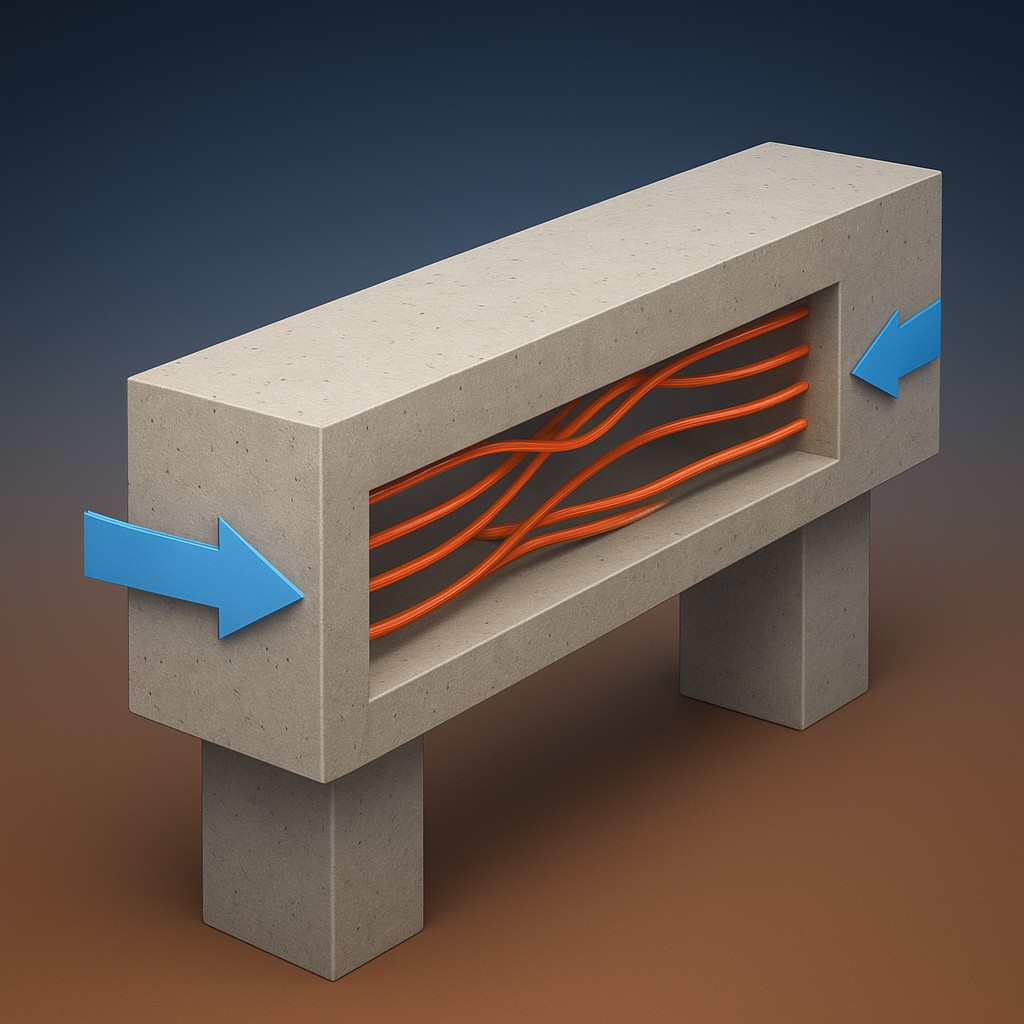
Prestressed concrete changes the game by treating steel not as a stationary skeleton, but as a giant, powerful rubber band. The process involves taking high-strength steel cables, often called tendons, and placing them under incredible tension. When these cables are released or anchored against the ends of the concrete, they want to snap back to their original length. Because they are gripped by or anchored against the concrete, they transfer that "snap back" force into the material itself. The result is a beam that is being squeezed from both ends with millions of pounds of force.
This internal squeeze creates a "pre-compressed" state. When a heavy load, like a freight train, crosses a prestressed bridge, the weight of the train tries to stretch the bottom of the beam. But because the beam is already being squeezed tightly by the steel tendons, the train’s weight only serves to slightly reduce that squeeze. The concrete at the bottom never actually gets pulled apart; it just goes from "very squeezed" to "slightly less squeezed." Since the material is never stretched to the breaking point, it never cracks. This allows engineers to design beams that are much thinner and lighter than traditional reinforced concrete, enabling the soaring, graceful curves we see in modern infrastructure.
Two Paths to the Perfect Squeeze
There are two primary ways to achieve this internal pressure, and the choice usually depends on whether the project is being built in a factory or on a construction site.
The first method is pre-tensioning. In a specialized factory, steel tendons are stretched across a long casting bed by massive hydraulic jacks. Once the steel is pulled taut, concrete is poured around it. As the concrete hardens, it grips the steel. Once it has finished setting, the external jacks are released. The steel tries to shrink back, but because it is now "glued" to the hardened concrete, it squeezes the entire block into a high-density, high-strength unit. These pre-made beams are then trucked to the site and lifted into place.
The second method is post-tensioning, which often feels like a high-stakes surgery performed right on the construction site. In this scenario, the concrete is poured around hollow plastic tubes. Once the concrete has hardened into its final shape, steel cables are threaded through those tubes. Engineers then use powerful jacks to pull the cables from the outside, anchoring them with specialized steel wedges at the ends of the beam. This method is incredibly useful because it allows the cables to follow a curved path. By pulling a cable that curves downward in the middle of a beam, the tightening force actually creates an upward "lift" in the center, helping the bridge fight gravity even more effectively.
Comparing Concrete Methods
| Feature |
Standard Reinforced Concrete |
Pre-tensioned Concrete |
Post-tensioned Concrete |
| Role of Steel |
Passive skeleton |
Active spring |
Active spring |
| State of Concrete |
Strained or cracked at bottom |
Always under compression |
Always under compression |
| Span Length |
Short to medium |
Long and efficient |
Extremely long and custom |
| Construction Site |
Poured in place |
Factory-made |
Poured in place or stressed on-site |
| Durability |
Vulnerable to rust via cracks |
Highly resistant to cracking |
High resistance; cables protected |
The Engineering Logic of Early Defense
The genius of this system lies in its strategy of early defense. In many fields of engineering, we design things to withstand a force after it arrives. In prestressed concrete, we apply the "cure" to the force before the force even exists. If we know that gravity will try to bend a bridge downward, we use the steel tendons to bend the bridge slightly upward (a process known as cambering). When the bridge is finished and cars begin to cross, the downward weight simply flattens the bridge out into its intended flat position. It is a constant balance where the internal forces of the steel and the external forces of the world work together.
This internal tension also makes prestressed concrete incredibly resistant to weather and wear. Because the concrete is kept squeezed tight, the tiny pores of the material are effectively closed shut. This makes it much harder for salt, water, and chemicals to soak into the surface and reach the steel. In traditional reinforced concrete, the unavoidable hairline cracks act as highways for rust. By getting rid of those cracks through constant pressure, prestressed structures can last for decades with much less maintenance. This makes them the top choice for bridges in salty coastal areas or regions where road salt is used heavily in winter.
Correcting the Myth of Brittle Strength
A common mistake is thinking that because concrete is brittle, squeezing it harder would make it more likely to shatter like glass. In reality, the opposite is true. Prestressing turns a brittle material into a high-performance floor or beam by ensuring it stays within its "comfort zone" of compression. Another myth is that the steel cables are simply there to hold the pieces together if the concrete breaks. As we have seen, the steel is actually the main engine of the structure’s strength. If those cables were to lose their tension, the entire bridge would fail because the concrete would immediately collapse under stretching forces it was never meant to handle alone.
This is why the "tensioning" part of the process is handled with extreme care. Every inch of pull is calculated, and the hydraulic pressure used to stretch the cables is monitored by computers. Engineers must also plan for a phenomenon called "creep," where concrete actually shrinks a tiny amount over several years, or the steel cables relax slightly. To ensure a bridge stays safe for a hundred years, engineers over-tighten the cables at the start. This ensures that even after a century of slight relaxation, there is still enough "squeeze" left to keep the concrete strong.
Ultimately, prestressed concrete shows that we do not always need "stronger" materials to build bigger things; we just need to understand the materials we have more deeply. By playing to the strengths of concrete and using steel to cover its weaknesses, we have built a world of soaring skylines and massive bridges that seem to defy the laws of physics. The next time you walk across a long, thin concrete span, remember that beneath your feet, there is a silent battle happening - a million pounds of steel pulling tight, keeping the concrete squeezed together so it can hold you up without ever breaking a sweat. It is a masterclass in turning internal pressure into external stability.