Most of us remember learning to ride a bicycle as a terrifying, wobbling ordeal that ended in a bruised knee or a frantic shout for a parent to keep holding the seat. We usually frame this childhood milestone as a triumph of human coordination, a moment where our brains finally mastered the delicate dance of shifting weight and counter-steering to keep us upright. We assume that if we stop moving, the bike gives up and gravity takes over because we are no longer providing the necessary balance.
The truth, however, is far more mechanical - and slightly less dependent on our own athletic prowess - than we would like to believe. A bicycle is not merely a mode of transport but a remarkably sophisticated autonomous machine with an internal geometry designed to outsmart gravity. While we provide the power and decide the direction, the bike itself takes care of the basic physics of staying vertical. Understanding how this happens requires us to stop looking at the rider and start looking at the frame, specifically the genius of the front fork and the invisible forces that govern the movement of the handlebars.
The Secret Geometry of the Front Fork
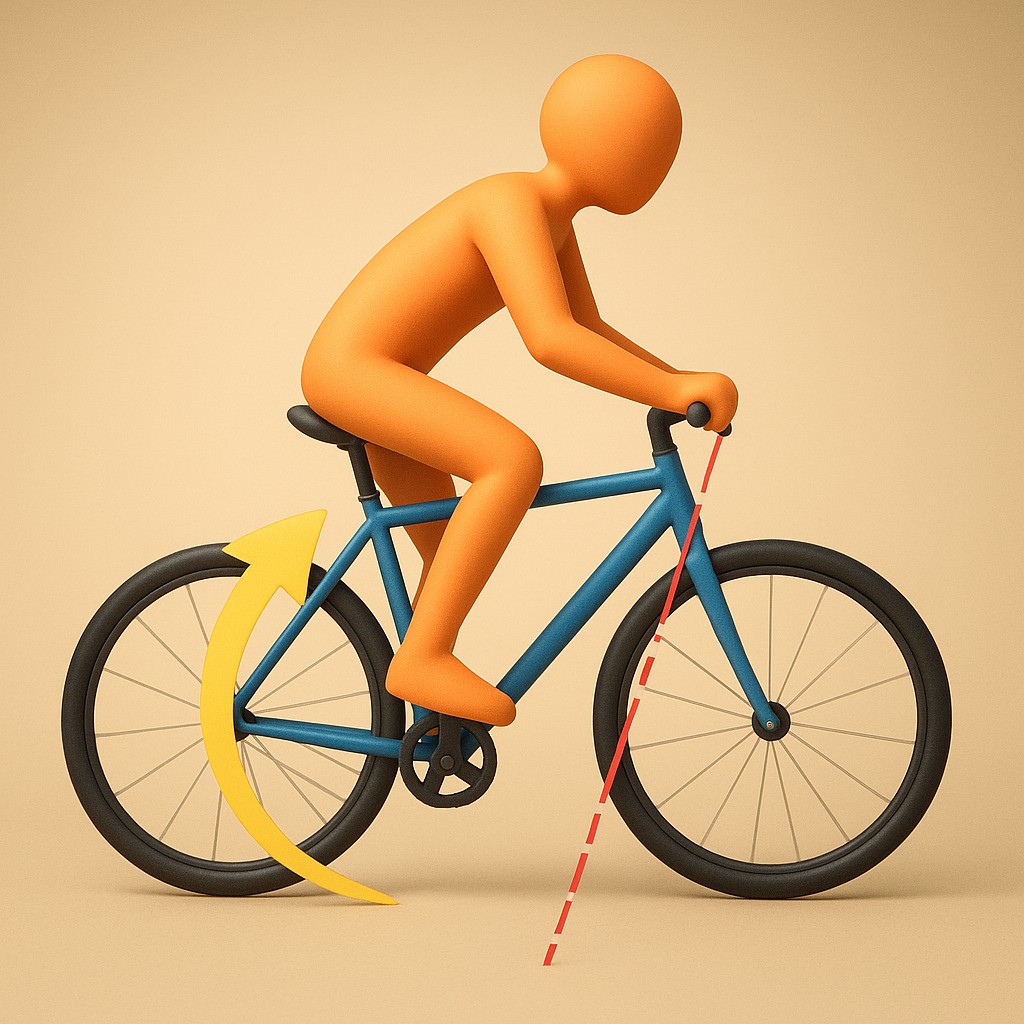
To understand why a bicycle balances, we have to look past the rubber tires and the handlebars and focus on an engineering feature called trail. If you look at a bicycle from the side, you will notice that the front fork is rarely a straight vertical line extending from the handlebars to the center of the wheel. Instead, it is angled forward, or the mounting point is offset, so that the point where the tire touches the ground sits physically behind the steering axis.
This contact point is the key to the bike's stability. Because the contact point trails behind the pivot axis of the steering, the front wheel acts just like the caster wheels on a shopping cart or an office chair. When the bike begins to lean to the left, the force of gravity pulls the frame downward, but the trail geometry forces the front tire to turn into the direction of the lean. This turn creates a steering arc that moves the base of the bike back underneath its center of mass. It is a constant, microscopic feedback loop that functions as a mechanical brain, correcting the tilt before the rider even realizes a fall is imminent.
Why Speed Changes the Rules of the Game
While the trail geometry does the lion’s share of the work at most speeds, it works in tandem with the physics of momentum to keep the unit balanced. When a bicycle is stationary, that lean-to-steer mechanism is dormant because there is no forward force to drive the wheel into a new position. Once you start rolling, however, the bike becomes a dynamic system where steering input is linked to lateral movement. The faster you move, the more sensitive this response becomes, which is why a bike feels rock steady at speed but impossible to balance while standing still.
There is a long-standing misconception that the gyroscopic effect of the spinning wheels is the primary stabilizing force. While the rotation of the wheels does add a bit of angular momentum that fights against sudden changes in orientation, researchers have successfully built bicycles with counter-rotating wheels that cancel out these gyroscopic forces, yet the bikes stayed upright. The stability is baked into the frame geometry and the way the steering system interacts with the road. The wheel is essentially trying to chase its own center of gravity, and as long as you provide enough forward momentum, it will continue this chase indefinitely.
Demystifying the Role of the Human Pilot
If the bike is so good at staying upright, why do we feel like we are working so hard to stay balanced? The answer lies in the difference between passive stability and active navigation. When you are riding, you are not just a passenger waiting for the bike to correct itself; you are an active participant in an ongoing feedback loop. While the bike handles the micro-corrections caused by uneven pavement or slight wind gusts, you are continuously adjusting your center of mass to initiate turns or navigate tight corners.
We often confuse our own anticipatory movements for the bike's primary stability. If you have ever noticed that riding no-handed is easier than you expected once you pick up a bit of speed, that is the bike’s mechanical autonomy in action. Your subconscious quickly realizes that the bike is inherently stable and stops over-correcting, allowing the frame and fork to do what they were born to do. You shift your weight, the bike tilts, the front wheel turns, and the system resolves the lean. You are essentially letting the machine do the heavy lifting while you provide the intent.
Comparing Mechanical Stability and Human Intervention
To better visualize how the bicycle maintains its balance, it helps to break down the different forces at play and determine what is doing the heavy lifting during a typical ride. The interplay between the machine's design and the rider's input is a classic study in ergonomics and physics.
| Factor |
Mechanism of Action |
Responsibility |
| Trail Geometry |
Naturally steers into a lean to restore balance. |
Mechanical / Frame Design |
| Forward Momentum |
Enables the steering mechanism to function. |
The Rider / Pedaling |
| Gyroscopic Effect |
Adds minimal resistance to toppling at speed. |
Physics of spinning mass |
| Active Weight Shift |
Redirects the bike for turning and navigation. |
The Rider / Intention |
| Steering Feedback |
Corrects micro-deviations from the vertical line. |
Mechanical / Self-correcting |
Understanding these components allows us to demystify one of the most common physical skills we learn. We often place a high premium on the skill of balancing, characterizing it as a rare athletic feat, but in reality, it is a partnership between biology and geometry. Because the bike is a self-correcting system, the human brain only needs to learn how to keep its hands off the steering, preventing the mechanical loop from being interrupted. Most wobbling novice riders are actually sabotaging their own bikes by fighting the natural turn-into-the-lean mechanism.
Breaking the Cycle of Over-Correction
The biggest hurdle for any new rider is the human tendency to over-analyze and over-correct. When we feel a slight tilt, our nervous system panics and jerks the handlebars in the wrong direction, effectively fighting against the bike's internal recovery mechanism. This is a classic case of human intuition failing to grasp the power of simple mechanical systems. If you could simply freeze your arms and trust the bike's trail geometry, the machine would theoretically be far better at staying upright than a frantic beginner.
Think of it as an invitation to collaborate with the engineering of the frame. Instead of viewing yourself as the dictator of every movement, view yourself as the supervisor of a very competent, dedicated employee. Once you reach the minimum forward velocity required to kick the mechanical feedback loop into gear, your role is simply to provide the environment for that system to flourish. You aren't creating balance; you are allowing the bicycle to manifest the balance already designed into its structure.
Moving Beyond the Myth of Human Mastery
There is a profound beauty in recognizing that some of our most impressive physical accomplishments are actually enabled by the tools we use. By learning how these systems function, we stop feeling like we are fighting nature and start feeling like we are working in harmony with it. The next time you find yourself gliding along a path, take a moment to notice the steering. Feel how the handlebars feel light and responsive. Remember that the bike is working just as hard as you are, perhaps even harder, to keep you upright.
We tend to romanticize the idea that humans always need to be in total control for a system to succeed. We fear that if we take our hands off the wheel, or if we rely on a machine to handle the heavy lifting, we have somehow failed the test of skill. But the bicycle teaches us a much more elegant lesson: true mastery is not about holding on with white-knuckled intensity. It is about understanding the mechanics of the world around us, trusting the systems we occupy, and providing just enough energy to keep the wheels turning. When you trust the physics, the ride becomes less of an effort and more of a conversation, where the bike handles the equilibrium and you are free to simply enjoy the motion.