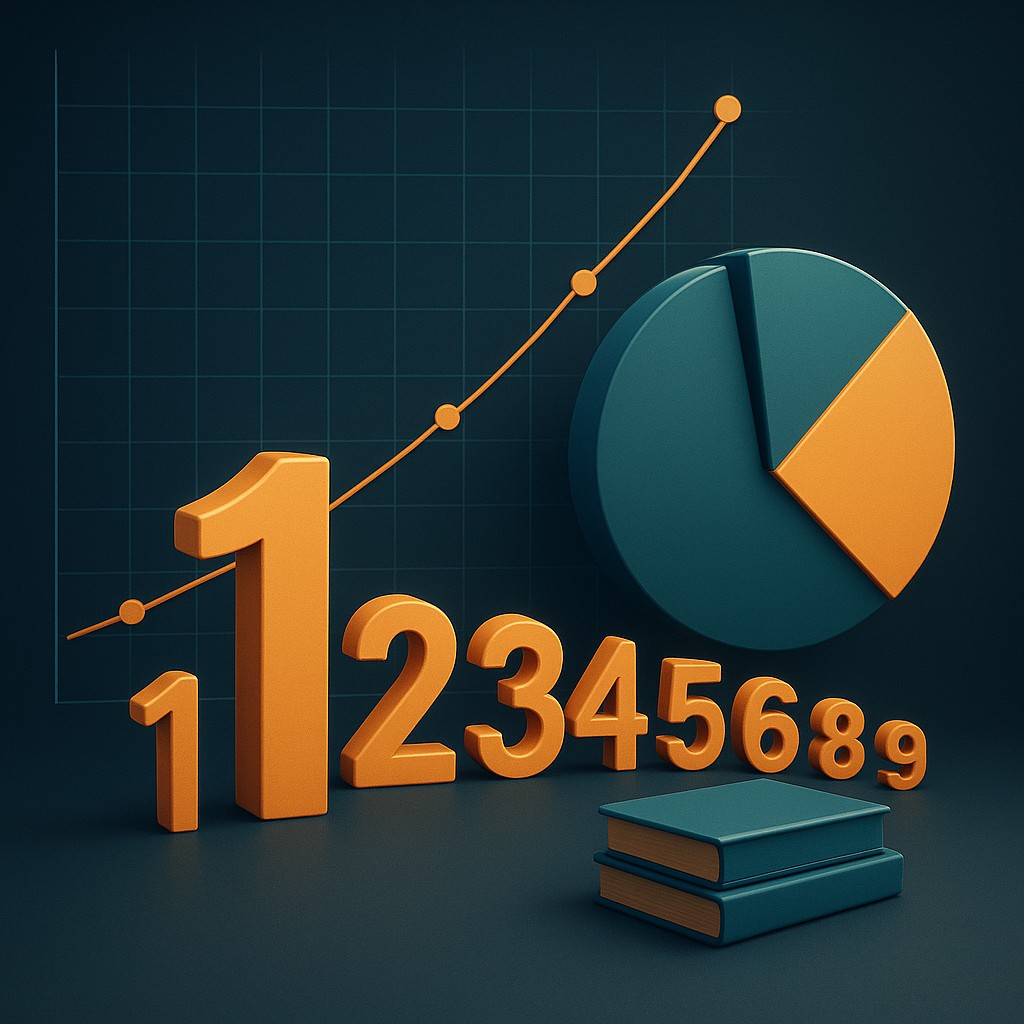
If you walked into a room and shouted, "What is the most common number in the universe?" you would probably get a lot of different answers. Some might guess zero because space is so empty, while others might pick nine because it feels like a substantial, heavy-hitting digit. If you asked a group of people to randomly list a hundred numbers between one and one million, they would likely try to be helpful by spreading their choices out evenly. In their minds, a number starting with the digit 1 is just as likely to appear as a number starting with the digit 9. However, nature does not play by the rules of human intuition, and our instinct for "randomness" is often fundamentally flawed.
In reality, the world of data is heavily biased toward the beginning of the number line. Whether you are looking at city populations, the lengths of rivers, prices on a grocery store shelf, or the figures in a corporate tax return, the number 1 appears as the leading digit far more often than any other. This strange phenomenon is known as Benford’s Law, and it reveals a hidden mathematical structure that governs everything from the heights of mountains to the behavior of the stock market. By understanding why the digit 1 appears about 30 percent of the time, while the digit 9 appears less than 5 percent of the time, we can unlock a powerful tool for detecting lies, spotting fraud, and understanding how the world around us grows.
The Accidental Discovery of a Hidden Pattern
The story of Benford’s Law does not actually begin with a man named Benford. It starts in 1881 with an astronomer named Simon Newcomb, who noticed something peculiar about his books of logarithms. Before the era of pocket calculators, scientists used thick books of logarithmic tables to solve complex multiplication problems. Newcomb realized that the early pages of his book, which contained numbers starting with the digit 1, were significantly more worn and dirty than the later pages. This suggested that he and his colleagues were constantly looking up numbers that began with 1, but rarely needed to look up numbers starting with 8 or 9. Newcomb published a paper on this oddity, but the scientific community largely ignored it for decades.
In 1938, a physicist named Frank Benford rediscovered this pattern while working at General Electric. Unlike Newcomb, Benford was obsessed with testing this theory across as many datasets as possible. He spent years collecting data on 20 different categories, including the surface areas of 335 rivers, the molecular weights of thousands of chemicals, and even the street addresses of the first 342 people listed in a physics handbook. To his amazement, the pattern held firm across every single one of these seemingly unrelated groups. He formalized the mathematical formula that predicts how often each leading digit occurs, cementing his name in history for a law that suggests our world is far less uniform than it appears.
The law basically tells us that if a dataset is truly natural and spans several "orders of magnitude" (meaning the numbers range from very small to very large), the leading digits follow a logarithmic distribution. This means the gap between 1 and 2 is mathematically "wider" than the gap between 8 and 9 when it comes to the probability of a number starting with that digit. It is a counter-intuitive reality that makes perfect sense once you look at the mechanics of growth and scale.
The Logarithmic Ladder of Growth
To understand why the digit 1 is so dominant, we have to stop thinking about numbers as a flat line and start thinking about them as a ladder with uneven rungs. Imagine you have a small savings account with exactly 100 dollars in it. For the leading digit of your balance to change from a 1 to a 2, you need to grow your money by a full 100 percent to reach 200 dollars. This is a massive jump that takes significant time and effort. However, once you reach 900 dollars, you only need to grow your account by about 11 percent to reach 1,000 dollars, at which point the leading digit flips back to a 1 again.
Because growth is often proportional or exponential, things stay in the "one" category much longer than they stay in the "nine" category. Consider a city with 10,000 people. If that city grows at a steady rate of 5 percent per year, it will take many years to reach a population of 20,000. During all those years of growth, the leading digit remains a 1. once it finally hits 90,000 people, the jump to 100,000 happens relatively quickly in comparison. This "stickiness" of the lower digits is the heart of Benford’s Law.
This principle applies to almost anything that grows over time or exists on a wide scale. If you measure the sizes of files on a computer, the prices of stocks over several decades, or the flow of water in a river basin, you are looking at systems that cover multiple orders of magnitude. In these systems, a value has to cover a lot of ground to move from a leading 1 to a leading 2, but it covers very little ground to move from a 9 back to a 1. The following table shows how often these leading digits are expected to appear according to the law.
| Leading Digit |
Expected Frequency (Percentage) |
| 1 |
30.1% |
| 2 |
17.6% |
| 3 |
12.5% |
| 4 |
9.7% |
| 5 |
7.9% |
| 6 |
6.7% |
| 7 |
5.8% |
| 8 |
5.1% |
| 9 |
4.6% |
Why Humans Are Terrible at Faking Randomness
One of the most fascinating uses for Benford’s Law is in forensic accounting and fraud detection. When people try to invent numbers, they almost always fail to mimic the natural logarithmic distribution. Humans have a psychological bias toward uniformity; if someone is making up fake expenses for a tax return, they will likely sprinkle in an even mix of numbers starting with 4, 5, 7, and 9. They feel that using too many ones will look suspicious, when in fact, the absence of ones is what actually tips off the investigators.
Tax authorities like the IRS use sophisticated algorithms to scan financial records for deviations from Benford’s Law. If a company claims thousands of transactions but their leading digits are distributed evenly (about 11 percent for each digit), it is a red flag that the data might have been fabricated. Similarly, election monitors have used this mathematical filter to analyze tallies in countries where results are suspected of being tampered with. If the vote counts in various precincts do not follow the natural distribution of digits, it suggests someone might have written in numbers that "looked" random to the human eye but were mathematically impossible.
However, Benford’s Law is not a "magic bullet" for every situation. It is a powerful warning sign, not definitive proof of guilt. A deviation from the law might simply mean that the dataset is too small or that it does not meet the necessary criteria for the law to apply. It serves as a starting point for an investigation, signaling to experts that they need to look closer at a specific set of books or records. It turns the math of the universe into a high-tech lie detector that works because our brains are simply not wired to think in logarithms.
Knowing When the Law Does Not Apply
While Benford’s Law feels like a universal truth, it actually has a very specific set of requirements. If you try to apply it to the wrong kind of data, you will get "false positives" that look like fraud but are actually just the result of a limited data range. The law only works on data that spans several orders of magnitude, meaning the largest numbers in the set should be at least 100 or 1,000 times larger than the smallest numbers. If your data is too narrow, the distribution will be skewed by the nature of the category rather than the laws of growth.
For example, Benford’s Law is useless for looking at the heights of adult humans. Most adults are between five and six feet tall, meaning the leading digits will be almost exclusively 5 or 6. This does not mean humans are "faking" their height; it just means that human height does not span several orders of magnitude. We do not have people who are one foot tall living next to people who are 1,000 feet tall. Similarly, the law fails for things like telephone numbers, zip codes, or prices at a "99-cent" store. These are assigned numbers or numbers with a fixed cap, rather than results of natural growth.
To successfully use Benford's Law, you need to check for three main things. First, the data must be numerical and not just labels (like social security numbers). Second, the data must be free from human-imposed minimums or maximums (like a legal height requirement or a set price limit). Third, the dataset must be large enough for a statistical pattern to emerge. When these conditions are met, the law is remarkably resilient. You can even change the units of measurement from miles to kilometers or from dollars to yen, and the pattern of leading digits will remain exactly the same.
The Mathematical Beauty of a Predictable World
There is something deeply comforting about the fact that a physicist in 1930 could predict the first digit of your electricity bill today. It suggests that despite the chaos we see in the news or the volatility of the economy, there is an underlying structure to the way things grow and interact. Benford’s Law is a reminder that math is not just something found in textbooks; it is the silent architecture of our lives. It connects the length of the Amazon River to the closing price of a tech stock, proving that both are subject to the same laws of scale.
By learning to spot these patterns, we become more than just observers of data; we become savvy interpreters of reality. We learn to ask better questions and to look beneath the surface of the information we receive. Whether you are a student, a curious citizen, or a future fraud investigator, understanding Benford’s Law gives you a lens to see the "unnatural" among the "natural." It encourages us to look at the world with a bit more skepticism when things look too perfect and a bit more wonder when we see the "one" appearing again and again, exactly where it belongs.
As you go about your week, try to keep an eye out for this pattern. Look at your bank account balance, the populations listed on road signs, or the numbers in a news article. You will start to see the number 1 popping up with a frequency that seems almost magical. It is a small, quiet secret of the universe, hidden in plain sight, waiting for someone with a curious mind to notice the worn-out pages of the world's ledger. When you finally see it, you will realize that the universe isn't just random, it is beautifully, predictably biased.