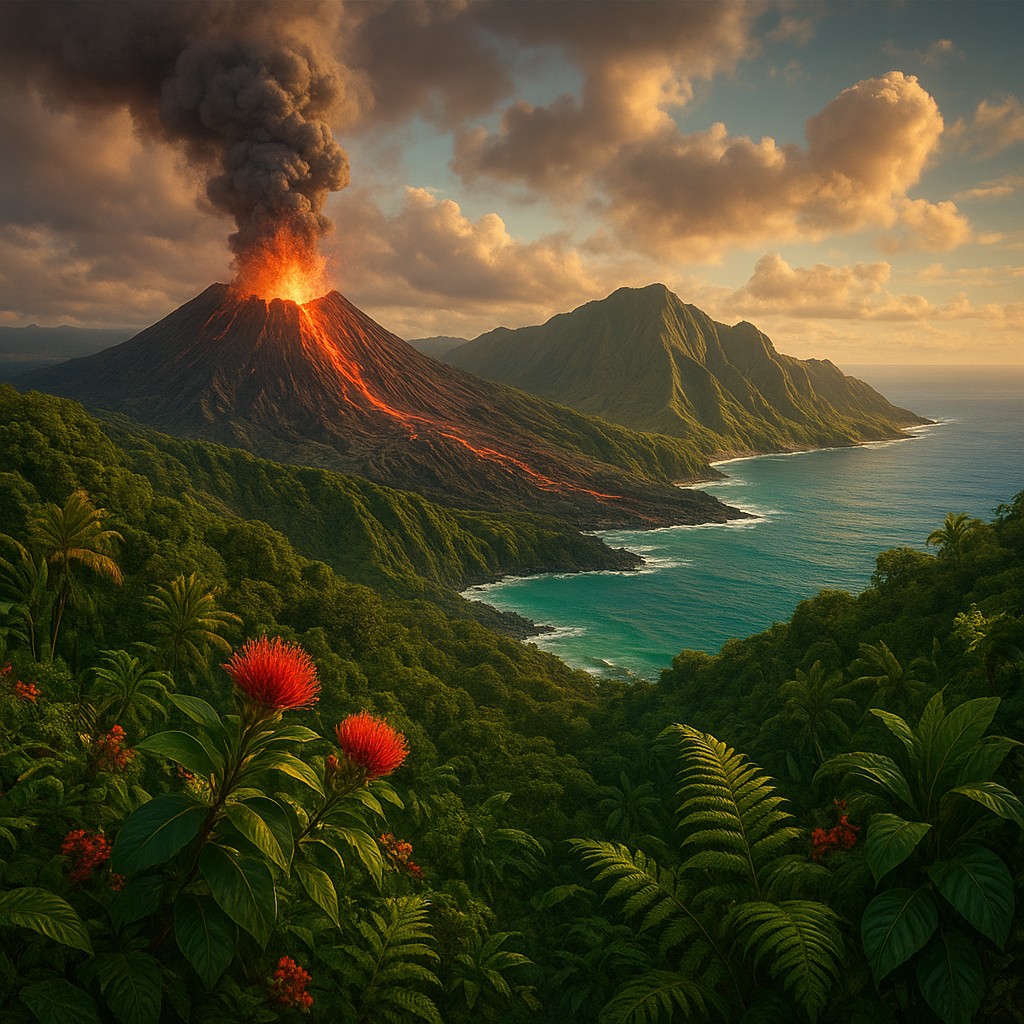
Imagine standing in the heart of the Pacific Ocean, thousands of miles from any continent, on a piece of land that didn't even exist a few million years ago. Hawaii is more than just a vacation spot with postcards and pricey pineapple drinks. It is a geological marvel and a cultural powerhouse. As the most isolated island chain on the planet, these volcanic peaks were born from a "hotspot" in the Earth's crust that has been seeping magma for over 70 million years. This seclusion created a living laboratory where evolution took strange and beautiful turns, resulting in plants and wildlife found nowhere else on Earth.
To truly understand Hawaii, you have to look past the surface of luxury resorts and surfing videos. It is a place where the Earth's pulse is visible in the glow of flowing lava, where ancient Polynesian navigators pulled off the greatest feat of ocean exploration in history, and where a complex kingdom eventually became the 50th U.S. state. Whether you are drawn to the fiery mountains of the Big Island or the emerald peaks of Kauai, the story of Hawaii is one of resilience, adaptation, and a deep, spiritual bond with the land.
The Geological Conveyor Belt of the Pacific
The story of Hawaii begins deep beneath the sea floor. While most volcanoes form where tectonic plates meet, Hawaii sits in the center of the massive Pacific Plate. Underneath this plate lies a stationary "hotspot," a plume of intense heat rising from the Earth’s mantle. As the Pacific Plate slowly drifts northwest at about the same speed your fingernails grow, the hotspot punches through the crust like a blowtorch, creating a series of islands. This is why the islands to the northwest, such as Kauai, are the oldest and most weathered, while the islands to the southeast, like the Big Island, are the youngest and still growing.
Because "shield volcanoes" built these islands, they have a very distinct shape. Rather than the steep, explosive peaks seen in movies, shield volcanoes produce thin, runny lava that spreads out in broad sheets. This creates mountains with gentle slopes that look like a warrior’s shield lying on the ground. Mauna Kea, on the Big Island, is technically the tallest mountain in the world if you measure from its base on the ocean floor, rising over 33,000 feet in total. These islands are actually the tips of some of the largest mountains in the solar system, just poking their heads above the waves.
As the islands drift away from the hotspot, they lose their supply of magma. Slowly, the forces of wind, rain, and waves begin to wear down the rock. Deep canyons are carved into the slopes, and the heavy weight of the volcanic stone causes the entire island to sink back into the sea. Eventually, every Hawaiian island will become a "seamount" - a submerged mountain hidden beneath the waves - while new islands rise to take their place. In fact, a new island named Loihi is already forming about 20 miles off the coast of the Big Island, though it will take tens of thousands of years to reach the surface.
A Guide to the Major Islands
When people talk about Hawaii, they usually mean the eight main islands, though only seven are open to the public. Each island has its own personality, climate, and role in the local ecosystem. Choosing a favorite is nearly impossible, as each offer something unique.
| Island Name |
Nickname |
Notable Feature |
Island Vibe |
| Kauai |
The Garden Isle |
Waimea Canyon & Na Pali Coast |
Lush, quiet, and ancient |
| Oahu |
The Gathering Place |
Honolulu & Pearl Harbor |
High-energy, urban, and historic |
| Maui |
The Valley Isle |
Haleakala Crater & Road to Hana |
Luxury resorts and whale watching |
| Hawaii |
The Big Island |
Volcanoes National Park |
Diverse climates and raw lava |
| Molokai |
The Friendly Isle |
World’s highest sea cliffs |
Rural, traditional, and slow-paced |
| Lanai |
The Pineapple Isle |
Private luxury and rock gardens |
Quiet, secluded, and rugged |
Oahu is the heart of the state, home to the capital, Honolulu, and most of the population. It is a place of contrasts, where luxury shopping malls are just a short drive from legendary surf spots like Banzai Pipeline. Maui offers a bit of everything: beautiful beaches, high-altitude deserts atop the 10,000-foot Haleakala volcano, and a famous farm-to-table food scene. For a glimpse of "Old Hawaii," people head to Molokai, where there are no traffic lights and the community works hard to preserve their traditional lifestyle.
The Big Island is the giant of the group. It is larger than all the other islands combined and contains four out of the five major climate zones. You could theoretically go skiing in the morning on the snowy peak of Mauna Kea and go snorkeling in the warm waters of Kona that afternoon. It is also the only place where you can watch new land being created in real time at Kilauea, one of the world's most active volcanoes. This raw energy makes the Big Island feel like a planet still in the making.
The Epic Journey of the First Voyagers
A common mistake is thinking that Captain Cook "discovered" Hawaii in 1778. In reality, a sophisticated civilization had flourished there for nearly a thousand years. The first people to reach these shores were Polynesians from the Marquesas Islands and later Tahiti. These were the most skilled navigators the world has ever seen. Without compasses or GPS, they read the stars, the flight of birds, the color of the water, and the rhythm of the waves to find a tiny speck of land in a vast ocean.
These early settlers didn't arrive by accident. They traveled in massive double-hulled canoes called wa'a, carrying everything needed to start a new life. They brought "canoe plants" like taro (kalo), sweet potatoes, coconuts, and medicinal herbs, along with pigs, chickens, and dogs. This was a planned migration that required incredible bravery. Once they settled, they created a complex social structure and a brilliant land management system called the ahupua'a.
The ahupua'a system was a masterpiece of environmental planning. The islands were divided into pie-shaped sections that ran from the mountain peaks down to the sea. This ensured every community had what they needed: timber and birds from the mountains, fertile soil for farming in the middle, and fish from the ocean. This system encouraged sharing and a deep respect for water, which flowed from the peaks through taro patches and back to the sea, keeping it clean and productive. It was a sustainable way of life that supported hundreds of thousands of people long before the first Western ship appeared.
The Roots of Hawaiian Culture
At the center of Hawaiian life is the concept of Aloha. While often used as a greeting, it literally means "the presence of breath." It is a philosophy of living in harmony with people and nature. This isn't just a slogan for tourists; it is actually a state law, the "Aloha Spirit law," which reminds officials to treat others with care. This culture is further supported by Ohana (family, including friends and neighbors) and Malama Aina (to care for and protect the land).
Hula is another vital part of the culture that is often misunderstood. It isn't just a dance for entertainment; it is a sacred way to tell stories and a living library. Since ancient Hawaiians didn't have a written language, they used hula and rhythmic chants (mele) to record their history and legends. Every hand movement and footstep has a specific meaning, representing the swaying of a tree, the motion of the sea, or the deeds of the gods. Watching a hula kahiko (ancient style) is a direct connection to the past.
The Hawaiian language, Olelo Hawaii, is a melodic tongue that was once nearly lost. In the late 1800s and early 1900s, the language was banned in schools, and its use dropped sharply. However, a cultural rebirth in the 1970s brought it back. Today, there are immersion schools where children learn everything in Hawaiian. The names on the map also tell stories: "Waikiki" means "spouting water," and "Lanikai" means "heavenly sea." These names provide clues to the history and nature of each place.
Modern Challenges in Paradise
Life in Hawaii today is a mix of tropical beauty and the tough reality of living in the most expensive U.S. state. Nearly 90 percent of food and goods are imported by ship or plane, which drives prices very high. This has led to a "brain drain," where young people often move to the mainland for better-paying jobs. Additionally, while tourism is vital for the economy, the sheer number of visitors puts a strain on the environment and local roads.
Conservation is a top priority. Because Hawaii is the "endangered species capital of the world," many native birds and plants are struggling against invasive animals like mongooses and feral cats. There is a growing movement to return to traditional farming to become more self-sufficient. Local groups are restoring ancient fishponds and taro fields, proving that old methods often hold the key to a sustainable future.
The political history of the islands is also a deeply felt topic. In 1893, the Hawaiian Kingdom was overthrown by businessmen backed by U.S. Marines, which eventually led to Hawaii becoming a territory and then a state. This history remains alive today. Whether through fighting for native rights or protecting sacred sites like Mauna Kea, the people of Hawaii are deeply involved in shaping their future. The islands exist in a constant, vibrant tension between their sovereign past and their modern American identity.
A New Perspective on the Islands
Hawaii is far more than a collection of beaches. It is a geological wonder shaped by a restless hotspot, a cultural treasure built by master explorers, and a modern society balancing the costs of isolation with the need to protect its heritage. When you think of Hawaii, remember the volcanic smoke, the rhythm of the hula, and the wisdom of the ahupua'a. These islands remind us that even in the middle of a lonely ocean, life can flourish and build a community that treats the Earth as family.
As you explore the world, carry the spirit of Malama Aina with you. Whether you are in a local forest or on a black sand beach, the lesson is the same: the land provides for us only if we provide for the land. Hawaii isn't just a destination; it is a lesson in how to live with balance, respect, and a deep appreciation for the breath of life that connects us all.