Why habits quietly decide so much about your day (and why that is good news)
Imagine waking up and finding a cup of coffee already in your hand, or realizing you have scrolled through half your morning without remembering a single post. Those small, automatic behaviors are not magic, they are habits at work - efficient mental shortcuts your brain builds so you can save energy for bigger decisions. Understanding how these shortcuts form gives you leverage: you can design helpful ones and disrupt harmful ones instead of surrendering to them.
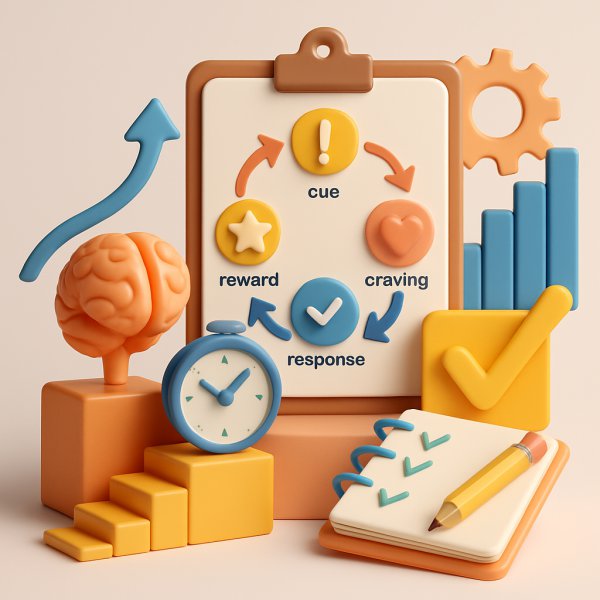
Habits are not character judgments, they are patterns. The science of habit loops shows that behavior emerges from a predictable cycle - a cue that triggers a craving, a response that follows, and a reward that tells the brain whether to save the pattern. Learn the loop and you can become a better architect of your life: plant cues that nudge you toward good behaviors and remove cues that feed bad ones.
This piece will walk from the simple to the complex, mix a bit of neuroscience with everyday examples like brushing teeth and checking your phone, and give you practical experiments you can try tonight. Read with curiosity and a pencil nearby - a few small changes in your environment can yield big returns.
The habit loop decoded: cue, craving, response, reward
At the heart of every habit is a four-part cycle: cue, craving, response, reward. A cue is any signal in your environment - time of day, an emotion, a specific place, or the presence of another person - that starts the loop. The craving is the motivational force, the felt desire for a change in state; it is not for the action itself but for the expected reward the action brings.
The response is the behavior you perform, which can be a thought, a physical action, or both. Brushing your teeth is the response to the morning cue of "leaving the bathroom." Checking your phone is a response to the cue of a buzz, a pocket vibration, or simply boredom. Finally, the reward is the outcome that satisfies the craving and teaches your brain whether to store the loop for next time. Rewards can be tangible, like sugar, or psychological, like relief from anxiety or the hit of novelty.
This loop makes habits predictable and trainable. If you identify each element, you can redesign loops: alter the cue, change the craving, make the response easier, or swap in a different reward. Below is a compact table that summarizes the components along with everyday examples and quick tweaks you can try.
| Loop Component |
What it does |
Everyday example |
Quick tweak to change it |
| Cue |
Triggers attention to start the loop |
Morning light, phone vibration, feeling tired |
Move cue - change time, silence phone, place toothbrush in view |
| Craving |
The motivational target - what you expect to feel |
Fresh mouth, social connection, distraction from boredom |
Reframe craving - focus on long-term benefit, add immediate reward |
| Response |
The habit action or routine |
Brushing, scrolling, snacking |
Make response easier or harder - use friction or automation |
| Reward |
Confirms value and reinforces habit |
Clean teeth, likes & novelty, sugar rush |
Substitute a similar reward - gum instead of candy, brief walk for stress |
The brain behind the loop: basal ganglia and the dopamine nudge
Habits live in the basal ganglia, a deep brain structure responsible for patterns, movement, and routine behaviors. While the prefrontal cortex is the thinking brain - weighing options and planning - the basal ganglia stores repeated sequences so they can run on autopilot. That saves energy, which evolution favored.
Dopamine plays a role, but not exactly as a simple "pleasure chemical." Dopamine signals prediction and learning, highlighting differences between expected and actual rewards. When a sequence reliably leads to a reward, dopamine helps stamp the pattern into the habit circuit. Over time the response becomes less effortful and more automatic, which is why you can drive and sing along without weighing each steering correction.
The practical implication is that repetition in the same context strengthens the basal ganglia's script. If you want to create a new pattern, you need consistent practice in the same cues until the brain replaces or layers the new routine.
Cues: the prompts that start the machine and how to spot them
Cues are often subtle and numerous - five common types are time, location, preceding action, emotional state, and other people. For example, the cue for checking your phone might be a pocket vibration, a moment of boredom, or seeing others on their devices. For teeth brushing the cue might be finishing breakfast, seeing your toothbrush, or the pattern of your morning routine.
To change a habit, first observe the cue. Use an "if-then" diary for a few days: write down what you were doing, feeling, and where you were when the habit occurred. This simple experiment lifts the curtain on automatic triggers and gives you leverage to rearrange the environment - hide, delay, or replace cues to alter what follows.
Small environmental redesigns are powerful. Place a bowl of fruit on the counter to cue healthy snacking, or move your phone charger to the bedroom to cue charging only overnight. The cue directs attention, and attention is the executive that puts the loop into motion.
Cravings: the hidden hunger that drives behavior
Cravings are often misidentified; we think we crave the action, but actually we crave the change in state the action produces. You do not crave scrolling itself, you crave the relief from boredom or the dopamine micro-hit of novelty. You do not crave brushing per se, you crave fresh breath and the social confidence that follows.
Understanding the true craving lets you substitute more helpful responses that satisfy the same need. If you crave connection and find yourself doom-scrolling, try a 60-second message to a friend instead. If you crave stress relief after a long day, replace reaching for a sugary snack with five minutes of deep breathing or a short walk.
Cravings are also fueled by anticipation. The brain learns to link cues to expected rewards, and that anticipation is what motivates action. Interrupt the association between cue and anticipated reward and you weaken the craving.
Response: making the desired action obvious, attractive, easy, and satisfying
When you know the cue and craving, the response is where habit design gets tactical. Good design makes the desired response obvious, attractive, easy, and satisfying. This mnemonic helps you create supportive conditions: make the cue visible, bundle the habit with something enjoyable, reduce friction, and give immediate feedback.
For example, to make brushing teeth more automatic, put the toothbrush somewhere obvious, play a favorite two-minute song to make it attractive, use a timer app to make it satisfying, and keep floss visible to extend the routine. For reducing phone checking, add friction by turning off notifications, putting the phone in another room, or using a lockbox during work hours.
Micro-habits matter. Smaller responses are easier to repeat and thus to wire into the brain. Start with two minutes if ten feels unreachable. The goal is consistency, not heroics.
Rewards: the truth about what your brain is learning
Rewards serve a single functional purpose: teach the brain whether a behavior is worth remembering. If the reward satisfies the craving, the loop strengthens. If it does not, the loop fades. Rewards can be sensory, social, or emotional, and sometimes they are delayed - which complicates learning.
Delayed rewards, like better health from exercise, are harder to link back to the response. That is why habit builders recommend immediate micro-rewards - a pleasant playlist while running, a checkmark on a progress calendar, or a small celebratory gesture after completing a task. These immediate signals help the brain connect action and outcome.
Rewards also differ in intensity. Novelty and surprise can amplify dopamine responses, which explains why social media habits hijack attention - the unpredictability of new content is a powerful reward. Recognizing this helps you substitute predictable, healthier rewards that still satisfy.
How habits form over time: repetition, context dependence, and memory consolidation
Habits do not form overnight, though the exact number of days varies by behavior and person. What matters more is repetition in a stable context. Each repetition strengthens the pattern through a process called memory consolidation, where short-term actions move into long-term circuits. Sleep and rest help consolidation, which is one reason consistent routines and adequate sleep support habit change.
Context dependence means that a habit practiced at home may not transfer at work. To generalize a habit you must practice it across contexts or deliberately recreate the same cues. Automaticity grows when the loop runs in the same context repeatedly, so aim for consistency rather than sporadic bursts of willpower.
The variability of daily life can derail new habits, so plan implementation intentions - specific if-then rules like "If I finish dinner, then I will walk for 10 minutes." These rules reduce decision friction and increase the chances of repetition.
Building new habits that stick: small wins and habit stacking
Start small, aim for consistency, and use habit stacking - attaching a new habit to an existing routine - to piggyback on already strong cues. For instance, if you always make tea after lunch, add two minutes of stretching immediately afterwards. The existing cue - making tea - triggers the new behavior until it becomes part of the ritual.
Use implementation intentions and public commitment for accountability. Track progress visually with a calendar or habit app to provide immediate satisfaction and social proof. Remove friction by preparing the environment: lay out workout clothes the night before, keep your phone out of reach during focused work, or place your guitar in the living room if you want to practice daily.
Celebrate small wins, but do not confuse celebration with indulgence. A quick fist pump, a sticky note check, or a single line in a journal is enough to signal reward to your brain and reinforce the loop.
Breaking bad habits: replace, rewire, and redesign the landscape
You rarely eliminate a habit by sheer willpower. Instead, replace the routine with a competing action that satisfies the same craving, rewire the context so the cue is absent, and redesign your physical and social environment to favor better choices. Blocking websites, removing junk food from the house, and telling friends about your goals are simple, effective moves.
When cravings hit, use a pause strategy: delay for five minutes and notice the urge. Often the craving will pass or reduce in intensity. Pair this with a constructive replacement, like a glass of water or a short breathing exercise, so your brain gets a satisfying outcome without the harmful routine.
Be kind to yourself during lapses. Habit change is messy. Analyze what cue slipped through, what craving took over, and how the reward was insufficient. Then iterate - small, informed adjustments beat grand, unsustainable promises.
Common myths and mistakes about habits
A lot of folk wisdom about habits is misleading. One myth says it takes 21 days to form a habit; in reality the timeframe varies widely and depends on the behavior and individual circumstances. Another mistake is assuming willpower is infinite. Willpower is a limited resource that fluctuates with stress, fatigue, and glucose levels, so design around it rather than relying solely on it.
People also confuse goals with systems. Setting a goal like "lose 10 pounds" is fine, but systems are the daily habits that make the goal inevitable - consistent meals, regular movement, sleep routines. Finally, many assume habits are purely individual; social context and identity play huge roles. Seeing yourself as "a runner" or "someone who reads" helps maintain behaviors beyond motivation alone.
Two short habit stories you can relate to
Amira used to skip flossing because she hated the extra step. She started leaving floss on top of her toothpaste at night, and paired flossing with a two-minute playlist she loved. The cue was now obvious, the action was tiny, and the immediate reward - a satisfying song and the clean-mouth feeling - created a loop that, after a few weeks, became automatic.
Ben could not stop checking his phone during work. He tried willpower and failed. Then he put his phone in a drawer at the start of the day and set a single 30-minute check window in the afternoon for social catch-up. The cue of reaching into the drawer vanished, the craving for novelty decreased, and his focused hours multiplied. The environment change did the heavy lifting.
A short, practical action plan you can start tonight
Think of this as a mini experiment you run for seven days. Choose one habit you want to build or break, and treat it like a scientist observing yourself. Keep the change tiny, and design the loop.
- Step 1: Pick one specific habit and write it down in an if-then format - for example, "If I finish dinner, then I will brush my teeth before dessert."
- Step 2: Identify the cue and make it obvious - move an object, set a time, or attach the habit to an existing routine.
- Step 3: Shrink the response to the smallest possible version - two minutes of the new behavior is better than none.
- Step 4: Choose an immediate reward and make it satisfying - a checkmark, a brief stretch, or a small celebratory gesture.
- Step 5: Track it publicly or visually - cross a calendar day, tell a friend, or use a simple app to create accountability.
- Step 6: After seven days, review what worked and adjust the cue or reward rather than relying on willpower.
- Step 7: Gradually increase the response only after the behavior feels consistent - stacking slowly beats sprinting.
This narrative approach makes the process manageable and fun. Run the experiment, keep notes, and iterate.
Reflection prompts to make this personal
Take a moment to look at your day like a scientist. Which three cues trigger your most automatic behaviors, and how might you rearrange them to favor better outcomes? Which craving do you think fuels your worst habit - is it boredom, stress relief, social connection, or something else?
Imagine the end of a week where one small habit has shifted for the better - what changed in your mood, energy, or sense of control? What concrete first step could you take tonight to start that shift? These questions turn knowledge into action by forcing you to map the loop in your real life.
Quick habit cheat-sheet you can memorize
Here are the essentials to keep handy while you design your habits:
- Habits follow a cue - craving - response - reward loop; identify each part.
- Make new habits obvious, attractive, easy, and satisfying.
- Start tiny and be consistent in the same context for stronger wiring.
- Replace routines instead of just suppressing them.
- Change your environment to reduce reliance on willpower.
- Track progress visually and celebrate micro-wins.
- Be patient, iterate, and learn from slips.
Go change one small thing today
Habits are not destiny, they are design problems waiting for your curious mind. With a few careful tweaks to cues, a clearer view of cravings, and a focus on tiny, repeatable responses that offer immediate reward, you can build powerful new routines and let go of unhelpful ones. Start small, be kind to yourself through the messy parts, and treat each day as another opportunity to rehearse the life you want.
Now pick one tiny habit, set the cue, shrink the action, and watch the loop do the rest. You will be surprised how quickly your environment and brain become allied allies in your favor.