Imagine for a moment that you are a high-wire artist, but your safety net is actually a complex machine. To stay unfolded, it requires thousands of gallons of fuel, a fleet of engineers, and a constant connection to the power grid. If the electricity cuts out or a pump breaks, the net simply vanishes.
This has been the core problem with nuclear power for decades. While nuclear energy is incredibly dense and carbon-free, the traditional "Big Nuclear" approach relies on active safety systems. These systems are essentially a collection of pumps, motors, and backup generators that must work perfectly to keep the reactor core from overheating once it is shut down. If the pumps stop, heat builds up, and the situation becomes critical very quickly.
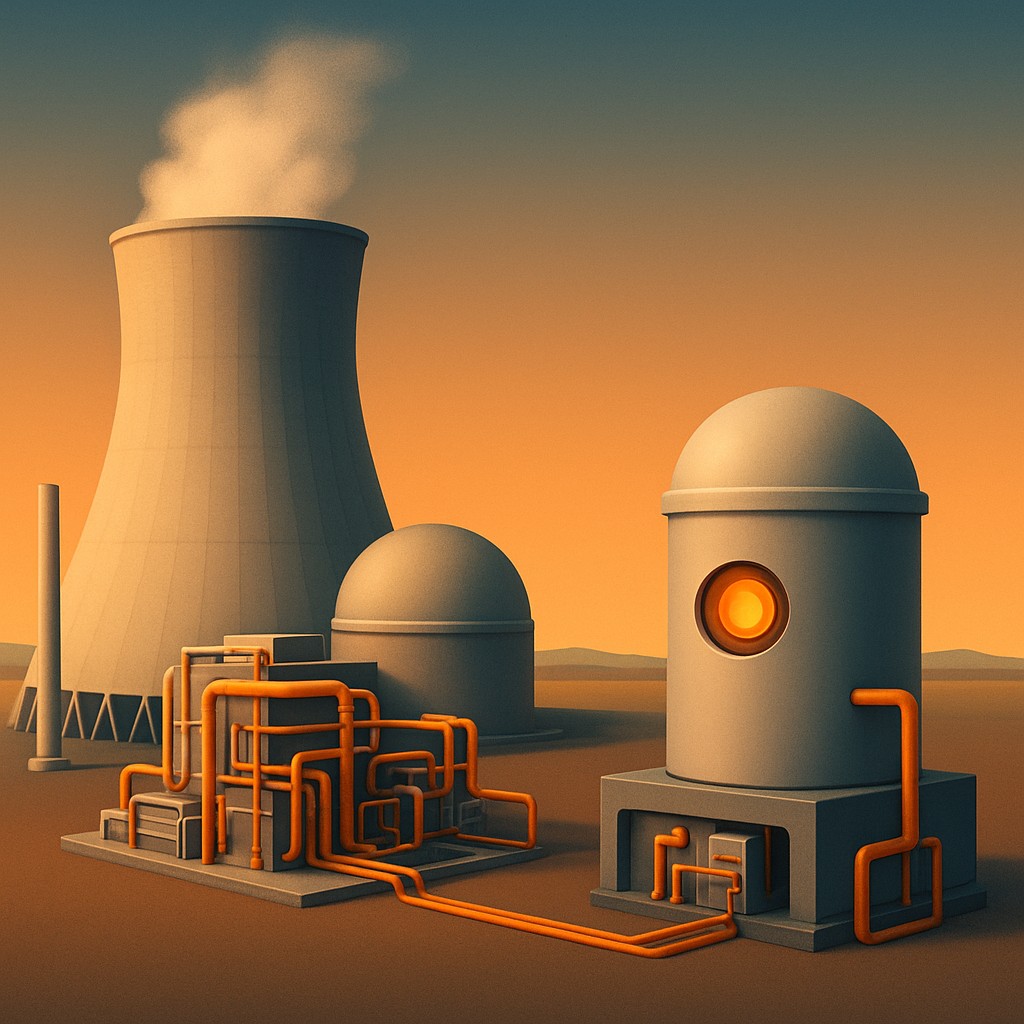
We are currently witnessing a profound shift in how we harness the atom. We are moving away from these gigantic, temperamental monoliths toward something much smaller and far more clever: the Small Modular Reactor (SMR). These reactors are not just "shrunken" versions of the plants we know today; they are a complete reimagining of the physics of safety. Instead of fighting against nature by forcing water through pipes with electricity, SMRs are designed to work with the laws of thermodynamics. They use the very heat they produce to keep themselves safe. By relying on the inescapable pull of gravity and the predictable way heat rises, they turn the "danger" of a power outage into a non-issue.
The Problem of Radioactive Leftovers
To understand why SMRs are a major breakthrough, we first need to look at what happens when you turn a nuclear reactor "off." Unlike a gas stove, where the heat vanishes the moment you click the dial, a nuclear core continues to generate significant heat even after the main reaction has stopped. This is known as decay heat, caused by the radioactive breakdown of fragments left behind from split atoms.
In a traditional large-scale plant, this decay heat is intense enough to melt the fuel rods if it isn't constantly carried away by circulating coolant. This is why the 2011 Fukushima disaster occurred. It wasn't the earthquake or the initial wave that caused the meltdown; it was the loss of electrical power to the pumps that were supposed to manage that lingering decay heat.
Traditional reactors are built like massive fortresses because they have to house these complex active safety systems. They require giant cooling towers, enormous containment structures, and several layers of backup diesel generators. This complexity makes them incredibly expensive and slow to build. Because they are so large, they must be constructed entirely on-site, a process that can take a decade or more and cost billions of dollars. SMRs aim to break this cycle by simplifying the entire cooling process, moving from a "must-act" safety mindset to a "let it be" philosophy known as passive safety.
Using Physics instead of Fuel Pumps
The secret to the modern SMR is natural convection. You have seen this in action if you have ever watched steam rise from a cup of coffee or felt a breeze in a house with the windows open. Hot fluids become less dense and rise, while cooler, denser fluids sink.
In an SMR, the reactor core sits at the bottom of a tall vessel filled with coolant, usually water. As the core heats the water, that water naturally flows upward. It eventually reaches a heat exchanger at the top, where it transfers its heat to a separate loop of water, cools down, and then sinks back to the bottom to start the cycle again.
This creates a self-sustaining loop that requires zero moving parts. Because the design is so much smaller than a conventional reactor, the volume of water is enough to absorb the decay heat through this natural "breathing" process. If the plant loses all external power, if the operators walk away, or if a giant tree falls on the control room, the physics of the water do not change. The heat will continue to circulate and dissipate into the environment through the walls of the containment vessel. This removes the "station blackout" scenario from the list of things that can cause a catastrophic failure.
Comparing Conventional Reactors to SMRs
| Feature |
Conventional Nuclear Plants |
Small Modular Reactors (SMRs) |
| Cooling Method |
Active (Requires pumps and electricity) |
Passive (Natural convection and gravity) |
| Construction |
Custom built on-site over 10+ years |
Factory-built modules shipped by rail |
| Power Output |
1,000+ Megawatts (Large cities) |
50 to 300 Megawatts (Small towns or industry) |
| Safety Philosophy |
Redundant mechanical systems |
Inherent physical laws (Thermodynamics) |
| Site Requirements |
Massive footprint near large water bodies |
Flexible footprint; can be built underground |
The Efficiency of the Assembly Line
Beyond the safety benefits, the "Modular" part of the SMR name is what has economists and climate scientists excited. In the past, every nuclear plant was a bespoke piece of architecture, like a custom-built mansion. If a welder made a mistake on a pipe in South Carolina, the whole project might stall for months.
SMRs are designed to be the "IKEA furniture" of the energy world. Because they are small, they can be manufactured in a controlled factory environment where quality control is much tighter and the process is repeatable. Once a module is finished, it can be loaded onto a truck, train, or barge and shipped to its final destination.
This factory-based approach solves one of the biggest hurdles to clean energy: the massive financial risk. Most investors are terrified of a twenty-year construction timeline. SMRs can be deployed in stages. A utility company might start with two modules to power a small region and then add four more as the population grows. This "plug-and-play" capability makes nuclear power accessible to remote areas, mining sites, or even massive data centers that need reliable power 24/7 but don't have the space or the budget for a giant plant. It also means that as we learn to build them faster, the cost per unit should drop dramatically, much like it did for solar panels and wind turbines.
Addressing the Elephant in the Lead-Lined Box
While SMRs solve many of the mechanical and safety headaches of the past, they are not a magic wand. The most persistent challenge is the one that has followed the nuclear industry since its beginning: radioactive waste. SMRs still use nuclear fuel, and when that fuel is spent, it remains hazardous for thousands of years.
In fact, some critics argue that because SMRs have a higher "surface-area-to-volume" ratio in their cores, they might actually produce more waste per unit of electricity than their larger cousins. This is a point of ongoing scientific debate, but the reality is that a transition to SMRs still requires a long-term national strategy for deep underground storage.
There is also the matter of fuel enrichment. Many of the most advanced SMR designs require a type of fuel called HALEU (High-Assay Low-Enriched Uranium). This fuel has a higher concentration of the isotope Uranium-235 than the fuel used in today's big plants. This higher enrichment allows the reactors to be smaller and run longer between refuelings, but the supply chain for HALEU is currently very limited. Until we scale up the production of this specific fuel, many of the most promising SMR designs will remain stuck on the drawing board.
The Shift Toward Local Power Grids
We are moving away from a world of massive, centralized power plants toward a more decentralized, resilient grid. In the old model, if one giant power plant went offline, a whole state might go dark. In a world powered by SMRs, the grid becomes a network of smaller energy nodes. If one reactor needs maintenance, the others continue to hum along.
This is vital for national security and disaster recovery. Imagine a hurricane-prone coastline where, instead of one giant vulnerable plant, you have a dozen SMRs tucked safely underground. They can provide power to hospitals and emergency services regardless of what the weather does to the overhead power lines.
This decentralization also opens up new possibilities for "co-generation." Because SMRs can be placed closer to where people live and work, the excess heat they produce can be used for more than just electricity. It can be piped into heating systems to warm homes in the winter, used to turn seawater into fresh drinking water, or provided as high-temperature steam for industrial tasks like making hydrogen or steel. By integrating nuclear power directly into our industrial infrastructure, we change it from a "scary thing on the horizon" into a helpful, invisible partner in daily life.
Navigating the Future of the Atom
The transition from "Atomic Giants" to "Atomic Modules" represents more than just a change in size; it is a change in our relationship with technology. We are moving from a world where we maintain safety through constant, anxious intervention to a world where we design systems that are "walk-away safe."
It is a testament to human ingenuity that we have learned to use the very heat we once feared as the engine for our safety systems. By simplifying the mechanics and embracing the factory floor, we are making it possible for carbon-free, reliable power to reach corners of the globe that have been left in the dark for far too long.
As you look toward the future of the power grid, keep an eye on these quiet, self-cooling canisters. They represent a bridge between our current fossil-fuel dependence and a future where the air is cleaner and the lights stay on without a pump ever needing to turn. The journey of the SMR is a reminder that sometimes the best way to solve a massive problem is to think much, much smaller. While there are still hurdles to clear regarding waste and fuel, the promise of a reactor that simply "breathes" its way through a crisis is a powerful step toward a more secure and sustainable planet. Science has given us the tools; now, it is up to us to build the factories that will power our tomorrow.