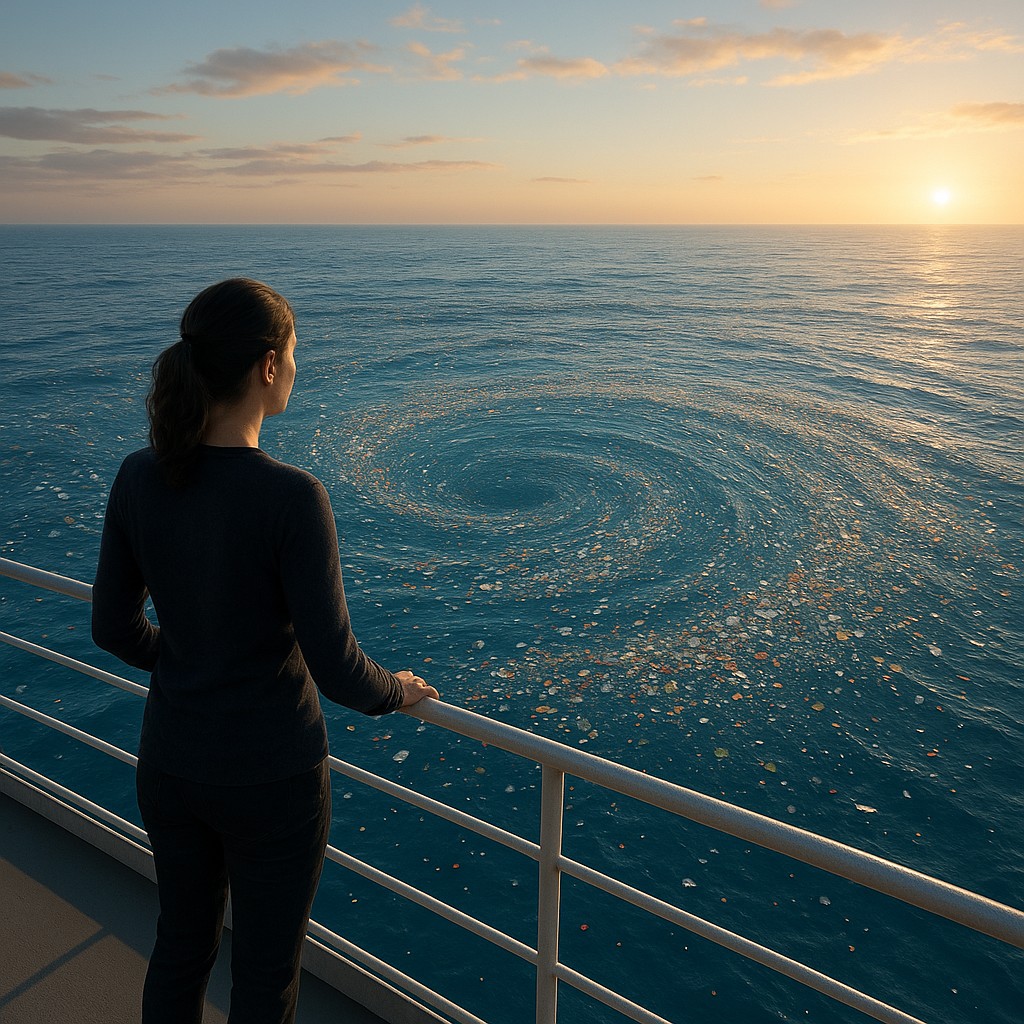
Imagine standing on the deck of a ship in the middle of the North Pacific, thousands of miles from the nearest coffee shop or skyscraper. You have been told you are entering a "plastic continent," so you naturally expect to see a solid mass of trash rising out of the waves - perhaps something sturdy enough to plant a flag on. You scan the horizon for a floating island of milk jugs and old tires, but as you look over the railing, the water looks exactly like water. It is blue, vast, and seemingly empty.
This is the first and most important trick the ocean plays on us. The "Great Pacific Garbage Patch" is not a continent at all. It is a thin, swirling soup of billions of tiny particles that are often invisible to the naked eye.
The reality of this phenomenon is far more complex and, in many ways, more concerning than a simple island of trash. Instead of a solid heap that we could scoop up with a giant crane, we are dealing with a massive "smog" of plastic spanning millions of square kilometers. It is held in place by a system of rotating ocean currents called a gyre. This acts like a slow-motion whirlpool, drawing in debris from across the globe and never letting it go. Understanding what is actually happening out there requires us to shrink our perspective down to the level of a single molecule while expanding it to the size of the entire planet.
The Invisible Architecture of the Ocean Vortex
To understand why plastic gathers in specific spots, we have to look at how our planet breathes and moves. The Earth has five major ocean gyres, which are massive systems of circulating currents driven by the wind and the planet's rotation. Think of these gyres as the ocean’s conveyor belts. When a plastic bottle slips out of a backpack on a beach in California or is washed into a river in Southeast Asia, it eventually hitches a ride on these currents. Over several years, these items are pulled toward the center of the gyre - a region of relatively calm water where rotational forces trap everything in a permanent, watery orbit.
The Great Pacific Garbage Patch, located between Hawaii and California, is the largest of these collection zones. It is not alone; there are similar patches in the Atlantic and Indian Oceans, but the Pacific one gets the most attention because of its staggering scale. Geographically, it is divided into two main sections: the Eastern Garbage Patch near the American coast and the Western Garbage Patch closer to Japan. They are connected by a thin "highway" of moving water called the Subtropical Convergence Zone. This entire system covers an area roughly twice the size of Texas. Yet, if you flew a plane over it, you might not notice a thing because the most dangerous parts are hiding just beneath the surface.
While we often focus on the stuff that floats, recent scientific expeditions have revealed a "reservoir" effect that goes much deeper than we originally thought. It turns out that about 70 percent of the plastic that enters the ocean actually sinks. This means that for every piece of trash we see bobbing on the waves, there is a massive graveyard of debris resting on the seafloor - potentially up to 100 times more than what is at the surface. The "continent" we talk about is really just the tip of a very deep, plastic iceberg that extends miles down into the dark abyss.
From Water Bottles to Pepper Flakes
The most common myth about the plastic continent is that it is made of recognizable objects. While explorers do find the occasional fishing net or floating crate, the vast majority of the patch consists of microplastics. These are tiny fragments less than five millimeters long, roughly the size of a grain of rice or a flake of red pepper. Plastic is a rugged material designed to last forever, but when it is exposed to harsh ultraviolet rays and the constant pounding of waves, it doesn't biodegrade. It simply shatters.
This process is called photodegradation. A single sturdy laundry detergent bottle can eventually break down into tens of thousands of microscopic shards. To a scientist measuring the water, these areas look less like a landfill and more like a cloudy broth. In some parts of the North Pacific, there are now more pieces of plastic than there are plankton. This creates a fundamental problem for the base of the food chain, as we are essentially replacing the "fuel" of the ocean with indigestible, toxic confetti.
The problem has become even smaller and more insidious lately. New research suggests that the most abundant form of plastic in some oceans might actually be nanoplastics - particles smaller than a micrometer. These are so tiny they cannot be seen with a standard microscope, yet they are capable of being absorbed into the tissues of marine animals or even passing through cell membranes. The "continent" isn't just a place on a map anymore; it is becoming a microscopic part of the biological fabric of the ocean itself.
The Residents of the Plastic Neighborhood
It might seem strange, but life is finding a way to thrive in this artificial environment, though not in a way that is healthy for the planet. Scientists have discovered a whole new ecosystem they call the "plastisphere." This refers to the communities of bacteria, algae, and even small crabs or barnacles that have adapted to live on floating plastic debris. In the open ocean, which is usually a watery desert with nowhere to hide, a floating piece of plastic is like a luxury apartment building for a tiny organism.
However, this man-made habitat has a dark side. By providing a permanent floating home, plastic allows species to travel thousands of miles away from their natural habitats. This turns the garbage patch into a vehicle for invasive species. A crab from the coast of Japan could hitch a ride on a plastic crate and end up in Hawaii, where it has no natural predators and can cause ecological chaos. Furthermore, larger animals like sea turtles and albatrosses often mistake these bright bits of plastic for food. A floating plastic bag looks remarkably like a jellyfish to a hungry turtle, and a colorful bottle cap looks like a tasty fish to a bird.
| Feature |
Myth: The Floating Island |
Reality: The Plastic Smog |
| Visibility |
Visible from space like a landmass. |
Mostly invisible; looks like clear water. |
| Composition |
Whole bottles, bags, and tires. |
Billions of microscopic shards. |
| Location |
Only on the water's surface. |
Spans from the surface to the seafloor. |
| Consistency |
Solid enough to walk on. |
A thin "soup" of suspended particles. |
| Size |
Small and concentrated. |
Expansive; covering millions of square miles. |
Why Cleaning It Up Isn't Just Using a Bigger Net
Whenever people hear about the plastic continent, the first reaction is usually, "Why don't we just go out there with a giant net and scoop it all up?" It is a noble thought, but the logistics are a nightmare. Because the plastic is mostly micro-sized and spread throughout the water, a net fine enough to catch the plastic would also catch and kill the tiny marine life - like plankton and fish larvae - that are essential for the ocean's health. We would basically be destroying the ecosystem to save it.
Furthermore, the scale of the area is simply too enormous for traditional cleanup methods. If we sent a fleet of ships to try and "vacuum" the North Pacific, the fuel used by those ships would create a massive carbon footprint. By the time they finished one lap, more plastic would have flowed in from the world's rivers to replace what was taken. Current estimates suggest that about 1.4 million tonnes of plastic flow from rivers into the ocean every year. Trying to clean the patch without stopping the flow at the source is like trying to mop up a flooded bathroom while the tub is still overflowing at full blast.
That said, there are brilliant people working on passive cleanup technologies. Some organizations use long, floating barriers that act like an artificial coastline, allowing natural ocean currents to push the plastic into a central collection zone. Others are focusing on "interceptors" placed in the world’s most polluting rivers to catch trash before it ever reaches the sea. While these efforts are impressive, most experts agree that the real solution lies in "turning off the tap" - reducing our production of single-use plastics and improving waste management so the ocean stops being our global trash can.
A Chemical Cocktail in the Water Column
Beyond the physical danger of animals choking on plastic, there is a hidden chemical battle happening in the gyres. Plastics act like "chemical sponges." In the ocean, they soak up oily pollutants like PCBs and DDT that have been lingering in the water for decades. When a fish eats a piece of microplastic, it isn't just eating a bit of indigestible material; it is swallowing a concentrated pill of toxic chemicals. These toxins then move up the food chain in a process called bioaccumulation.
Small fish eat the plastic, bigger fish eat those fish, and eventually, these chemicals can end up on our own dinner plates. This highlights the fact that the "plastic continent" isn't a distant problem happening "out there" - it is a cycle that eventually comes back to haunt our own health. Recent studies have even found microplastics in human blood and lung tissue, proving that the borders between the "plastic world" and the "human world" are blurring.
The deep sea, once thought to be the most pristine place on earth, is now revealing itself to be the ultimate destination for our waste. Researchers have found plastic bags in the Mariana Trench, the deepest point in the ocean. This suggests that the plastic continent isn't just a surface phenomenon or a mid-water soup, but a total transformation of the ocean's vertical structure. The deeper we look, the more we find that our footprints are made of polyester and polyethylene.
The story of the plastic continent is undoubtedly sobering, but it is also a powerful reminder of how interconnected we are with our blue planet. Every choice we make - from the reusable bag we carry to the policies we support - ripples across the currents and eventually reaches those distant gyres. While the problem is vast, our capacity for innovation is even greater. By understanding the true nature of the "patch" as a microscopic challenge rather than a solid island, we can better design the tools and lifestyle shifts needed to heal the sea. You are now part of a growing movement of people who see the invisible truth, and that knowledge is the spark for a cleaner, more vibrant future.