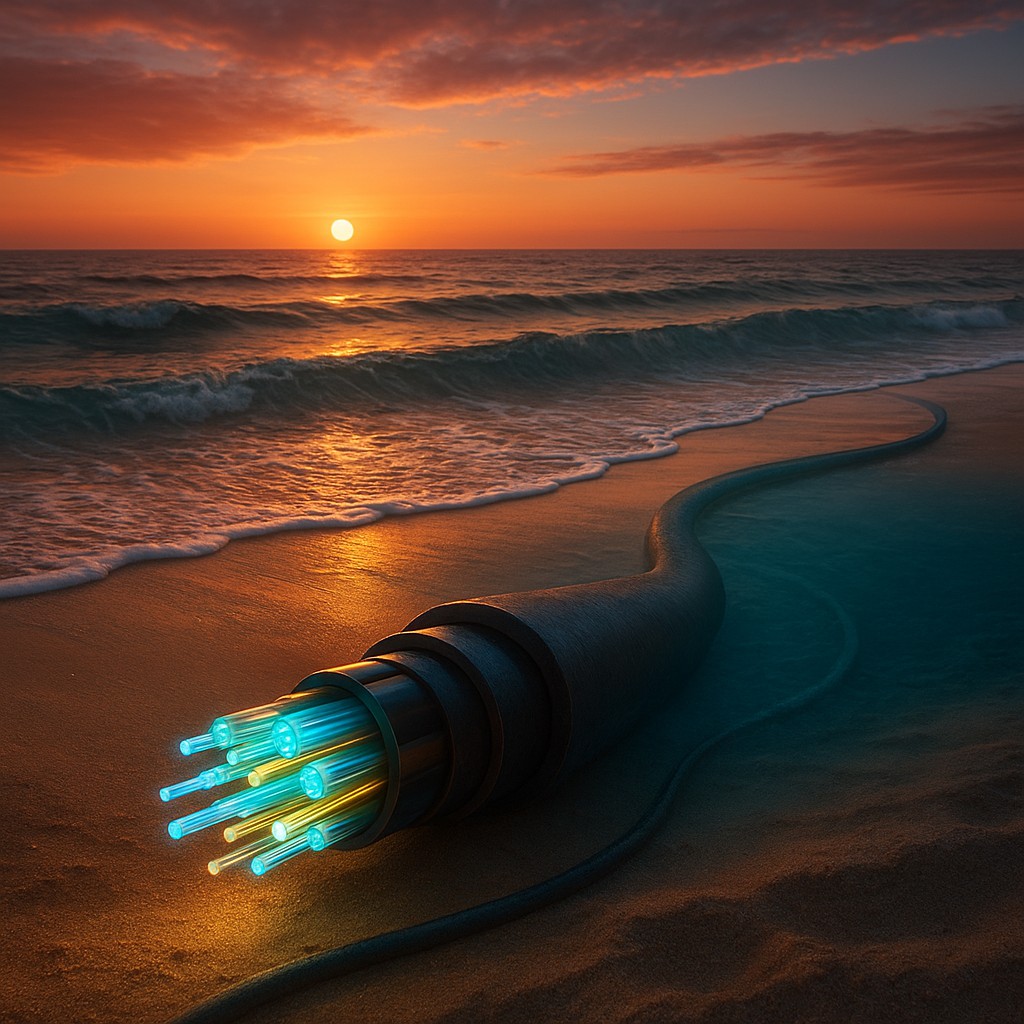
Imagine you are standing on a beach, watching the sun set over the horizon. The view looks peaceful and empty, but beneath those rolling waves lies a vital and fragile piece of infrastructure. Thousands of miles of fiber-optic cables, some no thicker than a garden hose, crisscross the ocean floor like a massive underwater spiderweb. These cables carry over 95 percent of all international data. Every time you send an email, stream a movie, or check your bank balance, your information likely travels through the dark, high-pressure depths of the Atlantic or Pacific.
For decades, these cables were "silent" observers of the deep. They were passive tubes of glass and plastic, vulnerable to ship anchors, fishing nets, and, more recently, intentional sabotage. If a cable broke, the world only found out after the internet slowed to a crawl or went dark entirely. However, a major shift is occurring in maritime security. Instead of just carrying data, these cables are being taught to "feel" and "listen" to their surroundings. By turning the global internet backbone into a planetary nervous system, we are ensuring the ocean floor is no longer a blind spot for security forces.
The Secret Life of a Fiber-Optic Pulse
To understand how a cable can act like a microphone, we first have to look at how fiber optics work. Inside these cables are tiny strands of glass that carry information as pulses of light. Under normal conditions, that light travels in a predictable path, bouncing off the inside walls of the glass fiber. However, no piece of glass is perfectly smooth. Microscopic imperfections within the fiber cause a tiny fraction of that light to bounce backward toward the source. This is called Rayleigh scattering, and for a long time, it was seen as a technical hurdle to overcome.
Engineers have now realized that these reflected light particles are actually incredibly useful messengers. When something vibrates near the cable, such as a boat engine overhead or a mechanical arm touching the line, the pressure of those vibrations slightly bends the glass fiber. Even a stretch smaller than the width of a human hair changes the pattern of the reflected light. By using a technology called Distributed Acoustic Sensing (DAS), we can send light down the cable and measure exactly how those reflections change. In essence, the cable becomes a string of thousands of individual sensors, each reporting what is happening at its specific location.
This shift is a game-changer because it uses infrastructure that is already in place. We do not need to drop thousands of new microphones into the sea; we simply attach "interrogator" units to the ends of the existing cables. These units act like the brain of the system, sending out light pulses and analyzing the return signals with incredible precision. Because light travels so fast, the system can detect a disturbance thousands of miles away in a fraction of a second, pinpointing exactly where someone is interfering with the line.
Telling the Difference Between a Predator and a Playground
The ocean is a very noisy place, which makes underwater acoustics difficult. It is filled with the clicks of dolphins, the low songs of whales, the churning of tides, and the constant rumble of shifting tectonic plates. If a security system treated every vibration as a threat, it would trigger a false alarm every five minutes. This is where advanced software and artificial intelligence come in. Modern maritime security relies on digital filters that can tell the difference between nature and man-made sounds.
A whale swimming near a cable creates a rhythmic, low-frequency pattern that the system can easily ignore. On the other hand, a ship's anchor dragging along the seabed creates a harsh, grinding vibration that looks very different on a data scan. A submarine or a remote-controlled underwater robot has its own distinct "acoustic thumbprint" based on its engine type and propeller speed. By feeding thousands of hours of sea noise into machine-learning algorithms, operators can set "smart" alerts. The system stays silent for the natural world but triggers an immediate alarm the moment it detects a mechanical signature.
This allows for a proactive defense. In the past, if someone wanted to tap into or cut a cable, they could do so anonymously in the middle of the ocean. Now, the moment a vessel stays too long over a sensitive junction or begins to lower equipment, the cable itself alerts the authorities. This turns the entire length of the cable into a tripwire. Security teams can see the threat coming from miles away, tracking the vessel’s path and speed in real time before any physical damage occurs.
Comparing Subsea Monitoring Technologies
While acoustic sensing is the gold standard for many experts, it is helpful to see how it compares to older methods. The ocean is too vast for any single solution, but the "nervous system" approach offers unique advantages in scale and cost.
| Feature |
Satellite Surveillance |
Traditional Sonar Buoys |
Distributed Acoustic Sensing (DAS) |
| Primary Use |
Tracking ships from space |
Local underwater detection |
Long-range cable protection |
| Response Time |
Periodic (depends on orbit) |
Real-time |
Instant |
| Weather Impact |
Blocked by heavy clouds |
Affected by surface storms |
Immune to surface weather |
| Cost |
High (requires satellites) |
Medium (deployment costs) |
Low (uses existing cables) |
| Detection Range |
Global surface view |
Only a few miles |
Thousands of miles |
| Main Weakness |
Cannot see deep underwater |
Needs frequent battery changes |
Needs power at the shore end |
As the table shows, satellites are great for seeing ships on the surface, but they are blind to what happens miles below the water. Sonar buoys work well for local defense, but you would need millions of them to cover the world’s internet cables. DAS fills the gap by providing a continuous deep-sea "ear" that never needs to come up for air or have its batteries changed. It is a permanent part of the environment it protects.
The Strategy of Ocean Sovereignty
Using these tools is not just a technical upgrade; it is a major move in international diplomacy and "gray zone" warfare. In modern politics, gray zone tactics are actions that hurt an opponent but stop just short of starting an open war. Cutting an underwater cable is a classic example. It can crash a nation's stock market, stop military communications, and cause mass panic, yet it is often hard to prove who did it or if it was just an "accident" involving a fishing boat.
Acoustic sensing removes the "accidental" excuse. When a cable records the exact acoustic signature of a ship, including the unique vibrations of its hull and engine, it is much harder for a perpetrator to claim they weren't there. This creates a powerful deterrent. It sends a message to any saboteur that the ocean floor is no longer a place to hide. The act of approaching the cable makes the intruder the star of a high-definition digital recording.
Furthermore, these systems are leading to more cooperation between the private companies that own the cables and the navies that protect them. Software now combines cable data with AIS (Automatic Identification System), the GPS tracking used by most legitimate ships. If the cable "feels" a ship overhead but there is no GPS signal on the map, the system flags a "dark vessel." This allows patrols to go directly to the exact coordinates, saving time and resources that would otherwise be spent searching empty water.
Resilience in a Connected World
The beauty of this technology is that it serves two purposes. While the main goal is security, the data collected is a goldmine for environmental science. Because these cables are sensitive enough to hear blue whales and distant underwater volcanoes, they provide scientists with details about the deep ocean that were previously impossible to get. We are seeing the rise of "dual-use" infrastructure, where the same pulse of light that protects bank transfers also helps us understand how climate change affects ocean currents.
We often think of the internet as something "in the cloud," but it is a physical thing, rooted in the mud of the seabed. Protecting it requires a mix of ancient maritime knowledge and futuristic physics. By turning cables into sensors, we are doing more than just building a wall around our data; we are building a more intelligent relationship with the two-thirds of our planet that has remained hidden for most of human history.
The next time you tap a screen, remember the scale of this achievement. Your signal may be racing across the ocean floor, protected by the physics of light and the watchful "ears" of the glass it travels through. The ocean is no longer a silent void; it is a monitored and protected space. By turning a weakness into a strength, human ingenuity has found a way to keep us connected, secure, and informed.