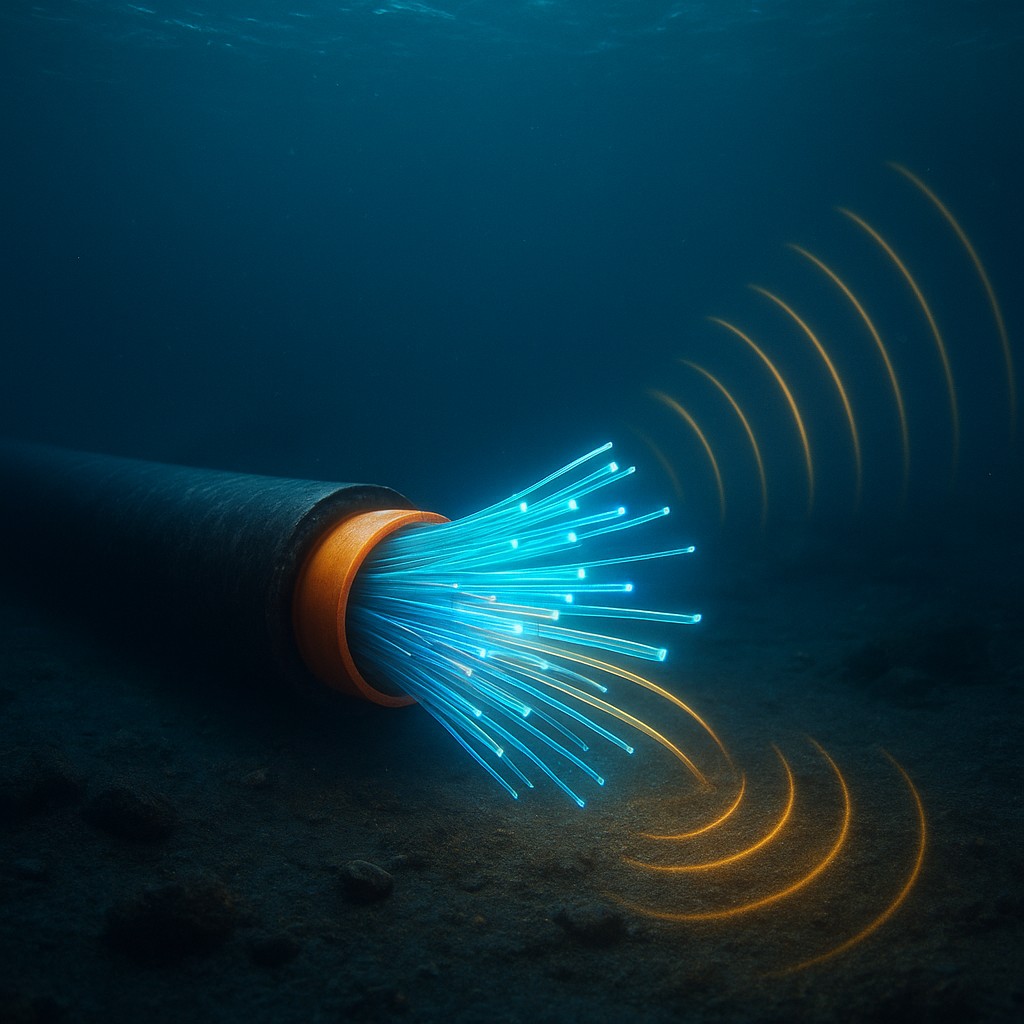
Imagine for a moment that you are streaming a high-definition movie, joining a lag-free video call with someone across the globe, or checking your bank balance. It feels as though this data is floating through the air or bouncing off satellites, but the truth is much more grounded - or rather, submerged. About 99 percent of all international data travels through a hidden network of fiber-optic cables resting on the dark, silent floor of the ocean. These cables are the nervous system of modern civilization, stretching hundreds of thousands of miles to connect continents, yet most are no thicker than a garden hose. This fragility makes our global connectivity surprisingly vulnerable to everything from accidental fishing accidents to intentional sabotage.
For decades, protecting these cables was a game of "wait and see." Management teams would only realize there was a problem when a connection went dark. At that point, they would have to send out specialized repair ships to fish the broken ends out of the muck, a process that is as expensive as it is time-consuming. However, a major shift is currently underway in maritime security. Instead of viewing these cables as passive pipes that simply carry data, engineers are turning them into active, intelligent sensors. By harnessing the unique properties of light and vibration, we are beginning to listen to the ocean in ways that were once science fiction, allowing us to spot threats before a single strand of glass is snapped.
The Glass Nervous System Beneath the Waves
To understand how a data cable can act as a security guard, we first need to look at what is happening inside the fiber itself. A fiber-optic cable works by sending pulses of laser light down a core of incredibly pure glass. In a perfect world, that light would travel in a straight line forever. In reality, tiny imperfections in the glass cause some of the light to scatter back toward the source. This is known as Rayleigh scattering. Under normal conditions, this backscatter is predictable and constant, forming a unique "fingerprint" for that specific cable.
When something happens near the cable, such as a ship dropping a heavy anchor or a submarine hovering nearby, it creates physical vibrations. These vibrations cause microscopic stress on the cable, essentially squeezing or stretching the glass by fractions of a millimeter. Even this tiny amount of pressure changes how the light pulses scatter. Using a technology called Distributed Acoustic Sensing (DAS), operators send specialized pulses down the line and measure the return signal with extreme precision. Because they know the speed of light, they can calculate exactly how long it took for the "disturbed" light to return. This allows them to pinpoint the location of the vibration within a few meters, even on a cable that is hundreds of miles long.
Turning Light Pulses into Underwater Radar
The magic of DAS lies in its ability to transform an entire length of cable into a continuous line of microphones. Traditional sensors are usually "point sensors," meaning they only tell you what is happening at the exact spot where the device is installed. To monitor a thousand-mile cable that way, you would need to install thousands of batteries, processors, and transmitters along the seabed. With DAS, the cable itself is the sensor. All the complex hardware stays safely on land in a terminal station, where computers analyze the light patterns returning from the depths.
This creates a real-time "acoustic map" of the environment around the cable. When a vessel approaches, its engine creates a specific rhythmic vibration that the system can recognize. If that vessel stops and begins to lower equipment, the "thud" and "scrape" of an anchor or a remote-controlled underwater robot hitting the seafloor sends a distinct signal back to the station. This allows security forces to tell the difference between a ship simply passing by and one engaged in suspicious activity. Instead of waiting for the internet to go down, security teams receive an alert the moment something unusual touches the seabed near their equipment.
Distinguishing Friends from Foes and Whales
One of the greatest challenges in acoustic sensing is "noise." The ocean is far from quiet; it is a chaotic symphony of crashing waves, clicking shrimp, singing whales, and rumbling tectonic plates. If the software is too sensitive, every passing school of fish might trigger an alarm, leading to "alarm fatigue" for the operators. To solve this, developers use advanced machine learning - computer programs that learn from data - to categorize vibrations based on their pitch, length, and strength.
A massive shipping vessel, for example, has a very low-frequency, steady "heartbeat" from its large engines, while a high-speed patrol boat has a much higher-pitched signature. However, nature often mimics human activity in confusing ways. A large marine mammal, like a Blue Whale, can produce sounds and movements that look like mechanical interference. The table below shows how different underwater events are categorized to help operators decide whether to send a naval interceptor or just enjoy the wonders of nature.
| Event Type |
Acoustic Signature Characteristics |
Typical Level of Concern |
| Commercial Transit |
Low frequency, steady rhythm, constant speed |
Low |
| Anchor Deployment |
Sharp "impact" spike followed by dragging sounds |
Critical / Immediate |
| Bottom Trawling |
Constant "scraping" sound over long distances |
High |
| Marine Mammals |
Changing frequencies, organic patterns, non-linear movement |
Very Low |
| Seismic Activity |
Deep, thunderous rumble across the whole cable |
Informational |
| Subsea Construction |
Rapid, repetitive hammering or mechanical whirring |
High / Scheduled |
From Passive Repair to Active Defense
The use of acoustic sensing marks a fundamental change in how nations protect their digital borders. In the past, subsea cables were "out of sight, out of mind" until a crisis occurred. Today, geopolitical tensions have made these cables targets for "gray zone" warfare - conflicts where an adversary might cut a cable and claim it was an accident caused by a fishing boat. By keeping a digital record of the exact acoustic signature of the event, cable owners can provide evidence of exactly what kind of vessel was there and what it was doing.
This shift toward active monitoring also has massive economic benefits. Repairing a cable in the middle of the Atlantic can cost millions of dollars and take weeks, depending on the weather and ship availability. If a DAS system detects a fishing boat dragging a net in a restricted zone, a nearby coast guard vessel can be sent to warn them off before the net ever snags the cable. It is the difference between having a home security camera that alerts you when someone is on your porch versus only finding out you were robbed when you see your front door is missing.
The Scientific Bonus of Listening to the Deep
While the primary goal of these new systems is security, the scientific community is reaping unexpected rewards. Because these cables are spread across every ocean, turning them into sensors has effectively created the world’s largest observatory for Earth sciences. Scientists are now using "dark fiber" - unused strands within a cable - to study underwater earthquakes and track the migration patterns of endangered whales across entire oceans.
For instance, by analyzing the "background noise" of the ocean captured by these cables, researchers can measure water temperature over vast distances. Sound travels at different speeds depending on how warm the water is. By timing how long certain sounds take to reach different parts of the cable, climate scientists can get a real-time look at ocean warming. It is a rare win-win situation where national security and environmental science work together, using the same pulses of light to protect both our data and our planet.
As we weave our digital lives more tightly into the seafloor, our methods for protecting that infrastructure must evolve. The transition from blind, underwater wires to a sensing, acoustic network represents one of the most significant leaps in maritime history. By listening to the whispers of the deep through the very glass that carries our emails and videos, we are transforming the ocean from a place of mystery and vulnerability into a transparent space where our global connections can be guarded. The next time you click a link, remember that somewhere, miles beneath the waves, a beam of light might be noticing a whale passing by, standing watch over the silent threads that keep us all connected.