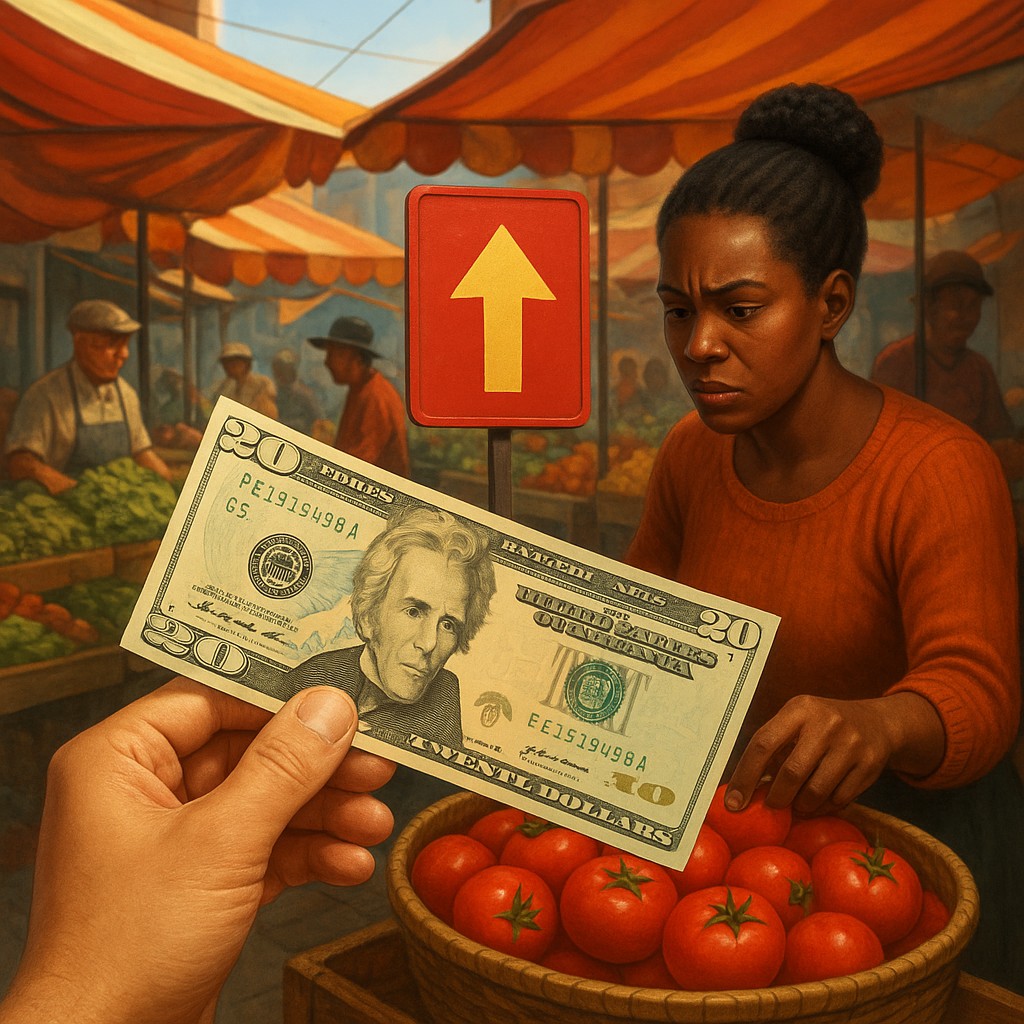
Imagine you are walking through a crowded marketplace with a twenty-dollar bill in your pocket. Usually, your shopping strategy is simple: if the price of your favorite coffee spikes, you grumble and switch to a cheaper tea. If steak becomes too expensive, you buy chicken instead. This is the "Law of Demand" in action. It is a fundamental rule of economics suggesting that when prices go up, people buy less. It feels like a universal law of nature, as reliable as gravity or the fact that toast always lands butter-side down. We are conditioned to hunt for bargains and avoid anything overpriced.
However, there is a strange corner of economic theory where gravity seems to reverse. In this upside-down world, as the price of an essential item rises, people actually buy more of it. While this sounds like a glitch in the matrix or a retail executive’s fever dream, it is a very real phenomenon known as a Giffen Good. This paradox does not happen because people are trying to be trendy or show off their wealth. Instead, it occurs under a desperate, narrow set of circumstances where a rising price leaves a consumer with no choice but to double down on the very thing that is becoming more expensive.
The Logic of the Upside-Down Market
To understand how a Giffen Good works, we first have to look at how we normally react to price changes. Economists break our reactions down into two distinct parts: the substitution effect and the income effect. The substitution effect is the most intuitive. If the price of apples goes up, you substitute them with oranges. You are still hungry for fruit, but you aren't willing to pay a premium for that specific crunch when a citrus alternative is cheaper. Under normal circumstances, the substitution effect is the dominant force in our decision-making. It keeps markets balanced and ensures that sellers can't raise prices forever without losing their customers.
The income effect is more subtle. It refers to how a price change affects your "real" income, or your actual purchasing power. If the price of everything you buy drops by half, you are effectively twice as rich, even if your paycheck hasn't changed by a single cent. Conversely, if the price of a staple you rely on every day rises, you feel poorer. You haven't lost your job, but your money doesn't go as far as it used to. For a Giffen Good to exist, this income effect must be so powerful that it completely overwhelms the substitution effect. It creates a scenario where a price hike makes you so much "poorer" that you can no longer afford the luxury items you used to pair with your staples.
When Staples Become a Survival Trap
Consider a classic, simplified historical example often attributed to the Victorian economist Sir Robert Giffen. Imagine a family living in extreme poverty in 19th-century Ireland. Their diet consists of two main items: potatoes and meat. Potatoes are the cheap, bland staple that provides most of their calories, while meat is an expensive treat they buy in small quantities to make life bearable. Because they are living on the edge of survival, most of their budget already goes toward potatoes; they are the foundation of the family's existence.
Suddenly, the price of potatoes rises. In a normal world, you might think the family would buy fewer potatoes. However, they still need to reach a certain number of calories to stay alive. Because the potatoes now take up a much larger chunk of their limited budget, they can no longer afford the meat at all. To make up for the missing calories from the meat, they have to buy even more potatoes. Even though the price went up, their demand went up too, because they were forced to abandon their "luxury" substitutes just to avoid starvation. The potato has become a Giffen Good, a product that dominates a budget so much that its own price hike reinforces its necessity.
Distinguishing Survival from Social Status
It is easy to confuse Giffen Goods with another economic oddity called Veblen Goods. At first glance, they look identical because both involve demand increasing alongside price. However, the psychology behind them is the polar opposite. Named after sociologist Thorstein Veblen, Veblen Goods are luxury items like designer handbags, high-end watches, or limited-edition supercars. People buy these things specifically because they are expensive. The high price tag is a "signal" of status. If a luxury watch brand lowered its prices by 90 percent, its core customers might actually stop buying it because the prestige of owning it would vanish.
Giffen Goods, by contrast, are "inferior goods." In economic terms, an inferior good is something you buy less of as you get richer, like instant noodles or used clothing. You don't buy a Giffen Good to show off; you buy it because you are backed into a corner. While a Veblen Good is driven by the desire for "conspicuous consumption," a Giffen Good is driven by the necessity of "conspicuous survival." One is about moving up the social ladder, while the other is about trying not to fall off the bottom rung. This distinction is vital for leaders who are trying to understand how inflation impacts different parts of society.
Comparing the Anomalies of Demand
| Feature |
Giffen Good |
Veblen Good |
Normal Good |
| Price Direction |
Price Up, Demand Up |
Price Up, Demand Up |
Price Up, Demand Down |
| Consumer Class |
Low-income/Poverty |
High-income/Elite |
All consumers |
| Primary Driver |
Survival and lack of substitutes |
Status and social signaling |
Utility and value for money |
| Good Type |
Inferior staple (e.g., rice) |
Luxury item (e.g., Rolex) |
Regular item (e.g., clothes) |
| Psychology |
"I must eat to survive." |
"I want people to see my wealth." |
"I want the best deal." |
The Rarity of the Paradox Today
You might wonder why we don't see Giffen Goods on the news every day. The truth is that they are incredibly rare in the modern, globalized world. For a product to truly become a Giffen Good, three very specific conditions must be met at the same time. First, the item must be an inferior good with almost no substitutes. Second, it must take up a massive portion of the consumer's total budget. Third, the consumer must be living at a near-subsistence level where any price change hits their purchasing power hard. In most developed nations, even the poorest citizens have access to a variety of cheap calories, which prevents any single item from becoming a "trap."
However, researchers still find evidence of this paradox in specific regions. A famous 2008 study by Harvard economists Robert Jensen and Nolan Miller looked at poor households in China. They found that in certain provinces, when the price of rice (a staple) was subsidized and lowered, people actually bought less of it. When the price went up, they bought more. This confirmed that for the truly vulnerable, the "income effect" of a price change is a powerful force that can override basic market logic. It serves as a stark reminder that the laws of economics don't always apply equally to everyone, especially when survival is the main goal.
How Scarcity Shapes Human Behavior
The existence of Giffen Goods teaches us a profound lesson about the hidden mechanics of poverty. When we look at markets, we often assume that everyone is making "rational" choices based on what they like. We assume that if something gets too expensive, people will simply find a better way to spend their money. But the Giffen Paradox shows us that for many, there is no "better way." Poverty limits the number of paths available, sometimes to the point where the only path left is to spend more on the very thing that is making you poorer. It is a cycle that can be incredibly difficult to break without outside help.
Understanding this paradox helps economists and governments design better safety nets. For example, if a government realizes that a staple food is acting as a Giffen Good, they know that simply letting "market forces" solve the problem won't work. High prices will only lead to more suffering and even higher demand. This knowledge can lead to better-targeted subsidies or the introduction of nutritional substitutes that help break the reliance on a single, volatile staple. It turns a cold mathematical theory into a tool for social empathy.
As you observe the world through an economic lens, remember that the "Law of Demand" is a guideline, not a physical constant. Human behavior is a complex tapestry woven from culture, status, and necessity. Sometimes, people buy more because they are proud; sometimes, they buy more because they are afraid; and sometimes, as with the Giffen Good, they buy more because they simply have no other choice. By recognizing these exceptions, you gain a deeper appreciation for the invisible forces that shape our lives, our wallets, and our survival.