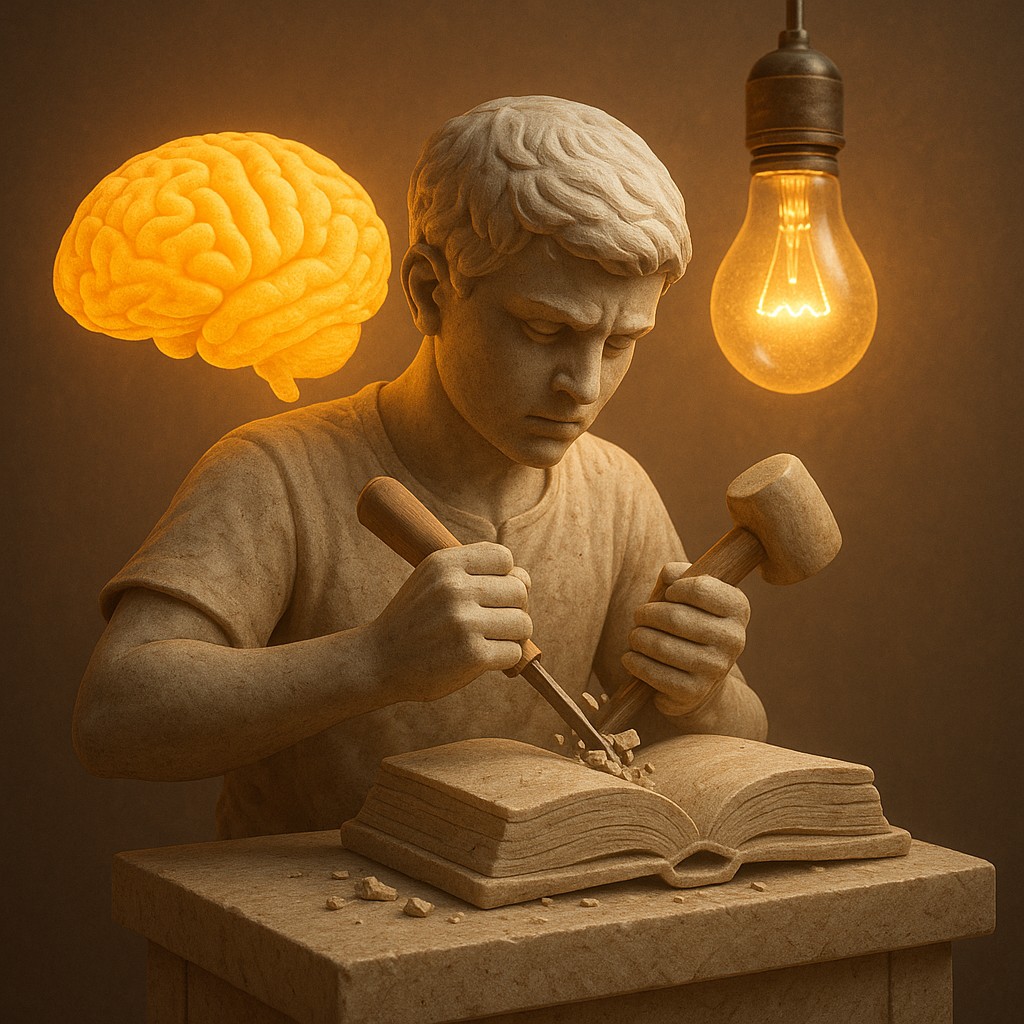
Have you ever spent hours highlighting a textbook until the pages looked like a neon yellow crime scene, only to realize two days later that you couldn't recall a single meaningful fact? It is a frustratingly common experience that makes us feel as if our brains are leaky buckets. We often assume that if we pour enough information into our eyes, some of it will eventually stick to the "walls" of our memory. Unfortunately, the human brain is not a passive sponge; it is more like a stubborn sculptor that only values the statues it carves by hand. This is the central paradox of learning: the harder you work to pull information out of your head, the more likely it is to stay there forever.
This phenomenon is known in cognitive psychology as the Generation Effect. It explains why you can vividly remember the plot of a movie you described to a friend last month, yet you struggle to remember a password you read on a sticky note ten minutes ago. When we simply consume data, our brains treat it as disposable noise. However, the moment we are forced to produce, create, or "generate" that information ourselves, our neural pathways light up like a city skyline. By shifting from a passive consumer to an active creator of knowledge, you can essentially upgrade your brain's operating system and make learning feel less like a chore and more like a craft.
The Mental Carpentry of Memory Construction
To understand why generating information is so much more effective than just reading it, we have to look at how the brain builds a memory. When you read a sentence, your brain is looking at a finished product. It recognizes the words and understands the logic, but it doesn't have to do much heavy lifting because the author has already done the work for you. This creates a "fluency illusion," where you mistake the ease of reading for actually mastering the material. You feel like you know it because the information is right in front of you, but as soon as you close the book, that support vanishes and the knowledge disappears with it.
Generation flips this script by forcing you to become a mental carpenter. When you try to summarize a concept in your own words, your brain has to search through its existing files, find related ideas, and stitch them together into a new, logical structure. This process of searching and stitching creates multiple "retrieval cues," which are mental hooks that help you find information later. Think of it like a spider web: the more silk threads you attach to a central point, the stronger that point becomes. By generating the information yourself, you are weaving those extra threads and making it much easier for your brain to find that specific memory.
This isn't just a theory; it is a well-documented biological reality. Studies have shown that "effortful retrieval," or the act of working hard to remember something, strengthens the synaptic connections between neurons. When you struggle to remember a name or a concept and finally "hit" on it, you are physically thickening the pathway to that information. This is why the struggle itself is actually the most productive part of the learning process. If it feels easy, you probably aren't learning as much as you think. If your brain feels a little tired or "itchy" from the effort of trying to explain something, that is the sound of a permanent memory being forged.
Moving Beyond the Highlighter Trap
For decades, the gold standard of studying was repetition. We were told to read a chapter, reread it, and then perhaps read it one more time for good measure. However, modern science shows that this is one of the least efficient ways to spend your time. Rereading is a passive activity that reinforces the "fluency illusion." You become very good at recognizing the text on the page, but you aren't getting any better at pulling that information out of your own mind. To truly use the Generation Effect, you have to break the habit of passive consumption and replace it with active production.
One of the simplest ways to do this is through the "blank sheet method." After you read an article or listen to a lecture, close your laptop and take out a blank piece of paper. Try to write down everything you can remember without looking at your notes. It will likely feel difficult, and you might only get a few bullet points down at first. That frustration is the Generation Effect in action. By forcing your brain to reconstruct the lecture from scratch, you are signaling to your hippocampus, the brain's memory center, that this information is vital. You are no longer just looking at a map; you are drawing the map yourself.
Another powerful technique is the "Protege Effect," which involves teaching what you have learned to someone else. When you prepare to explain a topic to a friend or even an imaginary audience, your brain automatically starts organizing the information into its most logical and durable form. You begin to look for gaps in your own understanding because you don't want to look foolish when someone asks a question. This internal pressure to be clear and concise acts as a massive catalyst for learning. You aren't just memorizing facts; you are building a narrative, and the human brain is evolved to remember stories far better than isolated data points.
Comparing Passive Consumption and Active Generation
To see the difference in these approaches, it helps to look at them side by side. Most traditional study habits are "passive," while the most effective techniques are "generative."
| Activity Type |
Passive Consumption |
Active Generation |
| Primary Action |
Rereading notes or textbooks |
Testing yourself with flashcards |
| Mental Effort |
Low (feels comfortable and easy) |
High (feels difficult or taxing) |
| Neural Impact |
Weak pathways, relies on recognition |
Strong pathways, creates mental hooks |
| Long-term Retention |
Information fades within days |
Information lasts for weeks or months |
| Common Example |
Highlighting key sentences |
Summarizing a chapter in your own words |
| Typical Outcome |
Familiarity without true mastery |
Deep understanding and ability to apply |
The Dangers of Building on Quicksand
While the Generation Effect is a superpower, it does come with one major warning: you cannot generate something out of nothing. A common pitfall occurs when learners try to jump into "active mode" before they have a basic grasp of the facts. If you try to summarize a complex physics theory before you have learned the basic vocabulary, you are likely to "generate" errors. The brain is so good at remembering what it builds that it will happily remember a mistake just as firmly as a fact. This is why the Generation Effect must be paired with immediate feedback.
Think of it like building a house. Generation is the process of hammering nails and raising walls, but you still need raw lumber to work with. Before you start testing yourself or teaching others, you need an "input" phase to ensure your mental blueprints are accurate. A great way to balance this is the "Read, Recite, Review" method. First, you read a section to gather the facts. Then, you "recite" by generating a summary from memory. Finally, you "review" by checking your summary against the original text to clear up any mistakes.
This feedback loop prevents you from becoming confidently wrong. In a classroom, this is why quizzes are so valuable. They aren't just there for a grade; they force your brain to generate an answer and then immediately show you if that answer was correct. Without that correction, the Generation Effect can actually work against you. But when you combine the effort of creation with a quick accuracy check, you create a "golden loop" of learning that makes information nearly impossible to forget.
Turning Every Day into a Learning Opportunity
You don't have to be a student to benefit from these insights. The Generation Effect can be applied to almost any area of life, from mastering a new hobby to remembering the names of new colleagues. If you are learning to cook, don't just follow a recipe line by line with the book open. Read the recipe, then try to cook the dish, only looking at the book when you are absolutely stuck. By forcing yourself to remember the next step or ingredient, you are training your brain to own the process rather than just borrow it.
In professional environments, this means changing how you handle meetings and presentations. Instead of just nodding along to a slideshow, try to jot down three "takeaway questions" or a two-sentence summary of the meeting's purpose in your own words. When you get home from a conference, instead of filing away the handouts, explain the three most interesting things you heard to a friend or family member. Each time you translate an experience into your own language, you are hitting the "save" button on your memory.
The beauty of this approach is that it actually saves you time. While active generation feels like more work upfront, it removes the need for hours of boring, repetitive review later. You are essentially front-loading the effort. By choosing the "hard" path of mental work today, you are gifting your future self a brain that is sharper, more agile, and packed with useful knowledge. Learning isn't something that happens to you; it is something you do. The more you "build" your mind, the more impressive the architecture becomes.
Now that you have reached the end of this article, don't let the words simply drift away. Take a moment to close your eyes and ask yourself: "How would I explain the Generation Effect to a twelve-year-old?" By answering that question, you aren't just thinking about the concept, you are actively building it into the structure of your own mind. You have the tools to transform your brain from a passive observer into a master builder. Start small, embrace the struggle, and watch as your knowledge finally starts to stick.