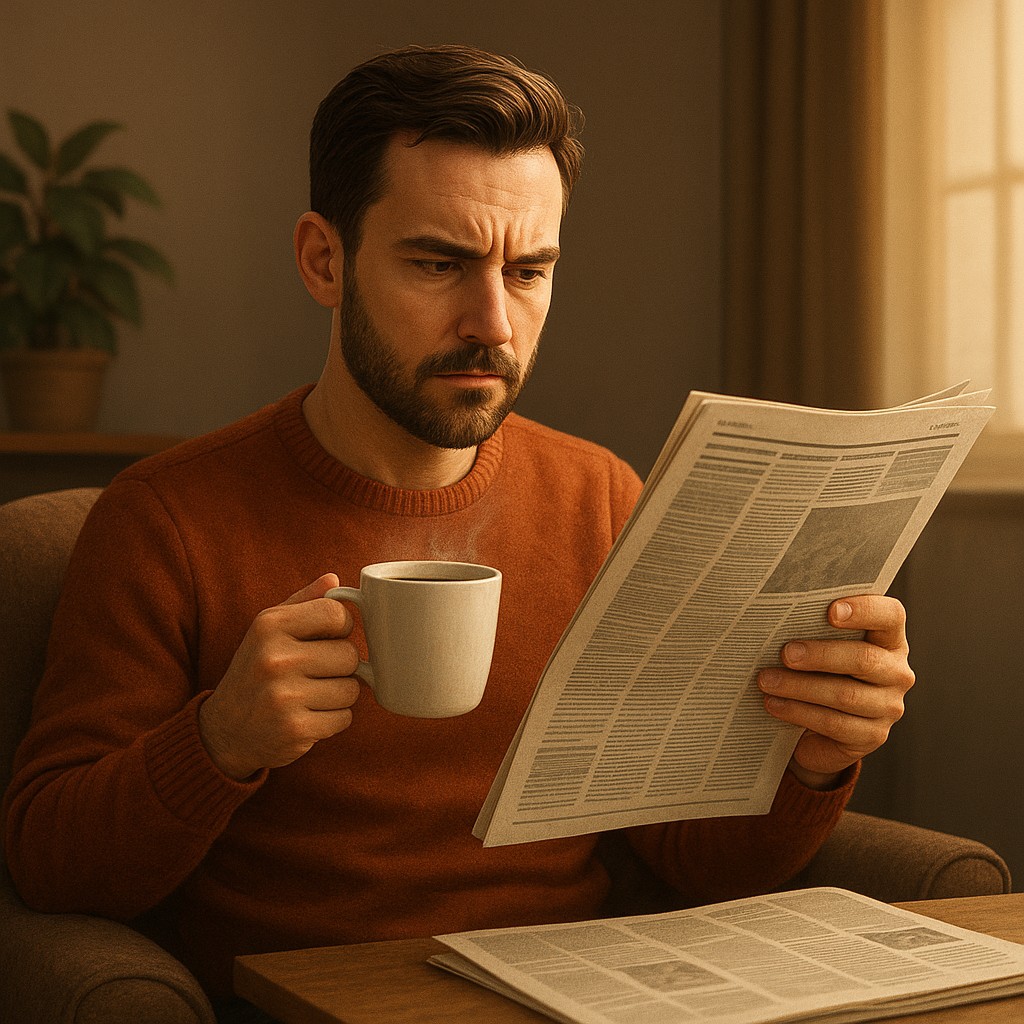
Imagine you are sitting in a comfortable chair, sipping a hot cup of coffee while flipping through the morning news. You stumble upon an article about a topic you know inside out. It might be your own profession, a hobby you have practiced for twenty years, or the neighborhood where you have lived your entire life. As you read, your brow furrows. The journalist has misspelled technical terms, confused the timeline of events, and completely misunderstood the heart of the matter. You put the paper down or close the browser tab, muttering about how the media cannot get anything right these days. It is a moment of total clarity. The curtain is pulled back, revealing the "expert" as a fallible person working against a deadline with only a surface-level understanding of your world.
Then, something remarkable happens. You turn the page or click a different link and find an article about a complex civil war in a country you have never visited, or a deep dive into the global lithium market. Suddenly, your skepticism vanishes. You read every word with rapt attention, nodding at the expert analysis and accepting the statistics as gospel truth. You have completely forgotten that this same publication failed a basic test of accuracy only five minutes ago. This strange mental glitch is not just a personal quirk; it is a documented psychological phenomenon that shapes how we perceive reality and authority today.
The Architect of the Amnesia Concept
This peculiar mental blind spot was first described by the late Michael Crichton, the physician and bestselling author of thrillers like Jurassic Park. Crichton was a polymath who was often frustrated by how the press handled scientific topics. He coined the term "Gell-Mann Amnesia Effect" during a speech in 2002, naming it after his friend Murray Gell-Mann, a Nobel Prize-winning physicist. Crichton’s choice of name was a bit of a joke, but the observation behind it was deadly serious. He noticed that even the most brilliant people seemed to suffer from a specific form of memory loss when moving from one news story to the next.
The core of the effect lies in how our brains categorize information. When we read a story about something we know well, we use "active" knowledge. We compare the text against a sturdy internal framework of facts. However, when we move to a story about a foreign land or a complex economic theory, we lack that internal framework. Instead of staying on guard, our brains default to passive acceptance. We assume that while the local reporter was a bumbling intern, the foreign reporter must be a seasoned veteran with deep knowledge. It is a comforting thought, but it is rarely based on any real evidence of better quality.
Understanding the Mechanics of Misplaced Trust
Why is it so difficult for us to apply a "one strike and you are out" rule to information? In most other parts of life, we are quite good at this. If a restaurant serves you raw chicken, you probably won't order the steak five minutes later, assuming the chef is only bad at poultry. Yet, when it comes to intellectual consumption, we treat news sections as if they exist in entirely different universes. Part of this stems from the "halo effect," a bias where we perceive an institution as competent simply because it looks and sounds professional. The polished layout, the authoritative tone, and the prestige of a famous newspaper act as a mask that hides underlying errors.
Furthermore, we naturally look for stories that help us make sense of a chaotic world. When a journalist provides a neat, simple explanation for a complex event, it satisfies our brain’s craving for order. Admitting that the journalist might be just as confused as we are would mean accepting that the world is messy and unpredictable. It is much easier to believe that someone, somewhere, actually knows what is going on. This creates a loop where we ignore red flags because the alternative, total uncertainty, makes us feel uncomfortable.
Professional Reality vs. Reader Perception
| Aspect of Information |
When You Know the Topic |
When You Don't Know the Topic |
| Fact Checking |
You catch errors in seconds. |
You assume the facts are verified. |
| Logic Gaps |
You notice missing context. |
The story seems logical and complete. |
| Tone |
It sounds simplistic or "dumbed down." |
It sounds authoritative and insightful. |
| Source Trust |
Low (The "they got it wrong" phase). |
High (The "Amnesia" phase). |
| Emotional State |
Frustration or amusement. |
Curiosity and belief. |
How Specialized Knowledge Clouds Our Vision
The Gell-Mann Amnesia Effect is especially powerful in an age where everyone is a specialist. Centuries ago, a well-educated person could reasonably expect to understand a large portion of all human knowledge. Today, knowledge is so vast and fragmented that even experts in the same broad field, such as medicine or engineering, may not understand the details of a different sub-discipline. This creates a world where almost everyone is an expert in one small thing and a layperson in everything else. Consequently, we spend 99 percent of our lives in the "Amnesia zone," consuming information about topics where we lack the tools to spot a lie.
This becomes dangerous when we consider how public policy and social movements are formed. If the public suffers from this amnesia, they may support complex plans based on reporting that is just as flawed as the article they laughed at earlier that day. It is not necessarily that journalists are trying to deceive us. Most of the time, they face the same problem we do: they are generalists tasked with explaining specialized topics on a tight schedule. They rely on "official" sources who may have their own agendas, and they often lack the years of context required to see when a statement is misleading.
Overcoming the Blind Spot Through Consistent Skepticism
How can we protect ourselves from falling into this trap? The goal is not to become a cynical hermit who believes nothing at all. Instead, the goal is to develop a consistent skepticism that applies the same standards to every piece of information, regardless of the topic. If you see a news source make a glaring error in your field, do not just dismiss that one article. Use that error as a data point for the overall reliability of the source. It is a sign that their fact-checking process, their editorial standards, or their choice of experts is broken.
A practical step is to use "triangulation." If you read a story about a foreign conflict, do not rely on a single source. Look for accounts from people with different biases and perspectives. When you see three different sources reporting the same fact from three different angles, your confidence in that fact can reasonably increase. However, if all the sources are simply repeating the same initial press release, the "consensus" is an illusion. By recognizing the Gell-Mann Amnesia Effect, we can train ourselves to pause and ask: "If I were an expert in this topic, what flaws would I be seeing right now?"
From Passive Consumption to Active Analysis
Developing this mental discipline changes the way you interact with the world. You begin to see information as a product created by people with limitations, rather than as a pure stream of objective reality. This shift in perspective is empowering. Instead of being a victim of misinformation, you become an investigator. You start to notice patterns in how stories are framed and how certain "official" voices are prioritized over others. You realize that the professional look of a website or newspaper is a design choice, not a guarantee of truth.
This awareness also encourages intellectual humility. When we realize how easily we are misled by topics we do not understand, we become less likely to hold stubborn opinions. We start to use phrases like "based on what I have read" rather than "this is the way it is." This makes us better at conversation, better at thinking critically, and more responsible as citizens. We stop assuming that a journalist holds a magic key to the truth just because they have a microphone or a column, and we start looking for the evidence ourselves.
As you move forward, carry this awareness with you like a secret weapon. The next time you catch a media outlet fumbling a story you know by heart, do not just scoff and move on. Let that moment of clarity serve as a reminder that the world is far more complex than a headline can capture. Embracing a healthy level of skepticism does not mean living in the dark; it means turning on a brighter light. You have the ability to see past the polished surface and seek a deeper, more honest understanding of the world.