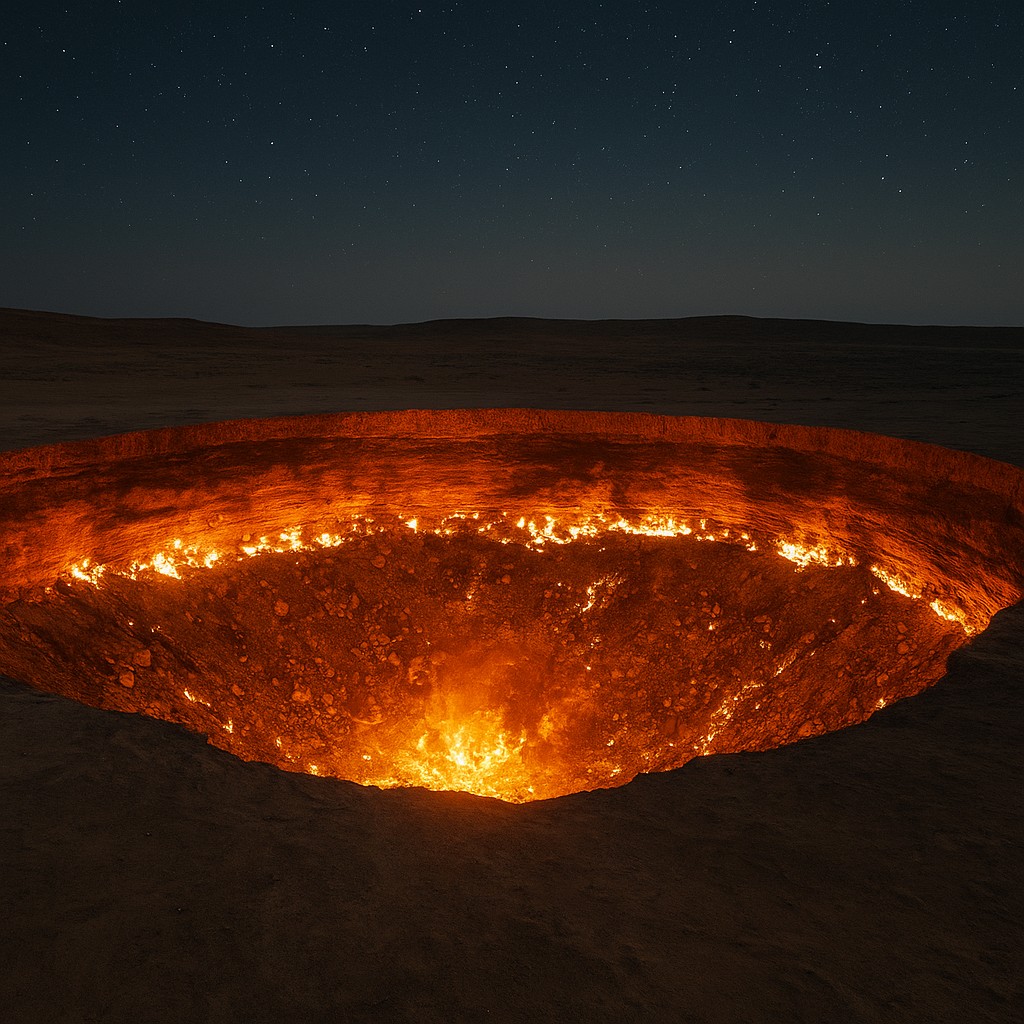
In the heart of Turkmenistan’s Karakum Desert, a vast and brutal stretch of shifting sand, there is a hole in the earth that looks like a gateway to the underworld. This massive, fire-breathing bowl is officially known as the Darvaza gas crater, but it is famous worldwide as the Gates of Hell. Imagine standing on a ridge in the middle of a silent, pitch-black desert night, only to see a glowing orange radiance like a rising sun coming from a pit 60 feet deep and 200 feet wide. It is a hypnotic sight that has fascinated explorers, scientists, and travelers for decades, offering a glimpse of what happens when industrial ambition runs into the unpredictable forces of nature.
Despite its frightening nickname, the crater was not caused by a volcano or a meteor. Instead, it is the result of a terrible industrial accident from the height of the Soviet era. For over 50 years, this giant pit has been burning with thousands of individual flames, fed by a seemingly endless supply of natural gas trapped beneath the desert floor. It is a place where physics, history, and environmental science meet, creating a spectacle that is as beautiful as it is troubling. Understanding how it got there requires looking into the high-stakes world of Soviet energy exploration and the volatile nature of methane gas.
The Day the Desert Swallowed the Drill
The story of the Darvaza crater begins in 1971, when the Soviet Union was aggressively searching for natural resources across its territories. Engineers and geologists arrived in the Karakum Desert convinced they had found a massive oil field. They set up a heavy drilling rig and began boring deep into the earth, unaware they were perched right on top of a huge cavern filled with pressurized natural gas. As the drill poked through the ceiling of this underground pocket, the ground gave way. In a sudden collapse, the entire drilling rig and the camp around it were swallowed into a massive sinkhole.
Surprisingly, no one died in the collapse, but the engineers were left with a major problem. The new crater was leaking huge amounts of methane. In the short term, this was deadly because methane can push out oxygen and suffocate local wildlife or anyone nearby. In the long term, it was a fire risk. To solve this, Soviet scientists decided to use a common industry fix called flaring. They believed that by lighting the gas on fire, they could burn off the fuel in a few weeks. They expected the flames to die out naturally once the gas was gone, making the site safe again. They struck a match, tossed it in, and waited.
They are still waiting. The scientists had badly underestimated the size of the gas reserve hidden under the sand. What they thought would be a few weeks of fire turned into a bonfire lasting generations. The volume of the gas pocket was so large that it has fueled a massive inferno for over half a century. This mistake turned a remote corner of the desert into one of the world's strangest tourist attractions, proving that nature often hides far more than our best tools can detect.
Why the Fire Refuses to Die
To understand why the Gates of Hell keep roaring, we have to look at the chemistry of the Karakum Desert. The region sits on one of the largest natural gas reserves on Earth. Natural gas is mostly methane, a fuel that burns very efficiently. In most places, we pipe this gas into stoves or power plants, but at Darvaza, the earth is essentially leaking its fuel directly into an open-air furnace. The crater acts like a giant burner on a gas stove that has been left on high for 50 years, with the pressure from deep underground acting as a constant pump.
The heat inside is intense enough to melt your footprints if you stand near the edge for too long. Because the crater is so large and the gas seeps out from thousands of tiny cracks in the rock, the fire is spread out. It is not one single torch, but a field of thousands of small fires and several large ones. This makes the fire almost impossible to put out using normal methods. If you tried to douse it with water, you would just create a massive cloud of steam while the gas continued to rise through the wet sand, ready to relight the moment it hit a spark.
| Feature |
Details of the Darvaza Crater |
| Diameter |
About 69 meters (226 feet) |
| Depth |
About 30 meters (98 feet) |
| Primary Fuel |
Methane (Natural Gas) |
| Original Date |
1971 (Approximate) |
| Location |
Karakum Desert, Turkmenistan |
| Temperature |
Can top 1,000 degrees Celsius in certain spots |
The shape of the crater also helps keep it burning. The pit is deep enough to protect the flames from strong desert winds. While a sandstorm might snuff out a few small flames, the core heat is so high that the gas often relights on its own. Furthermore, the porous rock in the area means gas isn't just coming from the bottom, but is bleeding out from the side walls as well. It is a self-sustaining system that has reached a fiery balance with the environment.
The Brave Soul Who Went Inside
For decades, people only looked at the crater from the safety of the rim. However, in 2013, an explorer named George Kourounis decided to find out what was actually happening at the bottom. Sponsored by National Geographic, Kourounis became the first person to descend into the pit. This was no simple hike; he had to wear a custom heat-reflective suit made of Kevlar and aluminum fabric, along with a specialized breathing mask. Even with the best gear, the heat was so punishing that he could only stay down for 15 minutes at a time to keep his equipment from failing.
The mission wasn't just for the thrill. Kourounis went down to collect soil samples to see if any life could survive in such an extreme, hot, and methane-heavy environment. To the surprise of many, the samples contained specialized bacteria thriving in the heat. These "extremophiles" are organisms that have evolved to live in conditions that would kill almost anything else. This discovery was important for scientists who study the possibility of life on other planets, as it shows how life might exist in harsh, chemically volatile places elsewhere in the universe.
Kourounis described the experience as feeling like he was on another planet. He reported that the sound inside the crater is like the roar of a jet engine, a constant hum of rushing gas and crackling fire. The ground was not just hot but unstable, made of crumbly soil that could collapse further at any moment. His successful mission proved that even in the most unwelcoming places on Earth, science can find something new. It also changed the story of the "Gate" from a scary legend into a serious site for geological and biological study.
Correcting the Myths and Legends
Like any famous landmark, the Darvaza crater has its share of myths. One common misunderstanding is that the crater is a natural volcano. As we have seen, it is entirely man-made, or more accurately, triggered by human activity. There is no lava involved; it is strictly a gas fire. Another story is that the Soviet government tried to hide the accident for decades. While the Soviets were not eager to advertise their failures, the crater was never a secret to the local Turkmen people, who have lived near the village of Darvaza for generations.
There is also a persistent idea that the fire is a waste of energy that could power a whole city. While it is true that a huge amount of gas is burning away, capturing it is a logistical nightmare. Because the gas is leaking from a collapsed sinkhole instead of a neat pipe, you cannot simply put a lid on it. The pressure would likely force the gas to find a new way out through the desert floor, potentially creating dozens of smaller fires that would be even harder to manage. The cost of building the equipment to collect gas from a crumbling, burning pit in the middle of a remote desert is often higher than the value of the gas itself.
Finally, there is the myth that the fire will burn forever. In reality, every gas reservoir has a limit. Eventually, the pressure will drop, the fuel will run out, and the Gates of Hell will flicker and die. However, current estimates suggest that "eventually" could be decades or even centuries away. The fire serves as a reminder that our industrial footprint can last much longer than the projects that created them, leaving a glowing scar on the planet that outlives the people who first broke the ground.
The Environmental Dilemma and Future Plans
While the crater is a fascinating sight, it is also a major environmental challenge. Methane is a powerful greenhouse gas, much better at trapping heat in the atmosphere than carbon dioxide. Paradoxically, burning the methane is actually better for the environment than letting it leak out into the air. When methane burns, it turns into carbon dioxide and water vapor. While carbon dioxide still contributes to climate change, it is significantly less damaging than raw methane. This is why the original decision to light the fire ended up being a somewhat responsible choice for the planet, even if it happened by accident.
However, the government of Turkmenistan has expressed concern over the loss of natural resources and the potential health effects on people living nearby. In recent years, there have been official orders to find a way to put out the flames. Scientists have suggested several methods, such as drilling "relief wells" nearby to draw the gas away or filling the entire pit with a special cement or sand mix. So far, these plans have mostly stayed on paper because they are extremely difficult and expensive to carry out.
Recent satellite data suggests that the amount of fire at the site may be decreasing, either due to natural pressure drops or efforts to capture gas from nearby fields. Even so, the crater remains a bright, glowing landmark. For Turkmenistan, the crater is a double-edged sword: it represents wasted resources and ecological damage, but it is also the country's most famous attraction, drawing travelers from all over the world. Balancing the desire to fix the crater with its fame and complexity is a puzzle that remains unsolved.
A Lesson Written in Fire and Sand
The Darvaza gas crater is a powerful symbol of the relationship between humans and the earth's hidden secrets. It reminds us that our actions, even when based on the best science of the time, can have consequences that last for half a century. It is a monument to a mistake, yet it has become a place of profound beauty and scientific value. By studying this flaming pit, we learn about the limits of engineering, the toughness of life in extreme places, and the massive amount of energy hidden beneath our feet.
As you look for your own next discovery, let the Gates of Hell inspire a sense of cautious curiosity. It encourages us to ask deeper questions about how we treat our environment and to respect the forces that lie just beneath the surface. The world is full of such strange places, where the ordinary rules of the landscape seem to have been rewritten by something extraordinary. Whether the fire eventually goes out or burns for another fifty years, it stands as a glowing testament to the unpredictable and endlessly fascinating nature of our planet.