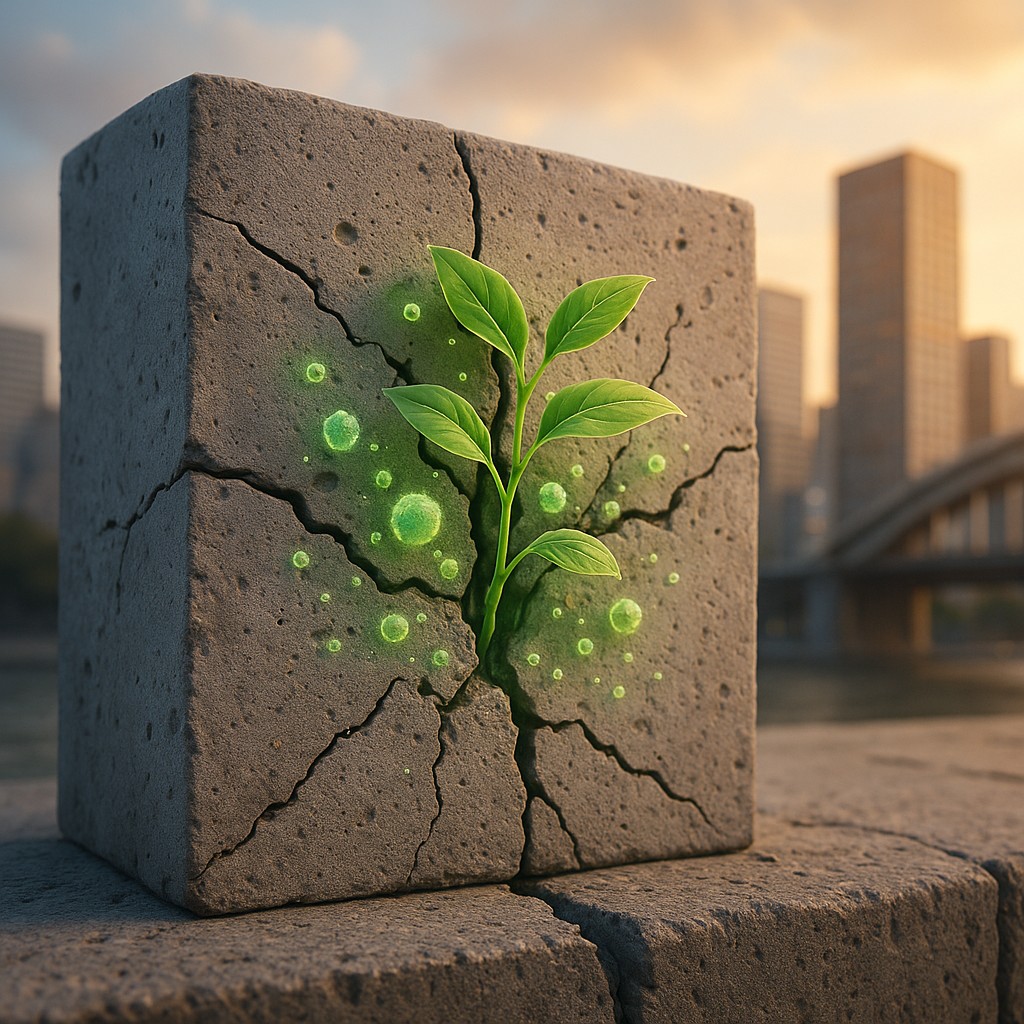
Imagine for a moment that the sprawling concrete jungle we call home is not actually a collection of dead stone and steel, but a sleeping organism waiting for a signal to wake up and fix its own wounds. For centuries, we have viewed the buildings, bridges, and tunnels around us as static objects that inevitably rot and crumble. When concrete cracks, we send in crews with buckets of mortar and high-pressure sealants to patch the damage. It is an expensive and temporary fix. We are fighting a losing battle against physics, because once a structure begins to fail, water and air find their way into its skeleton, triggering a slow-motion collapse that usually ends in a costly demolition.
We are now entering an era where we can "vaccinate" our infrastructure against the passage of time by giving it a biological immune system. By mixing specialized, dormant bacteria directly into the concrete during construction, engineers are creating a material that stays quiet for decades but springs into action the moment a crack forms. This is not science fiction; it is a clever marriage of ancient biology and modern engineering. It turns one of the world's most common building materials into a living, self-maintaining system. This shifts our goal from building things that are merely strong to building things that are resilient, moving us away from a "break and fix" economy toward a future where our structures last.
The Chemistry of Concrete and the Corrosion Clock
To understand why we need living concrete, we first have to look at the tragic flaw of traditional concrete. Concrete is phenomenal at handling heavy loads, which is why it can support the weight of a skyscraper, but it is very brittle and snaps easily under tension. Over time, temperature changes, shifting soil, and heavy traffic cause tiny, microscopic cracks to snake through the material. While a hairline crack might seem harmless on the surface, it acts as a highway for water, salt, and oxygen to reach the heart of the structure: the steel reinforcement bars. Once these steel bars begin to rust, they expand and push against the concrete from the inside. This causes large chunks to flake off, a process engineers call "spalling."
This is the main problem with modern infrastructure. We build for strength, but moisture eventually defeats us. In massive projects like deep-water tunnels or high bridge pillars, checking for these cracks is dangerous and patching them is nearly impossible. If we could seal those tiny fissures as soon as they appear, we could prevent water from ever reaching the steel. This is where the "bio-concrete" vaccine comes in. It transforms a structural weakness into a biological trigger, starting a repair sequence before a human even knows there is a problem.
Meet the Microscopic Maintenance Crew
The secret behind this technology lies in a group of bacteria known as extremophiles. These are the ultimate survivors of the microbial world, capable of living in environments that would kill almost any other life form. Concrete is a harsh, caustic environment with a chemistry similar to bleach, making it a wasteland for most organisms. However, certain bacteria have the remarkable ability to form "endospores," which are essentially armored biological pods. In this dormant state, the bacteria can survive without food or water for up to 200 years, waiting patiently inside the concrete like a tiny biological time capsule.
Engineers do not just throw the bacteria into the mix. They package them inside tiny, degradable capsules along with a specialized food source, usually a calcium-based salt. These capsules serve two purposes: they protect the bacteria from being crushed while the concrete is mixed, and they keep the "food" separate until it is needed. As long as the concrete remains solid, the bacteria sleep. They do not eat or grow, and they do not change the strength of the building. They are a silent insurance policy, waiting for the one thing that signals a need for their services: a breach in the wall.
| Feature |
Standard Concrete |
Self-Healing (Bio) Concrete |
| Primary Material |
Cement, water, and gravel |
Cement, water, gravel, and bio-capsules |
| Maintenance Style |
Reactive (humans fix it later) |
Proactive (repairs itself) |
| Healing Trigger |
External inspection and repair |
Water and air entering a crack |
| Repair Agent |
Synthetic glues or mortar |
Natural limestone made by bacteria |
| Primary Benefit |
Low initial cost |
Longer life and lower long-term costs |
| Steel Protection |
Fails once the surface cracks |
High protection against rust |
The Biological Repair Process
The magic happens the moment a crack forms and reaches one of these buried capsules. As the gap opens, moisture from the air or rain seeps in, bringing fresh oxygen with it. This water dissolves the shell of the capsule, essentially "watering" the sleeping spores. Within hours, the bacteria wake from their century-long nap and start eating the calcium salt provided in the capsule. Through their natural digestive process, the bacteria convert this food into a solid mineral: calcium carbonate, better known as limestone.
This process is called biomineralization. As the bacteria multiply and eat, they produce a steady stream of limestone that fills the empty space in the crack. Because the bacteria are so small, they can reach the deepest parts of the fissure that a human repair crew could never touch. Layer by layer, the limestone builds up until it fills the gap, sealing the crack and making the concrete watertight again. Once the crack is sealed and the water and oxygen are cut off, the bacteria go back to sleep, ready to wake up again if a new crack happens in the same spot.
Biological Limits and the Role of Steel
While the idea of "living buildings" is exciting, it is important to understand what self-healing concrete can and cannot do. It is not a magical glue that can put a collapsed building back together, nor can it replace structural steel. The limestone the bacteria make is excellent for sealing gaps and keeping water out, but it is not strong enough to hold up a ceiling on its own. Their job is "preventative medicine," stopping the rot before it starts by protecting the internal steel skeleton of the building.
There are also limits to how much these microbes can heal. Currently, this technology works best on cracks that are about 0.5 to 1.0 millimeters wide. While that sounds small, those are exactly the types of hairline fractures that lead to major rust problems over time. There is also the issue of cost. Bio-concrete is currently much more expensive to make than standard concrete. However, the goal is not a low starting price, but a lower "lifecycle cost." If a bridge costs 20 percent more to build but lasts twice as long without needing multi-million dollar repairs, the biological option is the smarter financial choice.
Designing for a Resilient Future
Using self-healing concrete represents a major shift in how we think about construction. In the 20th century, we focused on "resistance," building things as thick and heavy as possible to fight the elements. In the 21st century, the focus is shifting toward "resilience," or the ability of a system to recover from stress. By putting a living component into our structures, we are accepting that damage will happen and building the solution directly into the problem. We are moving toward a world where our infrastructure mimics nature, where a bridge heals a crack as easily as a human body heals a papercut.
As we look ahead, the potential uses for this technology are huge. Imagine sidewalks that never grow weeds, basement walls that seal their own leaks during a flood, or sea walls that use the ocean’s own moisture to trigger repairs. This crossover between biology and masonry is just the beginning. By giving our world a bit of biological life, we are not just building smarter; we are building for a future that can take care of itself. We are leaving behind structures that stand the test of time, not because they never broke, but because they never stopped healing.