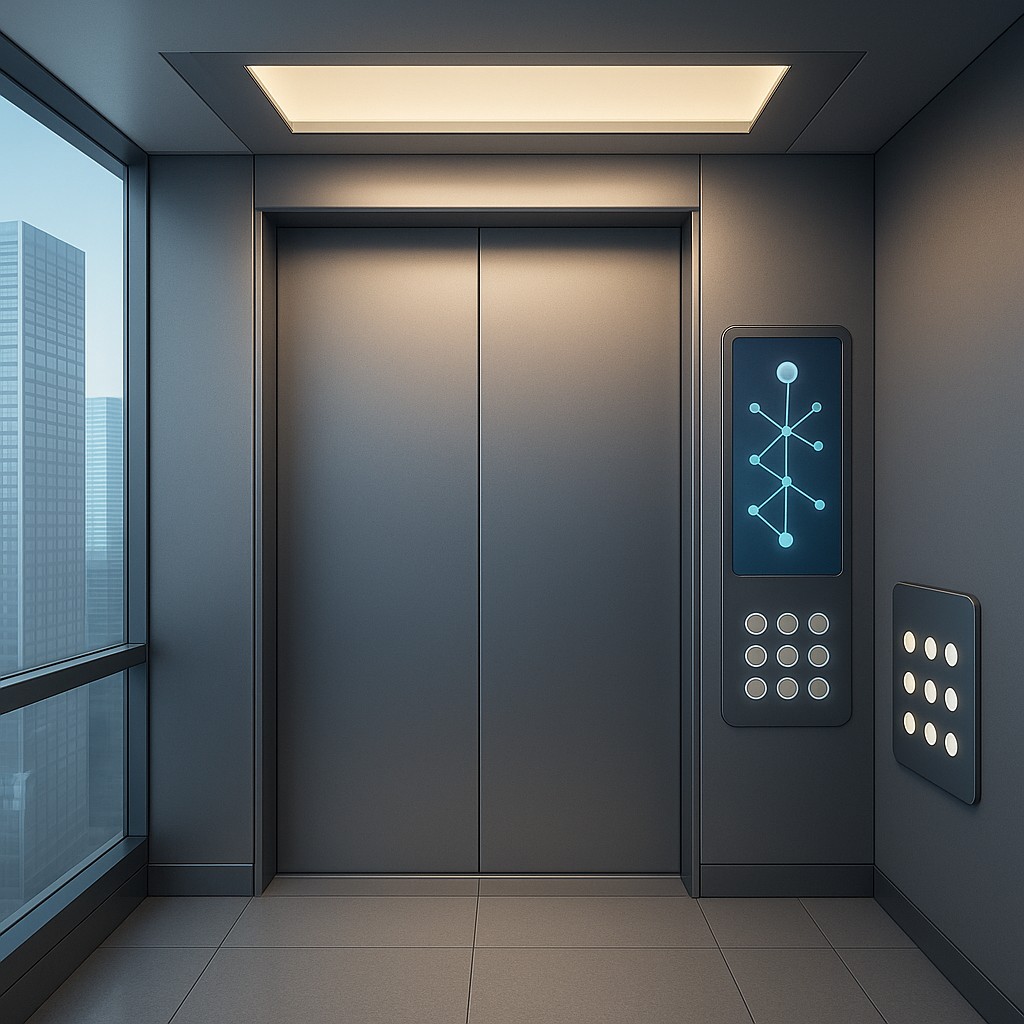
Imagine you are standing in the lobby of a gleaming, eighty-story skyscraper in a major global financial hub. You are slightly late for a meeting on the 54th floor. Your instinct as a modern human is to find an elevator, wait for the chime, step inside, and frantically tap the "5" and "4" buttons until they glow with the promise of moving upward.
But as you step into the car of a cutting-edge building, you find a smooth, blank wall where the buttons used to be. There is no tactile satisfaction of pressing plastic, and no way to select an emergency floor once the doors slide shut. You are essentially a passenger on a vertical train with a pre-set route. If you realize you actually needed the 42nd floor, you are out of luck until the next scheduled stop.
This shift in how we move through the sky is not a cost-cutting measure to save money on plastic buttons, nor is it a prank by minimalist architects. It is a sophisticated use of algorithmic efficiency known as destination dispatch. For decades, the elevator was the last "private taxi" in public transit, where you could call a vehicle and dictate its path in real-time. Today, busy buildings are switching to a "bus" model. A central computer brain groups people together based on their shared destination, ensuring the machine operates with the cold, calculated precision of a logistics network rather than the whims of an individual rider.
The Mathematical Mess of the Traditional Lift
To understand why the buttons disappeared, we first have to look at the massive inefficiency of the old elevator system. In a standard setup, people in the lobby press an "up" button, and whichever car happens to be closest or moving that way stops to pick them up. Once inside, those passengers might select five different floors. This creates a "stop-start" pattern that ruins architectural efficiency. If five people enter an elevator and each wants a floor just ten stories apart, that car essentially becomes a local shuttle. It wastes massive amounts of energy and time by speeding up, slowing down, opening doors, and waiting for slow-moving humans to exit at every single stop.
This legacy system relies on a first-come, first-served logic that falls apart during peak hours, such as the 9:00 AM rush or the lunch hour stampede. When every car stops at every other floor, the entire system bogs down. People on higher floors wait longer for an empty car to arrive, and when one finally shows up, it is often already stuffed to capacity with people who got on at lower levels. Engineers call this "handling capacity," and in the world of high-rise real estate, it is the most important metric there is. If people have to wait five minutes for an elevator, the building is considered a failure, no matter how beautiful the lobby looks.
Traditional elevators also suffer from a lack of data. When you press an "up" button in a 1990s office tower, the system only knows that someone is there and wants to go higher. It has no idea if you are one person or a touring jazz band with twelve members, and it doesn't know if you are going to the second floor or the penthouse. This lack of information makes it impossible for the system to plan. It is reactive rather than proactive, chasing demand across the vertical plane like a dog chasing reflections on a wall. Destination dispatch was designed to fill this information vacuum.
Thinking in Batches Instead of Beats
Destination dispatch flips the script by demanding information from the passenger before the elevator even arrives. Instead of a simple "up" arrow, you are greeted by a touchscreen or a keypad in the lobby. You enter your destination floor, and the system immediately assigns you a specific car, such as "Car B" or "Car 4." By the time you walk over to that door, the system has already placed you into a complex math equation. It has identified four other people also going to floors 50 through 55 and grouped you all together in one car.
This batching process is the secret sauce of modern skyscrapers. By grouping people by their destination, the elevator car becomes an express shuttle. Instead of stopping at the 10th, 12th, 15th, 22nd, and 54th floors, "Car B" might skip everything and go directly to 50, then 54. This reduces what engineers call "intermediary stops," which are the primary killers of efficiency. Fewer stops mean the car returns to the lobby faster, increasing the total number of people the system can move per hour. In many cases, switching to destination dispatch can increase a building's capacity by 30% or more without adding a single new elevator shaft.
This "grouping" logic is remarkably similar to how data is handled in computer networking or how packages are sorted in a shipping hub. If Amazon sent five different trucks to the same street to deliver five different packages, the company would go bankrupt. They group the packages by neighborhood to get the most out of every mile driven. Destination dispatch treats human beings like those packages, sorting us into the most logical containers to ensure the "total system cost," which includes energy and time, is as low as possible.
Comparing the Two Paradigms of Vertical Transit
| Feature |
Traditional Elevator Systems |
Destination Dispatch Systems |
| User Input |
Up/Down arrows in lobby; Floor buttons inside |
Specific floor selection in lobby; No buttons inside |
| Logic Model |
First-Come, First-Served (Reactive) |
Algorithmic Grouping (Proactive) |
| Stop Frequency |
High (Possible stop on every floor) |
Low (Grouped stops in specific zones) |
| Wait Times |
Random and often long during peak hours |
Reduced by up to 50% through better car use |
| Space Efficiency |
Needs more shafts for busy buildings |
Maximizes shaft use; needs fewer elevators |
| User Control |
High (Can change mind or add stops inside) |
Low (Fixed route once inside) |
The Invisible Benefits to Architecture and Environment
The shift to these smarter systems isn't just about getting you to your desk ten seconds faster. It has a huge impact on how buildings are actually constructed. In a massive skyscraper, elevator shafts are like the "dead space" of the floor plan. They take up a huge amount of square footage on every single floor, space that could otherwise be leased to tenants for thousands of dollars. If an architect can use destination dispatch to move the same number of people with six elevators instead of eight, they have just "created" a massive amount of valuable real estate out of thin air.
Furthermore, there is a significant environmental story hidden in the elevator cables. Elevators are one of the largest consumers of electricity in a commercial building. Every time a car starts and stops, it requires a massive surge of power to get moving. By minimizing stops, destination dispatch drastically reduces the wear and tear on mechanical parts and slashes the building's overall energy use. In a world focused on green building certifications and carbon neutrality, the "brain" of the elevator is just as important as the solar panels on the roof or the insulation in the walls.
There is also a social psychology element at play. Have you ever been in an elevator with a stranger who presses the button for the second floor while you are trying to get to the eightieth? There is a subtle, internal spark of annoyance at the "wasted" stop. Destination dispatch eliminates this social friction. By separating riders into zones, the system ensures that people with similar travel needs are grouped together. You are less likely to feel the frustration of a "slow" ride because the system has essentially promised you a semi-express route as soon as you used the lobby kiosk.
Navigating the Tradeoff of Lost Agency
Of course, no technological leap is without its downsides, and the "disappearing button" represents a significant loss of personal control. In a traditional elevator, you are the pilot of your own tiny room. If you realize mid-flight that you forgot your phone in your car, you can simply press the button for the lobby and change direction. In a destination dispatch system, you are a passenger on a scripted journey. Once the doors close, you are at the mercy of the algorithm. If you made a mistake at the kiosk, your only option is to ride to the assigned floor, get out, find another kiosk, and start over.
This loss of control can be jarring. It requires a level of trust in the "machine in the walls" that we aren't always comfortable giving. There is also the "empty stop" problem that occurs when people instinctively follow a crowd into a car they weren't assigned to. Because there are no buttons inside, if you hop into Car C because your friend is in there - but you were supposed to be in Car A - you will find yourself whisked away to whatever floor the algorithm decided for your friend’s group. You become a vertical hitchhiker with no way to tell the driver to pull over.
However, this is a small price to pay for the logistical magic that allows buildings to reach heights of half a mile or more. Without destination dispatch, the world's tallest buildings would be practically unusable, as the bottom third of the building would be nothing but elevator shafts. As buildings become even more "intelligent," these systems will likely connect with our smartphones. Your phone will tell the building you have arrived, the security gate will recognize your face, and your assigned elevator will be waiting for you, already knowing exactly where you need to go before you even think to ask.
Thinking Beyond the Shaft
The evolution of the elevator from a simple pulley system to an algorithmic coordinator is a perfect example of how our world is becoming more "optimized." We are moving away from systems that cater to the individual on demand and toward systems that manage the group for the benefit of everyone. Whether it is ride-sharing apps that group passengers together or smart grids that send electricity to where it is needed most, the logic is the same: information is the ultimate fuel for efficiency.
The next time you walk into a high-rise lobby and find yourself staring at a blank wall where the buttons used to be, take a moment to appreciate the invisible math happening around you. You aren't just taking a ride; you are a data point in a grand, vertical symphony led by a digital conductor. By surrendering a little bit of your personal control, you are contributing to a smoother, faster, and greener way of living in the sky. Embrace the lack of buttons, trust the assignment, and enjoy the express ride to the top.