Imagine you are a master carpenter hired to build a complex cabinet, but there is a catch: you have to work through a thick, fogged-up pane of glass while looking at a blueprint taped to the wall behind you. Every few seconds, you must turn away from your tools to check a measurement, then turn back and try to remember exactly where your chisel needs to go. This constant "context switching" between the work in your hands and the data behind you is more than just tiring; it is a recipe for small, building errors. For decades, this has been the reality of high-stakes surgery. Surgeons have had to balance their physical focus on the patient with their mental focus on 2D monitors across the room showing MRIs or CT scans.
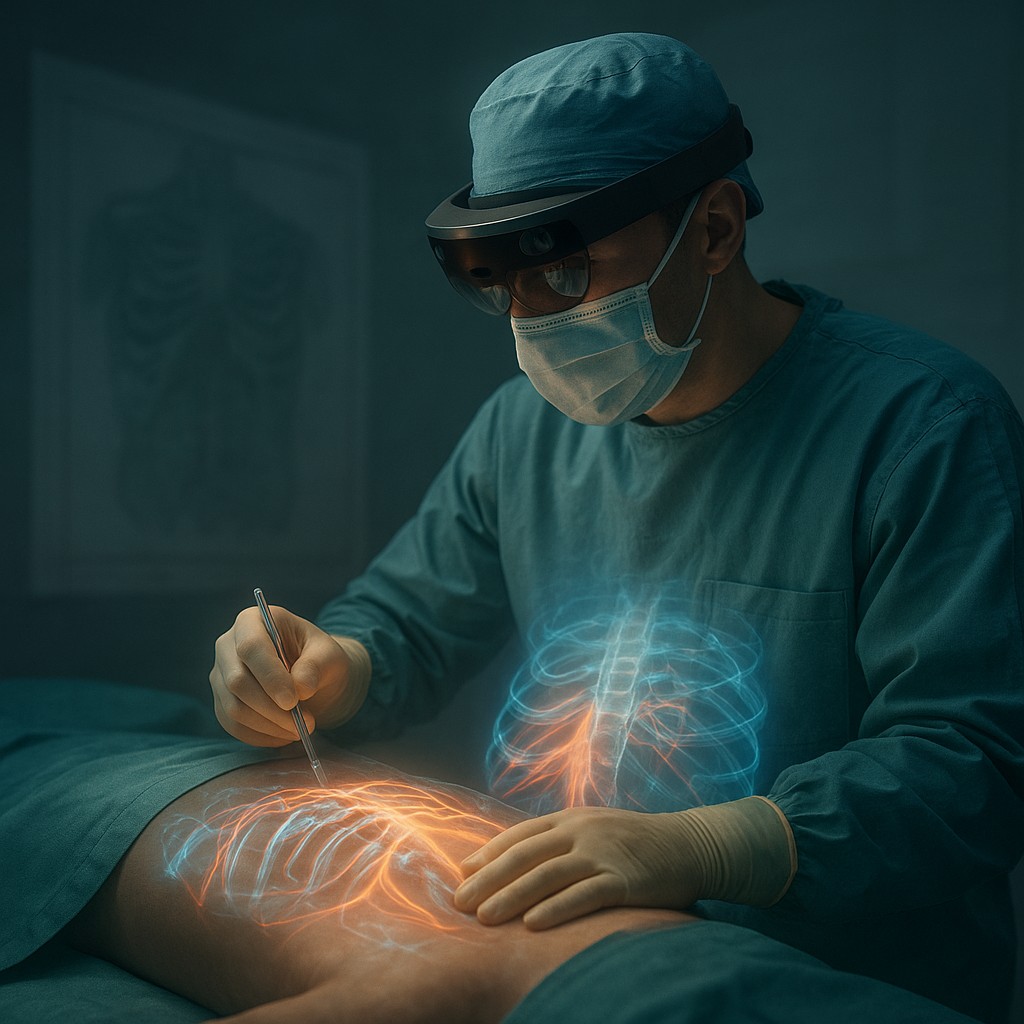
The arrival of Augmented Reality (AR) in the operating room marks the end of this era of divided attention. By using head-mounted displays, such as the HoloLens or specialized surgical visors, doctors are gaining a version of "X-ray vision" that is grounded in reality rather than science fiction. These devices project sharp, three-dimensional digital maps of a patient’s inner anatomy directly onto their body in real time. Instead of looking away at a screen to find a tumor or a hidden artery, the surgeon sees these 3D structures glowing softly beneath the skin, perfectly aligned with the person on the table. It is a shift from translating flat data into a physical space to seeing the data and the space as a single, unified world.
The Cognitive Blueprint of Spatial Mapping
To understand how AR transforms surgery, we first have to look at the "mental rotation" problem that has challenged medical professionals for a century. When a surgeon looks at a traditional CT scan, they are looking at a flat, 2D slice of a person. To use that information, the brain must perform a complex series of steps: it must stack those slices mentally, rotate them to match how the patient is lying on the table, and then guess the depth of structures that are out of sight. This creates a massive "cognitive load," meaning the brain uses so much energy just to visualize the map that it has less energy left for the surgery itself.
AR removes this mental middleman by handling those spatial changes digitally. The software takes the patient's medical images and turns them into a 3D hologram. Using "registration markers," which are basically digital anchors placed on the patient's body, the headset ensures the hologram stays pinned to the right spot. If the patient moves or the surgeon changes their angle, the digital map moves with them. This creates a state of "perceptual fusion," where the digital data feels like a natural part of the physical world. By reducing the mental work required to stay oriented, the surgeon can focus more on the delicate physical work of the procedure.
From 2D Shadows to 3D Landscapes
The difference between a 2D monitor and a 3D AR overlay is like the difference between reading a paper map of a mountain and standing on the peak with a GPS guide. In traditional surgery, depth is often the hardest thing to judge. A 2D screen might show that a tumor is "behind" an artery, but it is hard to tell if it is two millimeters behind it or ten. In the high-stakes environment of the human body, those eight millimeters are the difference between a successful recovery and a life-threatening mistake.
The 3D maps projected by AR displays provide true "binocular" depth perception, much like how our two eyes work together in daily life. Because the headset shows a slightly different image to each eye, the surgeon’s brain perceives the hologram with real volume and distance. This allows for much better hand-eye coordination. When the surgeon moves their scalpel, they can see exactly how close the blade is to the digital "danger zones" shown by the hologram. This spatial awareness is especially helpful in brain and spine operations, where the margin for error is often thinner than a fingernail.
A Comparative Look at Surgical Navigation
While traditional methods have worked well, the leap to AR represents a fundamental change in the "interface" of medicine. To better understand this evolution, we can compare how different eras of technology help a surgeon navigate a complex procedure.
| Feature |
Traditional 2D Monitoring |
Computer-Assisted Navigation |
Augmented Reality Surgery |
| Visual Focus |
Looking away from the patient to a screen. |
Looking at a screen that tracks tool position. |
Looking directly at the patient through a display. |
| Data Format |
Flat, "sliced" images (CT/MRI). |
3D models on a 2D screen. |
3D holograms overlaid on the body. |
| Depth Perception |
Mental estimation required. |
Limited by screen perspective. |
Real-time 3D depth. |
| Mental Effort |
High (must translate 2D to 3D). |
Moderate (requires screen-to-tool coordination). |
Low (visuals match physical reality). |
| Ergonomics |
Frequent neck strain and "monitor fatigue." |
Improved, but still requires looking away. |
Natural posture and continuous line of sight. |
The Mechanics of Digital Registration
You might wonder how the computer knows exactly where to put the hologram. It is one thing to play a mobile game where a digital monster sits on your coffee table; it is quite another to ensure a digital artery is placed exactly over a real one. This process is known as "registration," and it is the technical backbone of AR surgery. The system uses high-tech infrared cameras or sensors to scan the patient's body, matching it against the 1:1 3D model created from their medical scans.
Once the map is aligned, the system must maintain "latency-free tracking." If the surgeon moves their head and the hologram lags behind for even a split second, the illusion is broken and the tool becomes dangerous. Modern surgical AR headsets use powerful built-in processors to refresh the digital overlay dozens of times per second. They also account for "deformation," which is a technical way of saying that human bodies are soft. When a surgeon moves a piece of tissue, the internal parts might shift. Current trials are working on "dynamic registration," which uses AI to predict how internal organs move during surgery, ensuring the 3D map stays accurate even as the physical landscape changes.
Correcting the "Robot Replacement" Myth
A common misunderstanding about high-tech surgery is that the machine is taking over, or that we are moving toward a world where a computer performs the operation while the human just watches. In reality, AR is the opposite of automation. It is a "human-in-the-loop" technology designed to improve human judgment, not replace it. The AR headset does not move the surgeon's hand; it simply gives that hand better information. It is more like the "Head-Up Display" in a fighter jet, which gives the pilot vital data so they can fly the plane with more skill.
By keeping the surgeon in control, AR respects the "physical intuition" that takes decades to develop. A computer might be able to calculate the shortest path to a tumor, but it cannot "feel" the unexpected tension in a patient's tissue or react to a sudden change in blood pressure with the deep experience of a human doctor. AR acknowledges that the human brain is the best decision-making tool we have, as long as we give it the right perspective. It treats the surgeon as a master craftsman and gives them the digital equivalent of a high-powered magnifying glass and a transparent map.
Precision Through Digital Transparency
The goal of this technology is ultimately "minimally invasive" perfection. In the past, to be absolutely sure of what was happening inside a patient, a surgeon might have had to make a large cut to get a clear view. This leads to longer recovery times and a higher risk of infection. AR offers a "digital transparency" that allows for smaller, more targeted entry points. If you can see the vascular map through the skin, you don't need to open the skin as wide to explore.
This precision is life-changing for patients. In complex procedures like reconstructive surgery or "pedicle screw placement" (attaching hardware to the spine), the difference between a perfectly placed implant and one that is slightly off can affect a patient's ability to walk for the rest of their life. AR trials have shown that surgeons using these 3D overlays often finish procedures faster and with fewer "re-treads," which is when a surgeon has to adjust a tool or implant after checking a scan. Speed in the operating room isn't just about saving time; it's about reducing the time a patient is under anesthesia, which makes the surgery much safer.
The Future of the Augmented Operating Room
As we look forward, the use of AR in surgery is likely to become the standard rather than the exception. We are moving toward a "connected surgical ecosystem" where the 3D map isn't just a static image, but a live data feed. Imagine a headset that not only shows where the arteries are but also highlights blood flow intensity in different colors, or uses AI to flag a tiny suspicious cluster of cells that the human eye might miss. We are seeing the birth of a new kind of "super-perception" that blends human experience with digital accuracy.
This technological leap is an invitation to rethink how we interact with information. We are no longer limited by the boundaries of a plastic screen or a printed page. By bringing data into our physical three-dimensional world, we are making it more intuitive, more useful, and ultimately, more human. The surgeons of tomorrow will look back at the "monitor era" with the same curiosity we feel toward the days of medical leeches, wondering how anyone ever managed to work while looking the other way.
The journey into augmented surgery proves our desire to see more clearly and act more precisely. It reminds us that technology is at its best when it doesn't distract us from reality, but rather peels back the layers of the world to show us what was hidden in plain sight. As these tools continue to evolve, they will empower healers to perform wonders with a new sense of confidence, turning the most complex challenges of the human body into a clear, navigable path toward health. You are witnessing the moment when the digital and physical truly become one, all for the sake of a heartbeat.