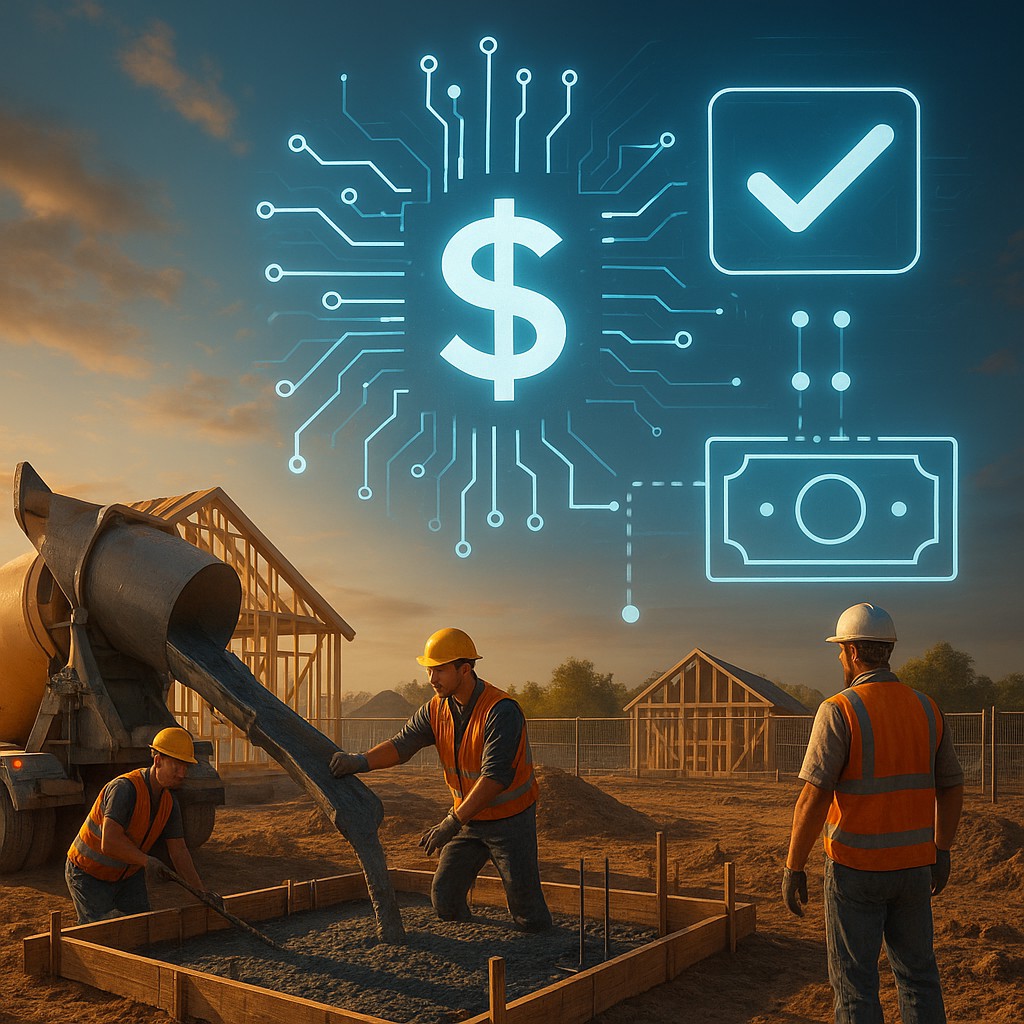
Imagine you are standing at a construction site, watching a crew pour the foundation for your dream home. In the traditional world of finance, paying your contractor is a major headache. You have to deal with manual checks, bank transfers that take three days to "clear," and perhaps an escrow officer - a neutral third party - who charges a steep fee just to confirm the work was actually finished. You are essentially paying people to watch other people work, while your money sits in digital limbo. It is a slow, clunky, and expensive process, largely because our current forms of money are "dumb." They are just static numbers on a screen that do not know where they are going or why they are there until a person or a bank manually pushes a digital button.
Now, imagine if the money itself had a brain. Imagine if the digital dollars in your wallet were aware of their surroundings and could "see" the digital signature of a building inspector. The moment that inspector uploads a verified certificate of completion, the money instantly and automatically leaps from your account into the contractor’s pocket. There is no middleman, no three-day waiting period, and no risk of the contractor vanishing with the funds before the job is done. This is the promise of programmable payments. It represents a massive shift where money evolves from a passive way to store value into an active, self-executing software system. Central banks around the world are currently testing this technology, moving us toward a future where "smart contracts" handle the heavy lifting of our financial lives.
Turning the Monopoly Board into a Living Machine
To understand how this works, we first have to distinguish between "programmable money" and "programmable payments." While they sound the same, the difference is vital for protecting your privacy and freedom. Programmable money refers to a digital currency where a central bank could, in theory, build rules into the coins themselves - such as making them expire if you do not spend them by a certain date. Programmable payments, however, are more like a sophisticated "If-Then" engine that sits on top of the money. It uses smart contracts, which are digital agreements written in computer code, to trigger a payment only when specific real-world conditions are met.
Think of it like a global vending machine. In a vending machine, the "contract" is simple: if you put in $2.00 and press button B4, then the machine releases the chips. You do not need a lawyer to oversee the deal, and you do not need to trust the owner of the machine because the logic is built into the hardware. Programmable payments bring this level of automation to complex, high-stakes deals. By using Central Bank Digital Currencies (CBDCs) as the fuel, these smart contracts can connect with "oracles" - external data sources that provide real-world information - to verify facts before any money changes hands. This creates an environment where the technology ensures honesty, rather than relying on expensive human oversight.
The Invisible Engine of Modern Commerce
The magic of this system is its ability to eliminate the "settlement gap." In our current financial system, when you swipe a credit card, the transaction feels instant. Behind the scenes, however, it can take days for banks to actually move the money and balance their books. This delay creates risk and ties up billions of dollars that could be used more productively elsewhere. Programmable payments solve this through "Atomic Settlement," which is a technical way of saying the exchange of goods and the payment happen at the exact same microsecond. If the conditions of the smart contract are met, the digital ledger updates for both parties instantly.
This has massive implications for global trade. Imagine a shipping container arriving at a port in Rotterdam. Sensors on the container detect that it has been unloaded and that the internal temperature stayed consistent throughout the trip. In a programmable payment system, this data would trigger an immediate payment to the shipping company and the supplier. There are no invoices to send, no manual audits of temperature logs, and no disputes over whether the goods arrived in good condition. The data speaks for itself, and the money responds. This level of efficiency would have been unthinkable twenty years ago, but it is becoming the new standard for digital economies.
Comparing Traditional Payments to Programmable Logic
To see the leap forward, it helps to look at how these two systems compare. While the traditional system relies on people and separate communication channels, the programmable system integrates the "message" and the "money" into one package.
| Feature |
Traditional Bank Transfers |
Programmable CBDC Payments |
| Settlement Speed |
Hours to days (T+2 or T+3) |
Instant (Atomic Settlement) |
| Trust Mechanism |
Middlemen (Banks, Escrows) |
Code-based Smart Contracts |
| Automation |
Basic recurring billing |
Complex "If-Then" logic |
| Cost |
High (Fees for middlemen) |
Low (Automated execution) |
| Data Integration |
Manual document checks |
Automatic via sensors and oracles |
| Availability |
Mostly business hours |
24/7/365 |
As the table shows, this shift is not just about speed; it is about changing the foundation of trust. We are moving from a world where we trust institutions to a world where we trust math. This reduces "friction" in the economy, allowing money to flow as easily as data moves across the internet today.
Navigating the Myths of Control and Privacy
Whenever we talk about central banks and digital code, people naturally worry about government overreach or "social credit" systems. These are valid concerns, and it is important to understand how these systems are actually being designed. Programmable payments are meant to be a tool for efficiency, not a way to control behavior. In a well-designed digital currency framework, the central bank provides the secure tracks, but the "smart logic" is managed by private companies or individuals who write their own contracts. The goal is to automate business, not to stop you from buying a coffee because you skipped the gym.
In fact, many central bank pilots, such as those at the Federal Reserve, are looking for ways to copy the privacy of physical cash in a digital format. They are exploring "zero-knowledge proofs," a security technique that allows a system to prove a transaction is valid without revealing who is involved or what was bought. By separating the technical "if-then" conditions from the user's identity, programmable payments can actually offer more security than our current credit card system, where every purchase leaves a digital footprint that is often sold to advertisers.
Transforming the Mundane into the Extraordinary
The beauty of programmable payments is that they will eventually become so seamless that we will forget they exist. We will simply notice fewer "hiccups" in daily life. Take car insurance as an example. Today, you pay a flat monthly fee based on an estimate of your risk. With programmable payments, your car could talk directly to your insurance provider’s smart contract. If your car is parked safely in a garage, the insurance cost per minute drops to near zero. If you are driving on a dangerous mountain road in a blizzard, the payment logic adjusts in real time. You only pay for the exact risk you are taking, and the payment happens automatically in tiny amounts.
This also makes "micro-payments" possible. If you want to read one article on a news site, you shouldn't have to sign up for a $15 monthly subscription. A programmable system could authorize a payment of five cents the moment you scroll past the first few paragraphs. Because the cost of processing the payment is nearly zero, services can be broken down into smaller, more affordable pieces. This could revolutionize the "creator economy," allowing artists and writers to be paid directly by their audience in real time without a platform taking a 30% cut.
The Future is a Protocol, Not Just a Currency
We are witnessing the "Internet of Value" moment. Just as the early internet turned information into a seamless software system, programmable payments are doing the same for money. We are moving away from the era of "dumb" money that requires constant human intervention. We are moving toward a world where financial systems are as flexible as a spreadsheet. This does not mean we are handing our freedom over to an algorithm; it means we are gaining tools that handle the boring, repetitive, and error-prone parts of finance, leaving us more time to focus on what matters.
The path ahead will require collaboration between tech experts, lawmakers, and the public to ensure these systems are private and open. But the potential is clear. Whether it is ensuring disaster relief funds reach victims the moment a storm hits or helping a small business get paid the second a product leaves the warehouse, programmable payments are the smart upgrade our economy has been waiting for. You are no longer just a participant in a financial system; you are becoming a user of a global, automated, and hyper-efficient operating system. Get ready to watch your money work as hard as you do.