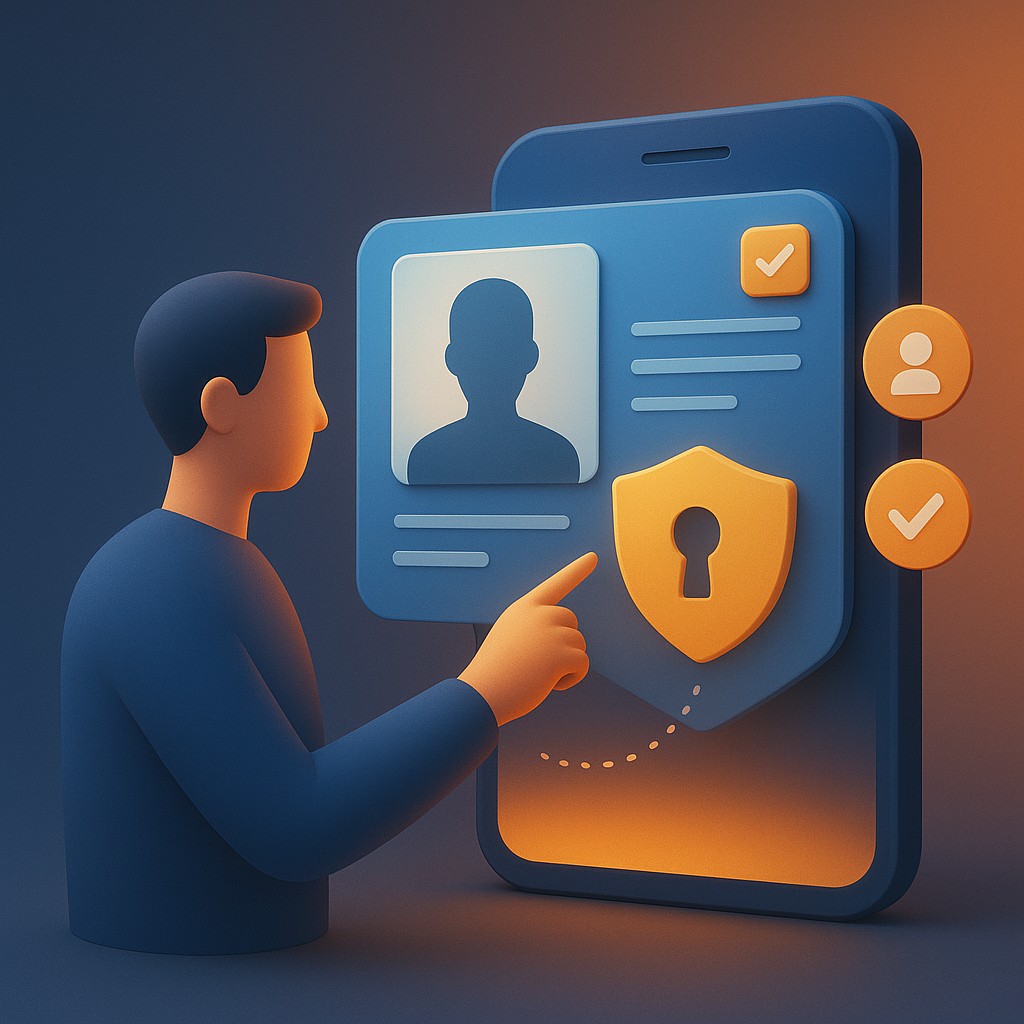
Every time you sign up for a new app or show your driver’s license to get into a club, you are playing a part in a digital tragedy. To prove one tiny fact about yourself, like being over 21 or living in a certain zip code, you are usually forced to hand over a plastic card or a digital file. This reveals your full name, home address, exact birthday, and even whether you are an organ donor. It is like giving a stranger the keys to your entire house just to prove you own a lawnmower. This "all or nothing" approach has created a world where our most sensitive data is scattered across thousands of vulnerable company databases, just waiting for the next big hack.
We are currently standing at the edge of a major shift in how we prove who we are. For decades, we have relied on central authorities to vouch for us. In return, those authorities, and the services they talk to, kept a copy of our personal lives. But a new framework called Decentralized Identity is flipping the script. By combining clever math with distributed ledgers (digital record books shared across a network), we are moving toward a reality where you own your identity. You carry it in a digital wallet and share only what is absolutely necessary. It is a world where "Selective Disclosure" is the gold standard, and your privacy is no longer a bargaining chip you have to trade away for convenience.
The Magic of Saying Less While Proving More
The heart of this revolution is a concept called Selective Disclosure. Traditionally, if a website needed to verify who you were, they would ask for a scan of your passport. Once they have that scan, they know your passport number, your birthplace, and exactly how bad your hair looked five years ago. Selective Disclosure turns a "document" into a collection of individual claims. Think of your identity as a bag of marbles, where each marble represents one specific fact about you. With this new technology, when someone asks for your age, you don't have to hand over the whole bag; you just show them the "Over 18" marble.
This is possible thanks to Verifiable Credentials. These are digital versions of your physical documents, but they are electronically signed by the issuer, such as a government or a university. Because these credentials are built using separate data modules, you can choose to show a "University Degree" to a recruiter without also revealing your student ID number or your graduation date. You are providing digital proof that is just as valid as a physical stamp, but it is surgically precise. It prevents "data bloat," which happens when companies collect more information than they actually need to provide a service.
Solving the Riddle with Zero-Knowledge Proofs
If Selective Disclosure is about choosing which facts to share, Zero-Knowledge Proofs (ZKPs) are the mathematical wizardry that lets you prove a fact is true without sharing the fact itself. This sounds like an impossible riddle. How can I prove to a liquor store that I am over 21 without telling them my birthday? In the physical world, this is nearly impossible. In the world of decentralized identity, it is standard procedure. A ZKP allows one person to convince another that a statement is true without revealing any information other than the fact that it is true.
To visualize this, imagine a secret door in a circular cave that can only be opened with a code. If I want to prove to you that I know the code without actually telling you the numbers, I can let you watch me enter one side of the cave and exit the other. By passing through the "secret" area, I have proven I have the knowledge without ever speaking a single digit of the password. In digital terms, your wallet uses ZKPs to answer questions like, "Does this person earn more than $50,000?" with a simple "Yes" or "No." The bank gets the assurance they need to approve a loan, but they never see your exact salary or your employer's name.
Moving from Central Hubs to Personal Records
The current identity model is "federated," which is a technical way of saying you use a Big Tech company’s login button to access the rest of the internet. While convenient, this creates a single point of failure and allows that company to track every single place you log in. Decentralized Identity (DID) removes the middleman by using a decentralized ledger to act as a source of truth. The ledger doesn't actually store your name or your social security number, that would be a privacy nightmare. Instead, it stores "public keys" and "revocation registries" to check if IDs are still valid.
When a government issues you a digital ID, they sign it and record a cryptographic "fingerprint" on the ledger. When you show that ID to someone else, they check the ledger to see if the signature is valid and hasn't been canceled. The ledger acts like a universal notary that is available 24/7 but doesn't know who you are or what you are doing. This gives you "Self-Sovereign Identity" (SSI), where you are the only holder of your data. If a company you use gets hacked, the hackers find nothing because the company never held your primary data in the first place; they only held a temporary verification.
Comparing Identity Models
To understand why this shift matters, it helps to look at how our relationship with data has evolved. We have moved from physical pockets to corporate servers, and we are now moving toward encrypted personal vaults.
| Feature |
Centralized Identity |
Federated Identity |
Decentralized Identity |
| Data Storage |
Company-owned databases |
Big Tech (Google/Apple) |
Your personal digital wallet |
| User Control |
None; they own the account |
Limited; they can ban you |
Absolute; you own the keys |
| Privacy Level |
Low; data is sold or leaked |
Low; sites track your moves |
High; you share only facts |
| Security Risk |
Huge targets for hackers |
One password unlocks all |
Risk stays on your device |
| Verification |
Manual or paper-based |
Calls to central servers |
Automated ledger checks |
Debunking the Myth of the Unhackable System
Whenever new technology involves cryptography, the word "unhackable" gets thrown around. We should be realistic: while decentralized identity is much more secure than a spreadsheet at a local gym, it isn't magic. The "pipes" that carry the information are incredibly secure because the data is scrambled from end to end. The ledger itself is virtually impossible to change. However, the weak point shifts from the big corporate database to the "edge" of the network, meaning your smartphone or your computer.
If a hacker cannot break into a government database to steal your ID, they will try to trick you into giving up the "key" to your digital wallet. If you lose your private keys or if your phone is infected with malware, a criminal could potentially impersonate you. We are moving from a world where we trust companies to keep our data safe to a world where we must trust ourselves to keep our keys safe. This requires a new kind of "digital hygiene," such as using the built-in security features on phones and staying alert for phishing scams.
The Physical Reality of Digital Credentials
You might wonder how this actually looks in daily life. Imagine you are renting a car. In the old world, you hand over your physical license, the clerk photocopies it, and that copy sits in a filing cabinet or a folder for ten years. In the decentralized world, the car rental app sends a request to your digital wallet. Your phone pops up and says: "Rental Car Co. is asking for proof that you are over 25 and have a valid driver's license. Do you approve?"
You tap "Yes" with your fingerprint. Behind the scenes, your wallet creates a Zero-Knowledge Proof. It doesn't send your license number or your address. It sends a tiny package of encrypted data that says, "I am the holder of a valid license and I am over 25, verified by the DMV." The car rental company gets a green checkmark. They have exactly what they need for insurance, and you have peace of mind knowing your home address isn't sitting on their server waiting to be stolen.
Building Local Trust on a Global Scale
One of the best parts of this technology is that it works across borders without needing a global "master database." Because the verification relies on open standards, a credential issued in one country can be instantly verified in another without those two governments ever having to share a database. This creates a "Web of Trust." It is similar to how the internet allows different networks to talk to each other, but instead of sharing videos, we are sharing trusted facts about our qualifications, our age, and our rights.
This has massive benefits for things like humanitarian aid, where refugees often lose their physical papers. If their credentials are tied to a decentralized ID that they can recover using biometric keys, they can prove their professional licenses or education anywhere in the world. It makes proving who you are more fair. It removes the "gatekeeper" and replaces it with a "protocol" that doesn't care about your nationality, only that the mathematical proof in your hand is valid.
Overcoming the Challenges of Common Use
Despite the benefits, we aren't at the point where you can burn your leather wallet just yet. There are still hurdles. The first is compatibility; for this to work, the DMV, your bank, and your pharmacy all need to agree on the same technical rules. Organizations like the World Wide Web Consortium (W3C) are working on this, but it takes time for big institutions to upgrade their old systems. We also have to consider the "digital divide." People without smartphones or reliable internet could find themselves locked out of a world that relies only on digital proofs.
Furthermore, we have to rethink our laws. If a company doesn't "store" your data but only "verifies" it, how do current privacy laws apply? Regulators are trying to figure out how to govern a system where the data is in the hands of the user rather than the corporation. These are not deal-breaking problems, but they are the natural growing pains of a society that is finally taking personal privacy seriously. As more people demand control over their digital lives, the pressure on institutions to adopt these "privacy by design" systems will grow.
A Future Where You Are More Than Your Data
The arrival of decentralized identity and selective disclosure marks the end of the "Information Age" as we know it and the beginning of the "Identity Age." For too long, we have been treated as data points to be harvested, indexed, and sold. We have been reduced to the sum of our records in other people's computers. By reclaiming the ability to prove who we are on our own terms, we are regaining our digital dignity. We are moving toward a more honest internet, where trust is built on math rather than on blind faith in a giant corporation.
As you navigate this changing world, remember that your identity is your most valuable asset. The technology to protect it is finally here, turning you from a passive participant in the data economy into the ruler of your own digital kingdom. It is a future that feels a bit more human, a bit more secure, and much more private. Embrace the power of choosing what to share, because in a world that wants to know everything about you, there is incredible power in telling them only what they need to know.