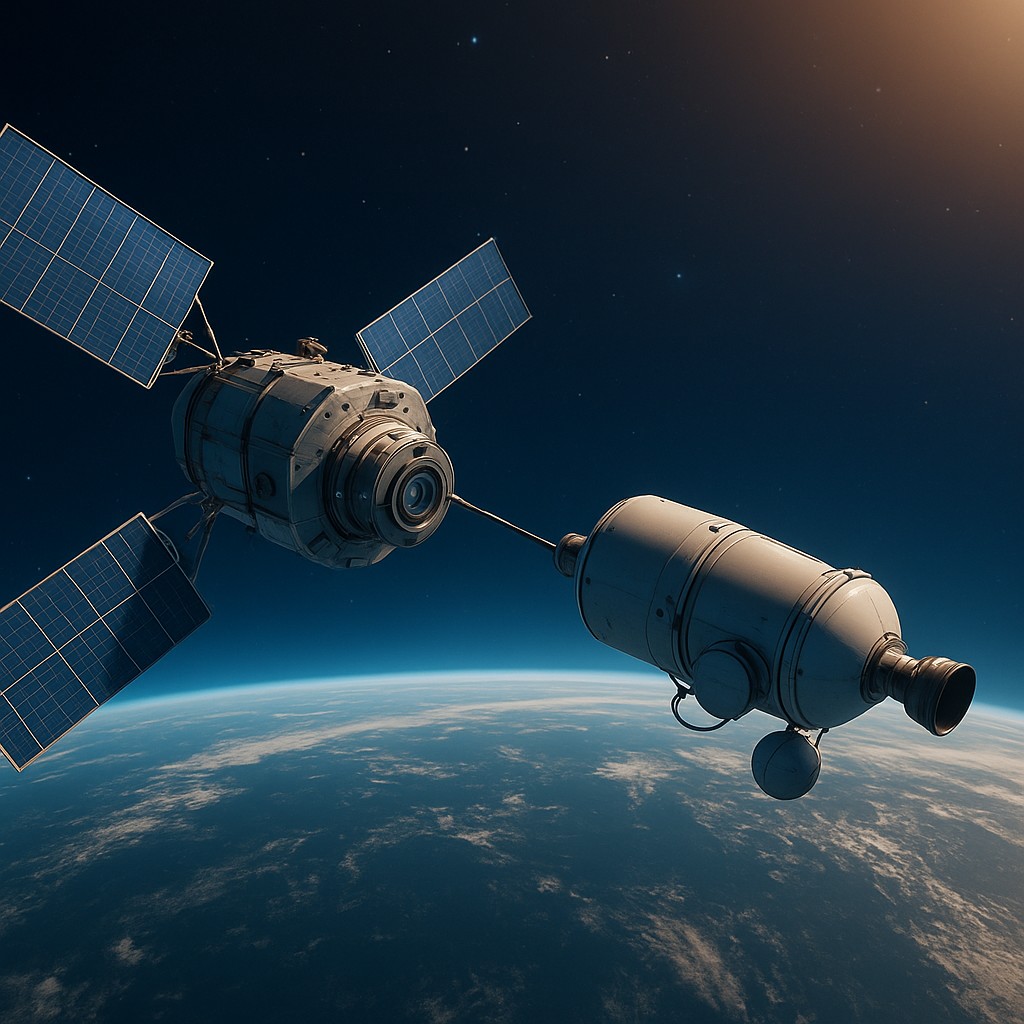
Imagine spending 300 million dollars on a high-performance sports car, driving it for a few years, and then abandoning it on the shoulder of a highway simply because it ran out of gas. In the world of satellite operations, this has not only been a possibility, but the standard way of doing business for more than sixty years. Traditionally, once a satellite uses up its chemical fuel, it can no longer keep its precise orbit or aim its high-gain antennas toward Earth. At that point, even if its cameras, sensors, and transmitters work perfectly, the satellite becomes a multi-million-dollar piece of space junk drifting aimlessly through the void.
We are now seeing a major shift in how we handle these expensive assets. Space agencies and private firms are moving away from the "disposable" era toward an age of orbital maintenance. This change relies on standardized docking ports - small mechanical links that turn a closed system into an open one. By building satellites to be "serviceable," operators are essentially adding a gas cap to a vehicle that used to be welded shut. This evolution promises to thin out the growing cloud of space debris while fundamentally changing the cost of how we communicate, predict the weather, and monitor our planet.
The High-Stakes Physics of Orbital Approach
To understand why refueling a satellite is so difficult, we have to look at the raw physics of space. Satellites in Geostationary Orbit (GEO) move at roughly 7,000 miles per hour, while those in Low Earth Orbit (LEO) race along at 17,000 miles per hour. Refueling requires a "tanker" spacecraft to catch up to a target satellite and match its speed so perfectly that they seem to stand still relative to each other. It is the orbital equivalent of two snipers on separate speeding trains trying to thread a needle through each other's barrels without touching the sides.
The challenge is even greater because space is a vacuum. In our atmosphere, we use air resistance to help stabilize motion, but in space, every push requires an equal counter-push. If a refueling craft bumps into a satellite too hard, it does more than just cause a dent; it can send both vehicles spinning out of control - a dangerous state called "tumbling." To prevent this, tankers use incredibly precise sensors, often involving LIDAR (a laser-based scanning system) and computer vision, to recognize the docking port and guide the ship into place with millimeter precision. Once they lock together, the two separate spacecraft act as one rigid body, allowing the fuel transfer to begin safely.
Anatomy of a Universal Gas Cap
Until recently, every satellite was a unique, custom-built machine with internal plumbing hidden behind layers of thermal blankets and debris shielding. To solve this, the industry is adopting standard interfaces like the Rapidly Attachable Fluid Transfer Interface (RAFTI). Think of this as the USB-C port for the cosmos. With a universal port that every manufacturer agrees to use, a single tanker can service dozens of different satellites from various companies, regardless of who built them.
The mechanics of these ports are engineering marvels. They must stay airtight against the extreme temperature swings of space, which can jump by hundreds of degrees as a satellite moves from shadow into direct sunlight. They also have to prevent "stiction," a strange effect where smooth metal surfaces in a vacuum can spontaneously weld themselves together. These ports use special coatings and multiple valves to ensure that when the tanker let goes, no precious fuel leaks into the void. This move toward standardization is the first step in building a sustainable "space economy" where specialized ships handle tasks like fuel delivery, hardware upgrades, or even orbital towing.
| Feature |
Legacy Satellites |
Modern Serviceable Satellites |
| Fuel Access |
Permanently Sealed / Welded |
Standardized Docking Ports |
| End of Life |
De-orbit or Drift (Junk) |
Refueling and Life Extension |
| Design Focus |
Carry maximum initial fuel |
Modular and accessible |
| Risk Profile |
Single point of failure (fuel) |
Higher initial cost, long-term savings |
| Security |
Low (not designed for contact) |
High (vulnerable to docking) |
Robotic Surgeons of the Void
Once a tanker docks, it does not just pour fuel into the satellite like a watering can. The process is a high-tech surgical procedure performed by robotic arms. One of the early pioneers was NASA's Robotic Refueling Mission (RRM), which proved that a robot could perform delicate repairs on a satellite that was never meant to be serviced. This involved cutting through protective wires, unscrewing caps, and navigating through layers of specialized tape.
Modern refueling tankers are built for much higher efficiency. Instead of "breaking into" a satellite, they use specialized graspers to lock onto the docking port and create a pressurized seal. Then comes the hard part: moving liquids in zero gravity. Without gravity to pull liquid to the bottom of a tank, fuel floats in big blobs or clings to the walls. Engineers solve this using "surface tension devices" or bellows that physically squeeze the fuel from the tanker into the satellite. This ensures a clean, bubble-free transfer so the satellite's engines do not "hiccup" when they fire later.
Saving Money and Cleaning the Skies
The main reason for this technology is, predictably, money. Launching a satellite is incredibly expensive, often costing hundreds of thousands of dollars for every kilogram of weight. A huge part of a satellite's weight at launch is just the fuel it needs to stay in position for 15 years. If a company can launch a lighter, cheaper satellite and top it up every few years, the entire business model of space changes. It turns a massive upfront cost into a more manageable monthly expense.
Beyond the balance sheets, there is a serious environmental need for this tech. Space is getting crowded, especially in Geostationary Orbit, where there are only a limited number of "parking spots" available. When a satellite runs out of fuel and cannot move itself out of the way, it stays in that valuable spot, blocking others from using it. By refueling these machines, we can keep them in their assigned positions longer, reducing the number of new launches and cutting down on the amount of "dead" hardware cluttering our orbital highways. This moves us from a "disposable" culture toward a "circular economy" in space.
The Dark Side of Orbital Proximity
While the benefits of refueling are huge, the technology creates a complex security problem. In international defense, any craft capable of docking with a satellite to refuel it is, by definition, also a potential "anti-satellite weapon." Because this technology has a dual use, a robotic system precise enough to attach a fuel hose is also precise enough to snap off an antenna, cover a camera lens, or push a satellite out of its orbit.
This creates a "neighborhood watch" problem. If a foreign nation launches a "refueling tanker" that starts drifting toward a high-value military satellite, it is hard to tell whether it is a helpful maintenance mission or a hostile act of sabotage. This has led to the rise of "Space Domain Awareness," where countries use radar and telescopes to monitor every movement in orbit. Docking ports make satellites "reachable," and while that is great for maintenance, it also means they are no longer isolated and safe from interference.
A Future of Permanent Infrastructure
We are heading toward a future where satellites are no longer lonely islands in the dark, but points in a busy, living infrastructure network. Imagine "orbital depots" acting like gas stations at the crossroads of different orbits, holding massive reserves of propellants like hydrazine or xenon. Tankers could zip back and forth between these depots and customer satellites, ensuring the tools our digital world relies on never go dark. This is about more than just saving money; it is about shifting our mindset from "exploration" to "habitation."
When you look at the night sky, remember that those tiny points of light moving across the stars are no longer just passive observers. Soon, many of them will be participants in a robotic dance of repair and replenishment. By solving the catch-and-refuel problem, humanity is building the foundation for a permanent, sustainable presence in the vacuum. We are learning that the key to staying in space is not just getting there, but having the foresight to keep the engines running once we arrive.