Imagine for a moment that you are responsible for keeping a giant pot of soup from boiling over. In the world of traditional nuclear energy, this job involves a complex array of electric pumps, backup generators, and human technicians constantly monitoring dials to ensure that water keeps circulating to carry heat away. If the power goes out and the pumps stop, the soup gets too hot. In the nuclear world, that leads to a "meltdown." For decades, we have built bigger and bigger "pots" to maximize efficiency, but this has made the safety systems incredibly complex and expensive, requiring heroic levels of intervention to keep things stable when something goes wrong.
Now, imagine a pot designed so cleverly that it literally cannot boil over, even if you walk away and the power to the kitchen is cut entirely. This is the promise of Small Modular Reactors, or SMRs. Instead of fighting the laws of physics with expensive machinery, these reactors use the fundamental behavior of heat to move fluids automatically. It is a shift from "active" safety, where we must take action to stay safe, to "passive" safety, where the universe does the work for us. As we look toward a future that demands carbon-free energy but remains understandably nervous about radiation risks, understanding this leap in engineering is essential for seeing how our power grids are about to change.
Scaling Down the Giants of Energy
For the better part of a century, nuclear power followed the philosophy that bigger is always better. The massive dome-shaped structures we see on the horizon are usually Gigawatt-scale plants, capable of powering millions of homes but requiring massive footprints and decades of construction. These giants are marvels of engineering, but they are also incredibly rigid. They are difficult to finance, hard to place, and their sheer size means that if a cooling failure occurs, the amount of heat trapped inside is astronomical. This "economy of scale" approach has dominated the industry, but it has also led to the stagnation of nuclear growth in many parts of the world.
Small Modular Reactors flip this script by focusing on an "economy of series." Instead of building a unique, massive cathedral of energy on-site, SMRs are designed to be built in factories and shipped to their destination by truck or rail. "Small" in this context usually means a power output of about 300 Megawatts or less, which is roughly a third of the capacity of a traditional reactor. "Modular" means these units can be plugged together like Legos. If a city grows and needs more power, it can simply add another module rather than building an entirely new plant. This flexibility allows nuclear energy to enter markets it never could before, such as powering remote mining sites and desalination plants, or replacing aging coal plants on existing local grids.
The physical footprint of an SMR is significantly smaller, which changes the social side of energy as much as the physics. Because they are less intimidating and have a smaller "exclusion zone" (the restricted area around the plant) around them, they can be placed closer to the people who actually use the power. However, the real magic of the SMR isn't just its size; being smaller allows for a fundamental change in how the reactor stays cool. By reducing the volume of the nuclear fuel, engineers can design systems that rely on natural forces rather than mechanical ones, a design philosophy known as "walk-away safety."
The Elegance of Moving Heat Without Moving Parts
To understand how an SMR stays cool without electricity, we have to look at a process called natural convection. You have seen this in action if you have ever watched steam rise from a coffee mug or seen "heat waves" shimmering off an asphalt road in the summer. Hot fluids (like water or liquid salts) are less dense than cold fluids, so they naturally rise, while the cooler, heavier fluid sinks to take its place. In a traditional large reactor, the core produces so much heat that natural convection alone isn't enough to keep things from melting; you need high-powered electric pumps to force water through the system at high speeds.
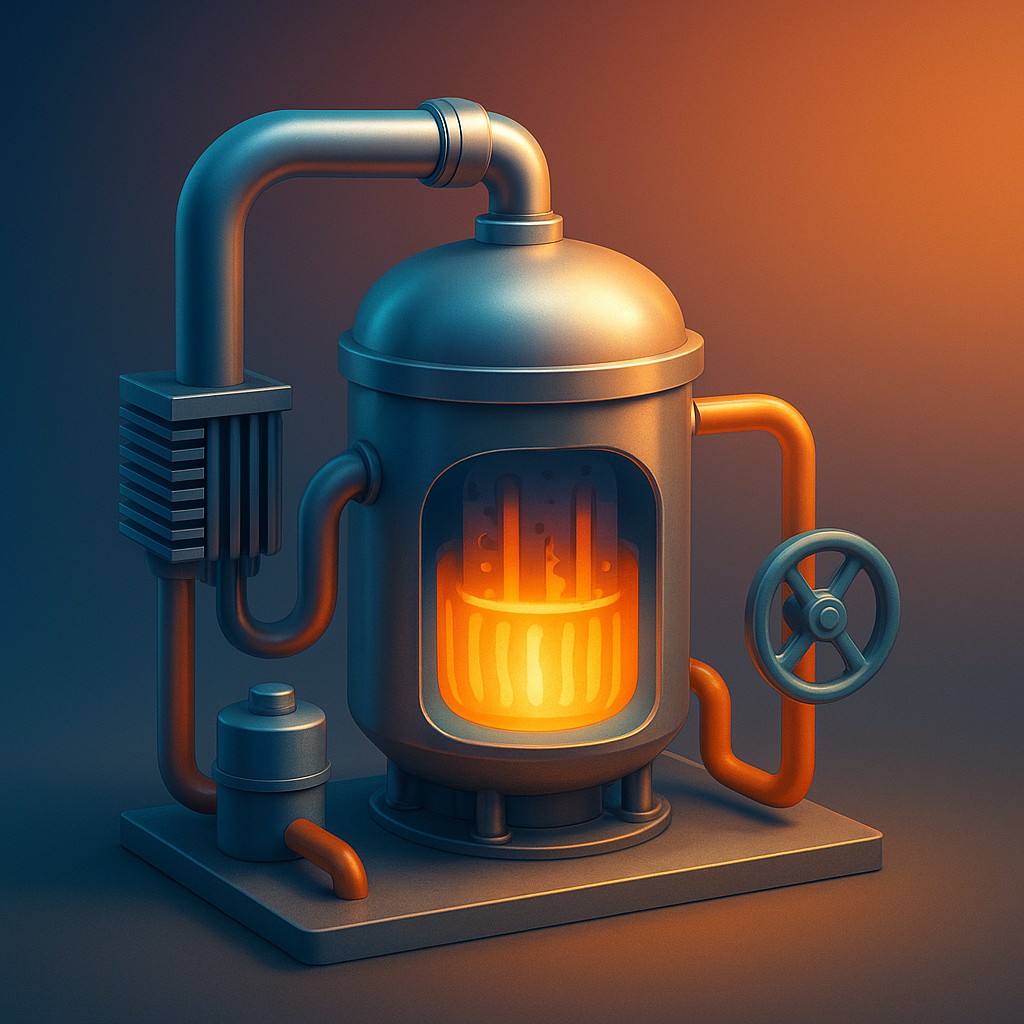
In an SMR, the ratio of the surface area to the volume of the fuel is much more favorable. The reactor is often submerged in a giant pool of water or contains a tall "riser" section. When the nuclear reaction produces heat, the coolant warms up and rises naturally through the core. It then travels to a heat exchanger where it gives up its energy to a secondary loop (which turns a turbine), cools down, and sinks back to the bottom of the reactor vessel to start the trip again. This creates a continuous, circular loop of flowing liquid. Because this happens due to gravity and thermodynamics, it does not require a single volt of electricity to function.
This passive mechanism is a game-changer for emergency scenarios. In a traditional plant, a "Station Blackout" - where all external and backup power is lost - is the ultimate nightmare scenario because the pumps stop. In an SMR, if the power goes out, the natural convection loop simply keeps on spinning. The heat is slowly and steadily pulled away from the core and dissipated into the surrounding environment or a large safety tank. This means that even if the operators are nowhere to be found, the physics of the universe act as a permanent, unbreakable safety switch that prevents the fuel from ever reaching its melting point.
Comparing the Old Guard and the New Wave
When we look at the evolution of nuclear technology, the differences between the massive stations of the 20th century and the modular designs of the 21st century become clear. It is not just about size; it is about the entire philosophy of risk management. While traditional plants focus on "redundancy" (having three pumps in case one breaks), SMRs focus on "inherent safety" (designing the system so it doesn't need a pump at all). This shift reduces the number of things that can go wrong, which in turn reduces the cost of building and maintaining these complex machines.
| Feature |
Traditional Large-Scale Reactors |
Small Modular Reactors (SMRs) |
| Power Output |
1,000 to 1,600 Megawatts |
10 to 300 Megawatts |
| Construction |
Custom built on-site over 10-15 years |
Factory-made and shipped; 3-5 years |
| Cooling Method |
Active (Electric pumps and backups) |
Passive (Natural convection and gravity) |
| Safety Logic |
Multiple mechanical backup systems |
Inherent physical properties of the coolant |
| Grid Integration |
Requires massive, high-voltage grids |
Ideal for local, micro-grid, or industrial use |
| Cost Profile |
Extremely high upfront financial risk |
Lower entry cost; scalable over time |
Despite these advantages, it is important to realize that "smaller" does not mean "perfect." As the table shows, while SMRs solve many of the logistical and safety hurdles of the past, they are still nuclear reactors. They use the same fundamental process of nuclear fission, which leads to the complexities of what happens after the power is generated. The transition to SMRs may change how we build reactors, but it doesn't entirely erase the environmental footprint associated with nuclear fuel and its lifecycle.
Addressing the Persistent Challenge of Waste
A common misconception about SMRs is that because they are "new" and "safe," they must not produce the same radioactive waste that older plants do. This is unfortunately a myth. SMRs still rely on nuclear fuel - usually uranium - and the fission process still results in spent fuel that remains dangerously radioactive for thousands of years. In fact, some critics argue that because SMRs are smaller and less efficient in their fuel burnup compared to massive reactors, they might actually produce more waste for every unit of electricity they generate. While engineers are working on "Generation IV" SMR designs that can recycle fuel, the current reality involves the same long-term storage dilemmas we have faced since the 1950s.
The waste issue is a social and political challenge as much as a technical one. SMRs produce high-level waste that needs to be cooled in "wet storage" pools for several years before being moved to "dry casks" made of concrete and steel. The ultimate goal for any nuclear waste is a deep geological repository - essentially a very deep, stable hole in the ground - but finding communities willing to host these sites remains difficult. Since SMRs are intended to be spread out in more locations, we also have to consider the logistics of transporting radioactive materials more frequently across the country.
Furthermore, we should talk about the "modular" part of the waste cycle. Because these reactors are often built as integrated units, taking them apart at the end of their lives might be simpler. Instead of tearing down a massive, contaminated building, a spent SMR module could potentially be disconnected, sealed, and shipped back to a specialized facility for recycling or disposal. This "cradle-to-grave" factory model could make the management of radioactive materials more controlled and standardized, even if it doesn't eliminate the waste itself. It is a trade-off: we gain immense safety and flexibility, but we must remain committed to the rigorous, long-term responsibility of managing the atomic leftovers.
The Future of the Localized Power Grid
The ultimate impact of SMR technology will likely be felt in how we structure our civilization's energy heartbeat. For the last century, we have relied on a "hub-and-spoke" model, where a few massive power plants send electricity out over hundreds of miles of wires. This system is vulnerable to storms, cyberattacks, and simple aging. SMRs allow us to move toward a "distributed" model. Imagine a future where a medium-sized city has its own SMR tucked away in an industrial park, providing steady, carbon-free "baseload" power (the minimum amount of power needed around the clock) that perfectly complements the variable energy coming from local wind and solar farms.
This localized approach makes the entire grid more resilient. If a major transmission line goes down, the local SMR can keep the city's hospitals, water treatment plants, and homes running. Because of the passive safety features we discussed, the residents of that city can live with the peace of mind that even in a total blackout, the reactor is designed to sit quietly and cool itself down without any human drama. It turns nuclear energy from a distant, intimidating titan into a helpful, local neighbor that works behind the scenes.
As we move forward, the conversation about energy shouldn't be a battle between different technologies, but a symphony of them. SMRs provide the steady, reliable rhythm that allows the "solos" of wind and solar to shine. By embracing the clever physics of natural convection and the logistical common sense of factory manufacturing, we are entering an era where nuclear energy is remarkably more approachable. You now have the knowledge to see past the old stereotypes of nuclear power and understand a future where the laws of physics are the ultimate safety net, ensuring that our lights stay on and our planet stays cool.