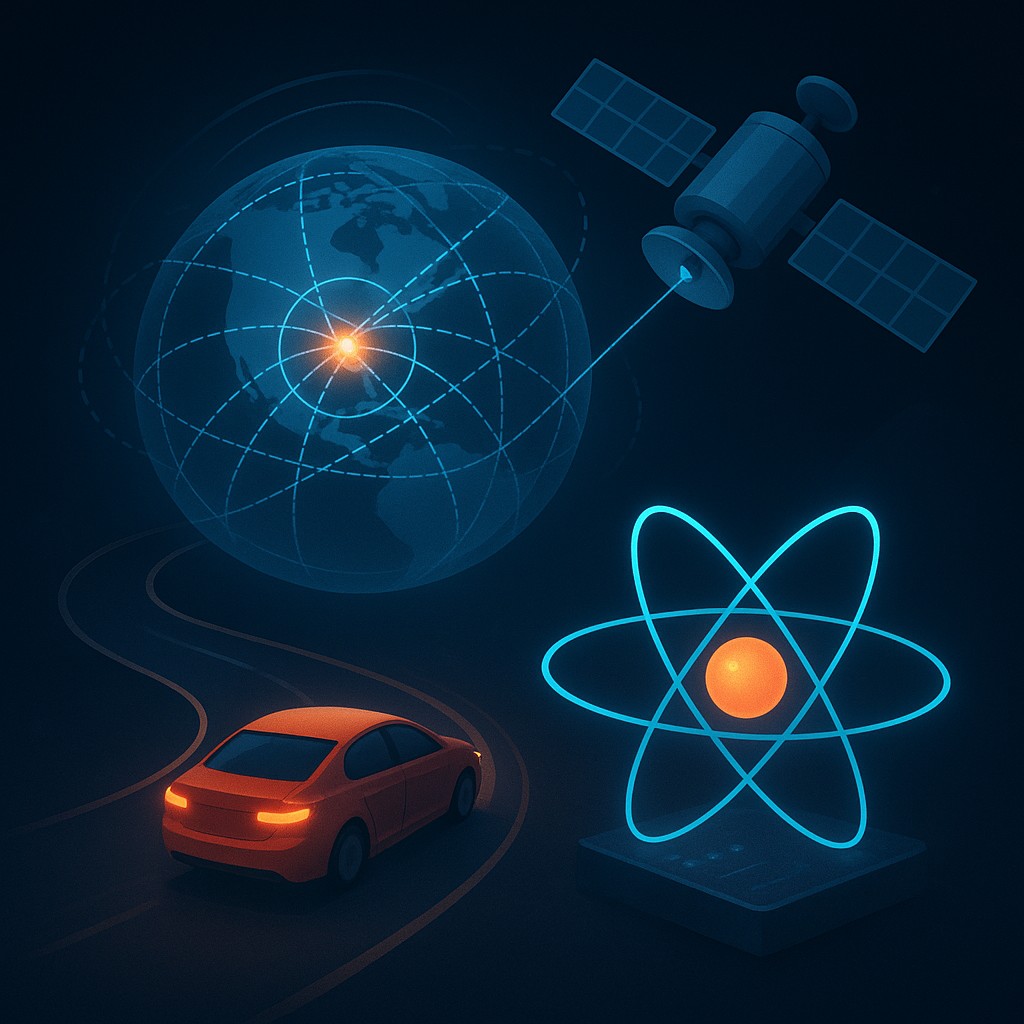
Imagine you are driving through a long mountain tunnel or steering a massive cargo ship through a narrow, fog-heavy fjord. Suddenly, your GPS flashes the dreaded "Signal Lost" warning. For most people, this is just a nuisance. But for a submarine, a freighter full of grain, or an autonomous delivery drone, this digital blindness can lead to disaster. Our modern world depends on a thin, invisible thread of microwave signals beamed from satellites 20,000 kilometers above the Earth. While these satellites are masterpieces of engineering, their signals are incredibly weak. They can be blocked by a few meters of rock or drowned out by cheap electronic jammers.
We have reached a point where simply "looking at the sky" is no longer a reliable way to know where we are. To fix this, scientists are looking inward at the basic building blocks of matter to create a map that doesn't need a signal. By catching atoms in a web of laser light and cooling them until they barely move, they can create a compass so sensitive that it feels the rotation of the planet and the tiniest nudge of movement. This is known as quantum sensing. It works like a high-tech version of "dead reckoning" (calculating your position based on how far you have traveled from a start point), allowing vehicles to navigate in the dark, deep underwater, or underground with incredible precision.
The Fragile Thread of Satellite Navigation
To understand why we need quantum sensors, we have to recognize how fragile our current systems are. The Global Positioning System (GPS) and its international counterparts, like Galileo or GLONASS, are essentially just very accurate clocks in space. Your phone figures out where you are by measuring exactly how long it takes for a time-stamped radio signal to travel from a satellite to your pocket. Because these signals move at the speed of light, even a tiny error of a few billionths of a second can put you on the wrong street. By the time these radio waves reach Earth, they are so faint they are like a whisper in a crowded, noisy room full of atmospheric interference.
This weakness creates what engineers call "GPS-denied environments." If you go deep into a city where skyscrapers block the horizon, or if you dive into an underwater trench, the signal vanishes. Also, because the signal is so weak, it is very easy to jam or "spoof" (sending a fake signal). A small device plugged into a car’s lighter can overwhelm the satellite's whisper with loud noise, making a ship think it is in the desert when it is actually docked at a pier. This vulnerability has started a race to find a "sovereign" form of navigation - one that relies entirely on physics happening inside the vehicle rather than signals coming from the sky.
Turning Atoms into Miniature Plumb Bobs
The solution lies in a field called Inertial Navigation, which is the art of tracking your movement from a known starting point. If you know you started at your front door, walked ten steps north, and turned left for five steps, you can figure out where you are without a map. In the past, we used mechanical gyroscopes - fast-spinning wheels that resist changing direction. Later, we used ring-laser gyroscopes that use light. However, these systems suffer from "drift." Over time, tiny errors in the sensors add up. After a few hours in the dark, a submarine might think it is a kilometer away from its real location.
Quantum sensing fixes this by replacing spinning wheels with individual atoms cooled to near absolute zero (the coldest possible temperature). At these temperatures, atoms stop acting like tiny billiard balls and start acting like waves. Scientists use lasers to slow the atoms down until they are almost perfectly still. When the vehicle moves, these "cold atoms" react to the motion. By using a technique called atom interferometry, we can measure the ripple patterns of these atomic waves. Because these atoms are a constant part of nature, they don't wear out, they don't have friction, and their "drift" is much lower than anything we have ever built before.
Comparing Navigation Technologies
| Feature |
Satellite GPS/GNSS |
Traditional Inertial (IMU) |
Quantum Cold-Atom Sensing |
| Primary Source |
External Satellite Signal |
Mechanical/Optical Sensors |
Atomic Wave Interference |
| Signal Source |
Fragile (Blocked by Earth/Water) |
Internal (Self-Contained) |
Internal (Self-Contained) |
| Long-Term Accuracy |
High (if signal is clear) |
Low (Drifts over time) |
Extremely High (Stable) |
| Susceptibility to Jamming |
Very High |
Zero |
Zero |
| Common Use Case |
Consumer Smartphones |
Short-term backup in planes |
Deep sea, Tunnels, Defense |
How the Quantum Compass Works
The way a quantum sensor "sees" movement is a beautiful application of modern physics. Imagine a cloud of rubidium atoms held inside a vacuum chamber. When specific laser pulses hit the atoms, they enter a state of "superposition," where they essentially travel along two different paths at the same time. This sounds like science fiction, but it is a standard lab procedure. When these two paths are brought back together by another laser pulse, they create an interference pattern - similar to the ripples made when two stones are dropped into a pond.
If the sensor stays perfectly still, the pattern looks one way. If the device moves, rotates, or even tilts slightly because of the gravity of a nearby mountain, the pattern shifts. Because the wavelength of these atoms is so incredibly small, even the tiniest movement causes a huge, measurable change in the pattern. This allows the system to detect changes in speed that are far too small for a human or a traditional mechanical sensor to notice. It is the ultimate "inner ear," providing a sense of balance and movement rooted in the laws of the universe.
From the Lab to the Real World
Until recently, quantum sensors were the size of a large dining table and required a team of experts to keep the lasers aligned. They were lab curiosities because the vacuum systems and cooling lasers were too fragile for the vibrations of a moving truck or a rocking ship. However, a major shift is happening. Engineering firms and universities are now "ruggedizing" these systems - making them tough enough for real-world use. Recent sea trials by the Royal Navy and defense agencies have successfully tested "quantum boxes" that can survive salt air and the constant motion of the ocean.
We are moving from "Big Physics" to integrated technology. Portable cold-atom clocks and sensors are being fitted into shipping containers and specialized planes. You won't find a quantum sensor in your phone next year because of the power and size they require, but they are becoming the invisible backbone of vital infrastructure. Logistics companies are very interested because a ship that can navigate without GPS is a ship that cannot be hijacked by electronic spoofing. This provides a "Ground Truth" that cannot be jammed, ensuring the global supply chain keeps moving even if satellites fail or solar flares knock out electronics in orbit.
Navigating the Dark Without a Clock
This technology does have some limits. While quantum sensors are incredible at telling you where you have gone, they don't necessarily provide the "universal time" that GPS satellites offer. GPS is essentially the world's master clock; everything from the power grid to the stock market relies on those time-stamps to stay in sync. A quantum sensor is a master of space, but it still needs a separate way to track time to fully replace a satellite.
There is also the challenge of the "starting point." Since quantum navigation is a form of dead reckoning, you must tell the device exactly where it is before it starts its journey. If you give it the wrong starting coordinates, it will perfectly track your movement from the wrong starting line. Because of this, many engineers see the future as a "hybrid" model. Your vehicle will use GPS when it is available to keep its clock in sync and its starting point fresh. But the moment the signal drops, the quantum sensor takes over, acting as a perfect memory of every turn, bump, and acceleration the vehicle has felt since it last saw the sky.
The Future of Independent Positioning
The impact of this shift goes far beyond avoiding a wrong turn. As we move toward a world of autonomous machines - from self-driving trucks to underwater drones - we are trusting our safety to computers that must know their location with absolute certainty. A robotic submarine mapping the ocean floor cannot "phone home" for a GPS link; it must rely on its internal quantum sense to find its way back to its ship. In this sense, quantum sensing represents a new era of "sovereign positioning," where a machine’s intelligence is finally matched by a physical, internal sense of place.
We are watching the birth of a technology that makes the world more resilient. By using the strange, wave-like properties of atoms, we are building a foundation for navigation that doesn't care about signals, satellites, or electronic interference. It is a reminder that sometimes, the best way to understand our place in the vast world is to look at the tiniest particles at the heart of matter. As these devices get smaller and tougher, they will quietly ensure that no matter how deep the tunnel or how thick the fog, we will always know exactly where we are.