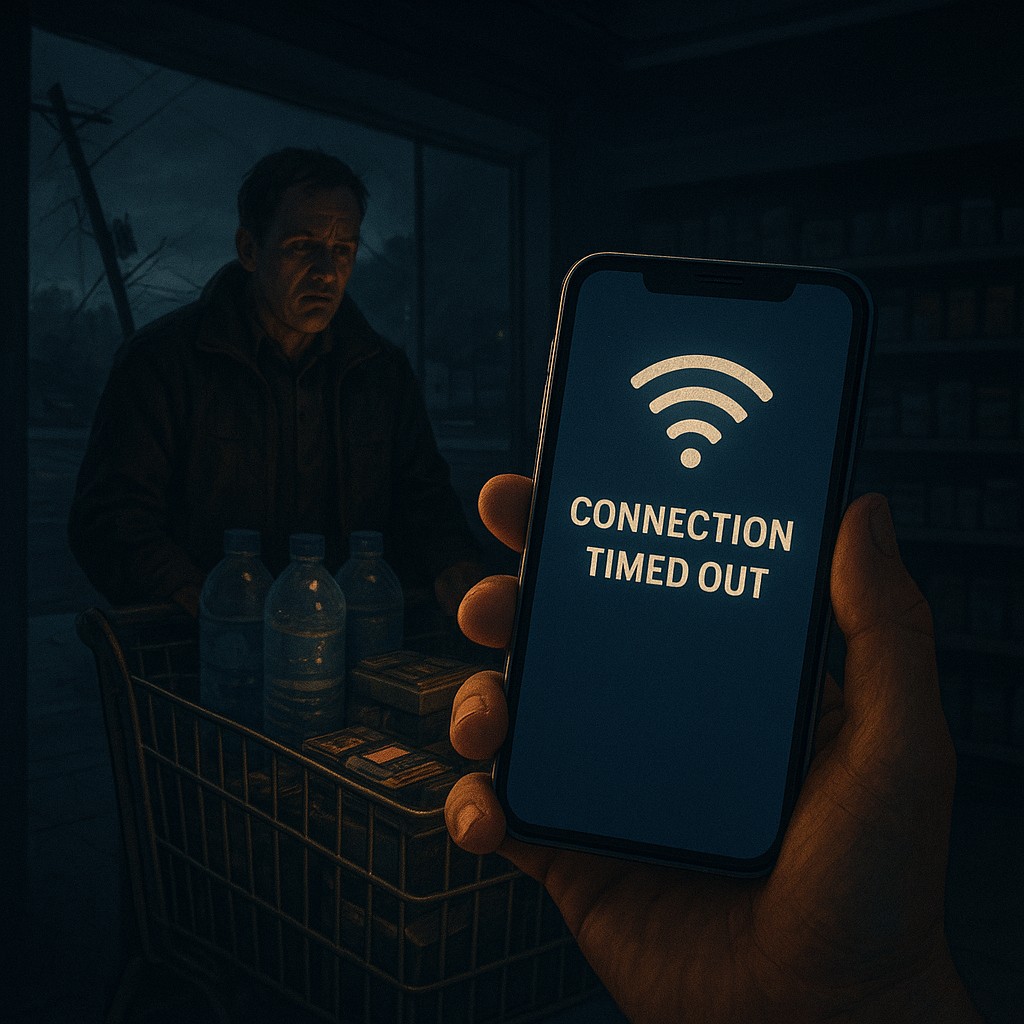
Imagine standing in a checkout line after a massive storm has knocked out the local power grid and cell towers. You have a cart full of bottled water and batteries, but when you go to tap your phone or swipe your card, the screen remains frozen. In our increasingly digital world, a "connection timed out" message is more than just an annoyance; it is a total systemic failure. We have spent decades moving away from the reliable feel of paper bills toward the convenience of pixels, yet we have inadvertently traded away the one thing cash never needed: a constant conversation with a satellite.
To fix this, central banks around the world are currently engineering a new type of money that aims to combine the speed of a digital transfer with the rugged independence of a twenty-dollar bill. This is the world of Central Bank Digital Currencies, or CBDCs, specifically designed with offline capabilities. By embedding the "permission" to spend money directly into your device's hardware rather than a distant server, these systems allow money to move from person to person even when the rest of the world is literally in the dark. It is a fascinating blend of high-tech security and old-school portability that is fundamentally changing how we define a "digital dollar."
The Digital Vault in Your Pocket
How do you spend money that doesn't exist in physical form if you can't talk to the bank? Usually, when you buy a coffee with a credit card, the merchant's terminal sends a message to your bank asking, "Does this person actually have five dollars?" The bank checks its records, says "yes," and the transaction goes through. In an offline CBDC scenario, that check happens locally. This is made possible through a piece of technology called a Secure Element. Think of a Secure Element as a tiny, tamper-proof safe hidden inside your smartphone or on a specialized smart card. This safe is designed so that even the phone's owner cannot "break in" to change the numbers inside.
When you receive your digital currency from the central bank, a portion of it is moved into this secure hardware "vault." When you go to pay for those storm supplies during an outage, your phone communicates directly with the merchant's device via Bluetooth or Near Field Communication (NFC), a short-range wireless link. The Secure Element on your phone subtracts the amount from your balance and digitally signs a "proof of payment," which the merchant's device accepts as valid. Because the hardware is trusted by the central bank, the merchant knows the money is real without needing to call the home office to verify it. It is as if the central bank has given you its official stamp of approval to carry around in your pocket.
Balancing Privacy and the Watchful Eye
One of the most spirited debates surrounding these new digital currencies involves the tension between anonymity and transparency. Physical cash is the ultimate privacy tool; if you give a friend five dollars for lunch, no government agency or tech corporation knows about the exchange. Most digital payments today, however, leave a massive trail of data for advertisers and banks to follow. CBDCs are trying to find a middle ground. While governments want to prevent money laundering and illegal activity, they also recognize that for a digital currency to be widely accepted, people need to feel they aren't being tracked during every everyday purchase.
Offline payments offer a unique solution to this privacy puzzle. Because the transaction happens between two devices without an immediate trip to a central server, it mimics the private nature of cash. However, to keep regulators happy, many of these systems use "tiered" privacy. This means small, daily transactions, like buying a sandwich or a bus ticket, can stay private and offline. On the other hand, if someone tried to move a million dollars offline, the system would likely hit a limit or require a check-in over the internet. This tiered approach attempts to satisfy the human desire for privacy while maintaining the safety rails necessary for a national economy.
The Double-Spending Dilemma
Every digital system faces a fundamental problem: the "double-spend." In the physical world, if you give someone a gold coin, you no longer have it. In the digital world, data is easily copied. If you have a digital file representing ten dollars, what is to stop you from sending that same file to two different people at the exact same time before the bank catches you? In a connected world, the central bank’s records update instantly to prevent this. In the offline world, where there is no central record to check, the challenge becomes much more difficult.
To combat this, engineers use a combination of hardware limits and periodic updates. The Secure Element mentioned earlier is programmed with "read-only" logic; once it sends a unit of currency, it mathematically destroys its own record of that unit. Furthermore, these offline features are often restricted by "transaction limits" and "sync" requirements. You might be allowed to spend up to two hundred dollars offline, but once you reach that limit, the device will insist on connecting to the internet to report its activity and "refill" its offline spending capacity. This ensures that even if a sophisticated hacker managed to bypass the hardware security, the total damage they could do is capped at a few hundred dollars.
Comparing Traditional Payments and Offline CBDCs
To understand where this new technology fits into our lives, it helps to see it alongside the tools we already use. We are currently living in a hybrid era where we use three very different types of payment.
| Feature |
Physical Cash |
Current Credit/Debit Cards |
Offline-Capable CBDC |
| Internet Dependency |
None |
Total (usually requires 24/7 connection) |
Minimal (periodic sync only) |
| Transaction Speed |
Slow (counting bills and change) |
Instant (when online) |
Instant (via NFC/Bluetooth) |
| Privacy Level |
High (fully anonymous) |
Low (tracked by private banks) |
Medium (private for small amounts) |
| Disaster Resilience |
High (works during blackouts) |
Zero (fails without power or net) |
High (works during blackouts) |
| Storage Risk |
High (can be physically stolen) |
Low (protected by fraud laws) |
Medium (stored on device hardware) |
The Road Toward Financial Resilience
The move toward offline digital currency is not just about making shopping easier; it is about national security and including everyone in the economy. In many parts of the world, internet access is not a guarantee. If a country moves entirely to a digital economy without an offline backup, it effectively bars its most vulnerable citizens from participating in society whenever a cell tower goes down or a provider fails. By building these "cash-like" features into the very code of national currencies, governments are ensuring that the economy can keep breathing even when the digital heart of the nation skips a beat.
As we look toward the future, the success of these trials will depend on trust. People must trust that the hardware in their phones is secure, that the government isn't overreaching into their private lives, and that the "digital coins" in their pockets are just as good as the paper ones they replaced. It is a bold experiment in redesigning the very concept of money for an era that demands both high-tech efficiency and low-tech reliability. We are witnessing the birth of a system that honors the age-old freedom of cash while embracing the possibilities of the digital age.
The next time you tap your phone to pay for something, take a moment to imagine the invisible dance of security happening beneath the glass screen. We are moving toward a world where the "cloud" is no longer the only place where our money lives. Instead, we are reclaiming a bit of that old-fashioned independence, carrying our wealth with us in a way that is modern, private, and stubbornly resilient. It is a quiet revolution, but one that ensures the world keeps spinning even when the lights go out.