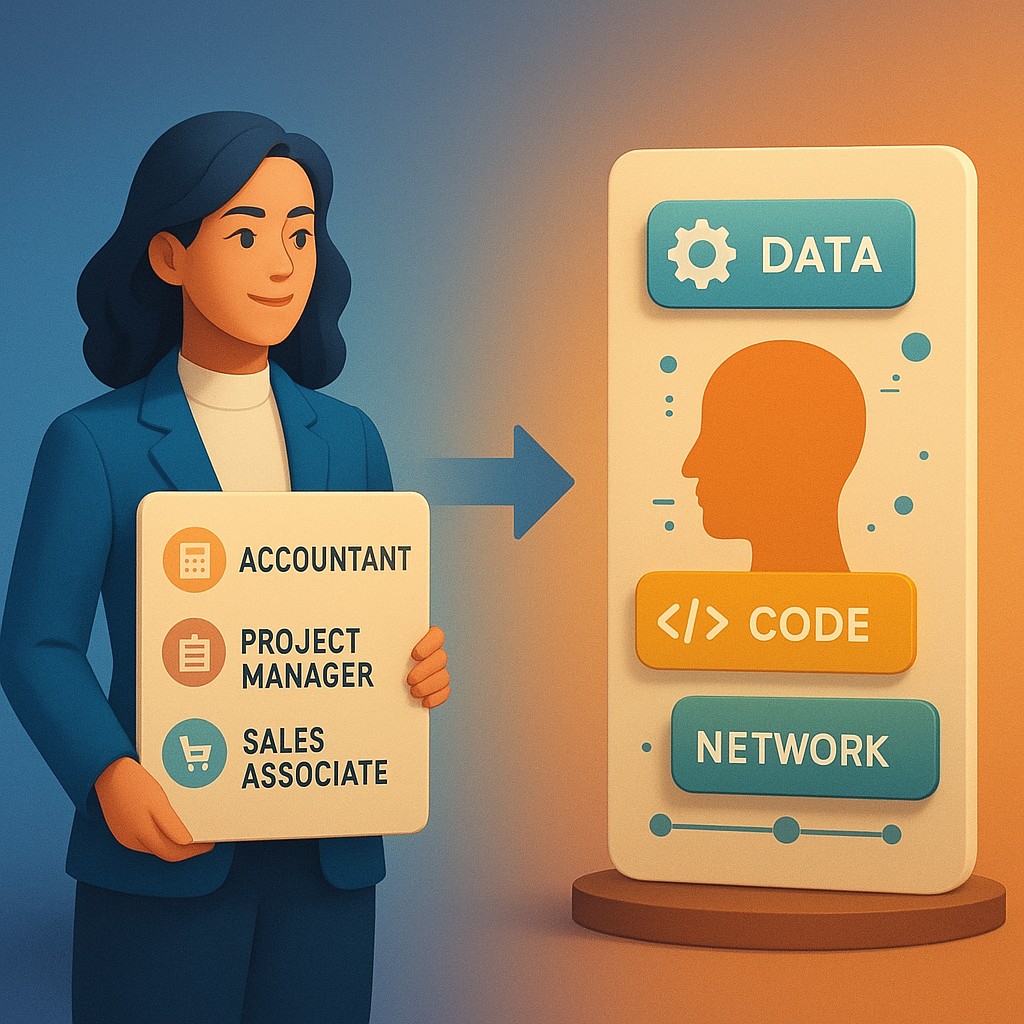
For decades, the standard way to start a new career has been the job title. We have been trained to believe that our professional identity is defined by a single, static noun: "Accountant," "Project Manager," or "Sales Associate." This system worked well enough when industries were isolated and career paths followed a straight line, but it has always had a major flaw. it assumes that a title perfectly describes everything a person can actually do. In reality, job titles are often empty shells, inflated by corporate ego at some companies and shrunk by budget cuts at others. A "Customer Success Lead" at a startup might actually spend their day doing advanced data analysis, while a "Data Scientist" at an old-school corporation might be stuck typing data into spreadsheets.
As technology changes faster than ever, the old language of hiring is failing. Recruiters no longer care only about the seats you have sat in; they are looking for the underlying mental and technical tools that make you effective. This shift has created a strategy known as skill-based routing. By breaking a traditional resume down into a detailed list of abilities, companies are finding that the best person for a high-stakes logistics job might not be an industrial engineer. Instead, it might be a retail manager who has spent years mastering inventory control and real-time problem solving. We are entering an era where your "industry label" matters far less than your proven ability to handle specific, transferable tasks.
How Modern Skill Mapping Works
To understand how recruiters find "hidden" talent, we have to look at the inner workings of modern hiring platforms. Companies like LinkedIn and Workday no longer view your profile as just a story of where you went to school or worked. Instead, they treat your profile as a set of data points within a "skills taxonomy." A taxonomy is essentially a massive dictionary that defines how different skills relate to one another. It understands, for example, that "Python" is a sub-skill of "Software Engineering," but it also knows that "Statistical Forecasting" is a bridge skill that links "Financial Analysis" to "Supply Chain Management."
This data-driven approach allows hiring software to perform "skill normalization." When a recruiter searches for a candidate, the system does not just look for keywords; it looks for groups of related abilities. If a candidate lists "mediation" and "conflict resolution," the system recognizes these as overlapping parts of a broader "negotiation" skill set. This helps the software bridge the gap between different professional worlds. A librarian and a database administrator might seem completely different, but in a skills taxonomy, they both rank high in "information architecture" (organizing complex data) and "metadata management." By focusing on these small bits of data, the system can match the "wrong" candidate to the right job with incredible accuracy.
Removing the Blind Spots of Industry Bias
Skill-based routing is gaining ground primarily because it fights the "mirror effect." Humans naturally tend to hire people who look like them, talk like them, and have followed the same paths. If a hiring manager has spent twenty years in insurance, they likely believe only another insurance professional can understand their business. This bias creates a bottleneck. Companies complain about "labor shortages" while thousands of capable candidates are ignored simply because they lack a specific industry label.
Skill-based routing skips this mental shortcut by focusing on the "how" of the work rather than the "where." Consider the role of a crisis manager. The traditional approach is to look for someone from public relations or emergency services. However, a skill-focused analysis might show that a veteran high-school principal has spent a decade perfecting the exact skills needed: making decisions under pressure, communicating with stakeholders, and moving resources quickly. Once you strip away the school hallways and the corporate boardroom, the mechanical requirements of the jobs are nearly identical. This allows organizations to diversify their talent pools not just for social fairness, but to survive in a competitive market.
Moving from Roles to Results
The traditional resume is a story told in the past tense, focusing on who you were. A skill-based profile is a map of what you can do next. This requires a major shift in how we value ourselves. To succeed in this new environment, you must stop thinking of your career as a ladder and start thinking of it as a LEGO set. Every project you finish and every tool you learn is a new brick you can use to build a completely different structure in the future.
This "LEGO-style" view of work is most obvious in how recruiters now handle career changes. The table below shows how specific skills allow people to jump between unrelated industries by using their core "building blocks."
| Old "Vague" Title |
Core Transferable Skill |
New "Future" Role |
Why it Works |
| Retail Store Manager |
Predictive Inventory Modeling |
Logistics Coordinator |
Both require balancing supply with changing demand. |
| Research Librarian |
Taxonomy Construction |
Data Governance Lead |
Both involve organizing massive amounts of messy data. |
| Military Officer |
Strategic Resource Allocation |
Operations Manager |
Both require managing complex systems on tight schedules. |
| ESL Teacher |
Cross-Cultural Communication |
International Sales |
Both require explaining complex ideas to diverse groups. |
| Theater Stage Manager |
High-Stakes Coordination |
Event Tech Producer |
Both require fixing technical failures instantly during live events. |
The Art of Precise Self-Tagging
While skill-based routing offers great opportunities, it also puts more responsibility on the job seeker. The system is only as good as the data it gets. In the past, a "vague but impressive" resume summary might get you an interview based on the reputation of your old boss. In a skill-routed world, vagueness is a dead end. If you describe yourself as a "dynamic leader with a passion for growth," a recruiter’s algorithm sees zero useful data. You are invisible to the machine because you have not provided any tags that link to the company’s dictionary of skills.
To be "routable," you must become an expert at labeling your own skills. This means moving away from broad descriptions and toward technical specifics. Instead of saying you "handled customers," specify that you mastered "omni-channel support" or "CRM data entry." Instead of saying you "helped with the budget," tag "variance analysis" or "capital expenditure planning." This is not just about using trendy buzzwords; it is about providing the detail that lets a recruiter see how your skills fit into a different puzzle. The more specific your tags are, the more likely you are to be picked for a role you had not even considered.
Solving the "Skill Gap" Myth
One of the biggest myths in the modern job market is that there is a massive "skills gap" that can only be fixed with more degrees or certifications. While training is important, much of this "gap" is actually a "matching gap." Millions of workers already have the skills needed for high-growth roles, but neither they nor the companies hiring realize it. They are trapped by their own job titles.
This is why companies are investing heavily in "internal talent marketplaces." Instead of hiring from the outside, a company might use a skills taxonomy to scan its own staff. They might find that the best candidate for a new cybersecurity project is actually an administrative assistant who has been teaching themselves "network protocols" and "threat detection" at home. By creating a database of what people actually know rather than what is on their business cards, companies can fill roles faster and more affordably while giving employees a clear path to move up. This turns a rigid company into a flexible ecosystem.
Why Verifiable Proof Matters
Of course, anyone can claim to have a skill. The final piece of the puzzle is verification. As we move away from the "trust me, I was a manager" model, recruiters are looking for digital proof. This often comes through skill tests, short-term certifications, or links to a portfolio of work. When you take a 15-minute test on Python or Adobe Premiere on a platform like LinkedIn, you are not just getting a badge; you are raising your "relevance score" in a recruiter's search results.
This verification process acts as a filter to keep the system honest. It ensures the librarian moving into data management actually understands the technical details of SQL, rather than just the theory. For the candidate, this is a liberating change. It means that even if you do not have an Ivy League degree or a fancy title from a famous company, you can still compete if you can prove you are good at what you do. Success in the future is built on what you can perform today, not where you sat in the past.
The move toward skill-based routing is making the professional world more fair. It strips away the labels of prestigious titles and focuses on a person's raw creative and technical power. By learning to break your career down into its basic parts, you stop being a passenger in your industry and start designing your own future. You are no longer just your job title; you are a versatile toolkit, ready to be used wherever your specific mix of talents is needed most. Be specific, master your tags, and prepare to find your next opportunity in a place you never expected.