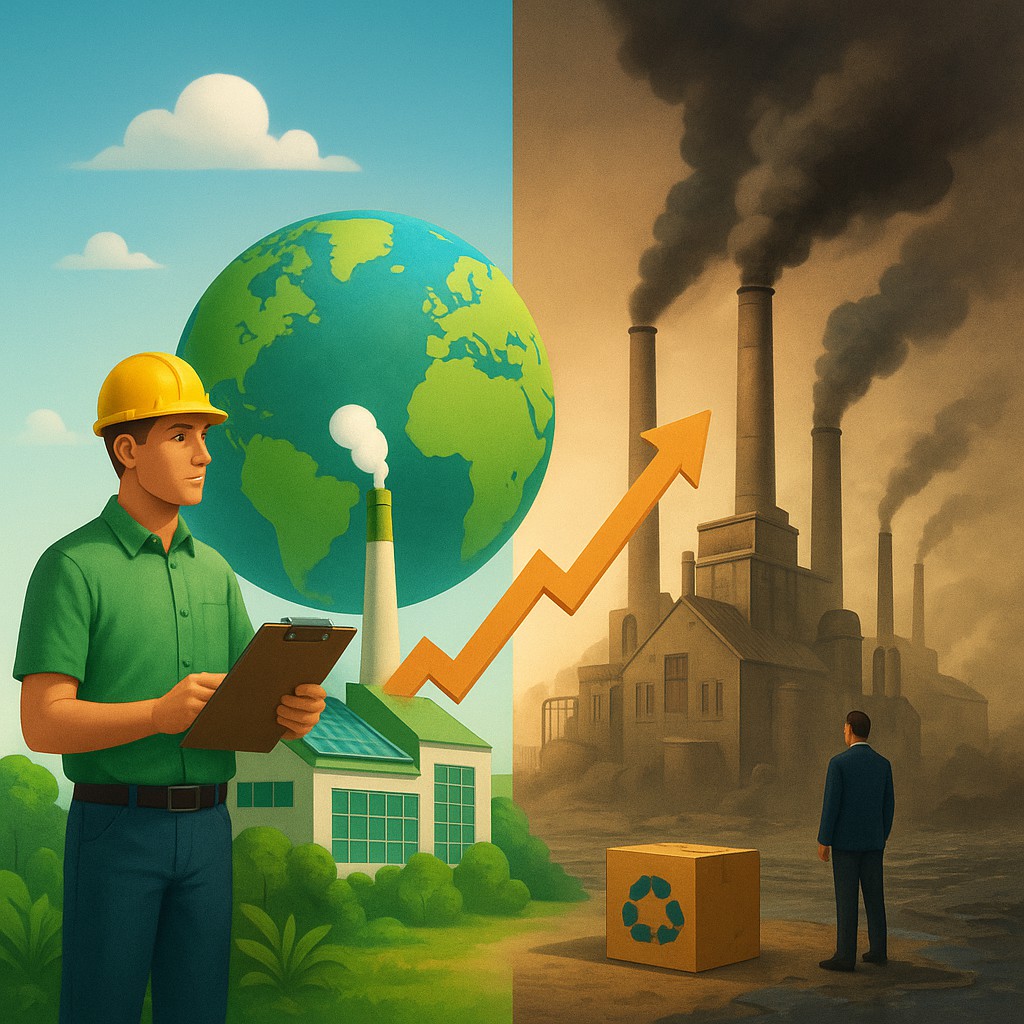
Imagine you are a manufacturer in a country that has just passed some of the world's most ambitious environmental laws. You have spent millions of dollars upgrading your factory filters, switching to renewable energy, and ensuring your waste is treated responsibly. Your product is cleaner than ever, but because those upgrades were expensive, you have to raise your prices. Suddenly, a competitor from across the ocean starts selling the exact same product in your neighborhood for half the price. Their secret? They operate in a region where they can pump smoke into the air and chemicals into the water without paying a cent in penalties. Their "efficiency" is not actually about better technology; it is effectively a subsidy funded by a total disregard for the planet.
This scenario is what economists and policy experts are now tackling with a bold new tool known as "Reverse Dumping" or Carbon Border Adjustments. For decades, global trade was mostly about finding the absolute lowest price, regardless of how that price was achieved. But as we move toward 2025, the rules of the game are shifting toward a concept called "regulatory alignment." This means that if you want to play in the global market, you have to follow the same environmental rules as everyone else, or pay a fee at the border to make up for the "unfair" advantage of polluting. It is a massive evolution in how we think about value, shifting the focus from the cost of labor to the cost of carbon.
The Shift from Cheap Goods to Clean Goods
In the traditional world of trade, "dumping" refers to a company exporting a product at a price lower than it normally charges at home, often to drive out competition. "Reverse Dumping" in the context of environmental policy is a clever twist on this idea. It suggests that by producing goods under weak environmental standards, a country is "dumping" the environmental cost of production onto the rest of the world. By 2025, major trading blocs like the European Union are perfecting systems that identify these hidden costs and add them back to the price of the product via a tariff. This ensures that a local, green business is not driven into bankruptcy by a foreign, high-polluting competitor.
This transition marks the end of the "pollution haven" era. For a long time, companies could lower their expenses by moving their factories to countries with lax regulations. This did not actually reduce global pollution; it just moved it to a different spot on the map. The new 2025 frameworks, such as the Carbon Border Adjustment Mechanism (CBAM), act as a giant equalizer. They calculate how much CO2 was emitted during the making of a ton of steel or a pallet of aluminum and tax it accordingly. It turns "going green" from a moral choice into a survival strategy for global exporters, as they can no longer hide their carbon footprint behind a low price tag.
Balancing the Scales of Global Competition
The mechanics of these new tariffs are complex, but the underlying logic is surprisingly simple: it is about creating a level playing field. If a domestic steel mill has to pay $50 for every ton of carbon they emit, but a foreign mill pays $0, the foreign mill has a $50 advantage right out of the gate. The border tax essentially checks the "receipt" for carbon payments at the frontier. If the importer cannot prove they already paid a carbon price back home, the government collects that $50 at the border. This removes the financial incentive to move production to places with weaker laws.
However, this is not just about protectionism. It is a powerful diplomatic tool designed to encourage countries to align their regulations. When a country realizes its exports are being taxed heavily because of its old, coal-fired factories, it faces a choice. It can keep paying the tax to a foreign government, or it can update its own factories and collect that money through its own domestic carbon tax. Most nations would prefer to keep that tax revenue for themselves, which triggers a "race to the top" where countries compete to have the cleanest, most modern industries to avoid these international penalties.
| Component of Trade |
Traditional Model |
2025 "Green Trade" Model |
| Primary Goal |
Lowest possible production cost |
Carbon-efficient production |
| Competitive Advantage |
Low labor and energy costs |
Clean energy and regulatory alignment |
| Environmental Impact |
High risk of "pollution havens" |
Encourages global modernization |
| Role of Tariffs |
To protect local jobs from low prices |
To account for "hidden" carbon costs |
| Consumer Impact |
Low prices at the cost of the climate |
Higher short-term prices for cleaner goods |
Navigating the Maze of Carbon Accounting
One of the biggest hurdles in this new era is the sheer amount of data required to make it work. It is no longer enough to just weigh a crate of goods. Importers must now provide detailed reports on the "embedded emissions" of their products, which are the total greenhouse gases produced during every stage of manufacturing. This involves tracking everything from the electricity used to run the machines to the type of fuel used to transport the raw materials. This shift has given birth to a massive new industry of green auditing and verification. If a company claims its cement is "carbon neutral," it now has to prove it with verifiable data that satisfies international customs agents.
This push for data is also revealing some uncomfortable truths about global supply chains. Many companies are discovering that their products are much "dirtier" than they previously thought. For example, a smartphone might be assembled in a high-tech, clean facility, but the rare earth metals inside it might have been refined in a facility that uses massive amounts of coal. Under the new 2025 rules, those "upstream" emissions count too. This forces companies to look deep into their supply chains and demand better standards from every single one of their suppliers, creating a ripple effect of modernization that stretches across the globe.
Correcting Common Myths About Green Tariffs
There is a frequent misconception that carbon tariffs are just another way for wealthy nations to bully developing countries. While it is true that these taxes put pressure on nations with older infrastructure, the goal is often the opposite of exclusion. Many of these trade frameworks include provisions for "technology transfers," which involve sharing technical knowledge, and financial aid to help developing nations upgrade their power grids. The idea is to move away from a world where "developing" is synonymous with "polluting" and instead provide a roadmap for these countries to jump directly into renewable energy and high-efficiency manufacturing.
Another myth is that these tariffs will permanently ruin the global economy by making everything too expensive. While prices for carbon-intensive goods like cement, steel, and fertilizers may rise in the short term, this is actually a "correction" of a market failure. For decades, the price of these goods was artificially low because the cost of the damage they caused to the environment was being ignored. By 2025, we are finally seeing the "true cost" of products. As technology improves and more factories switch to green methods, these prices are expected to stabilize, leading to a more sustainable and resilient global economy.
Building a Future Where Efficiency Means Cleanliness
We are entering a fascinating chapter in human history where the "invisible hand" of the market is being guided by an environmental conscience. Trade has always been a force for connection and change, but now it is also becoming a force for conservation. By using tools like Reverse Dumping duties, we are ensuring that the global race for economic dominance does not come at the expense of a breathable atmosphere. It is a shift from a world where we compete on who can cut the most corners to a world where we compete on who can be the most ingenious in saving them.
The journey toward 2025 and beyond will certainly have its growing pains, from administrative headaches to temporary price hikes at the grocery store. Yet, the end goal is a worthy one: a global market where the most successful companies are also the most responsible ones. As a shopper and a global citizen, you are part of this change every time you choose a product that prioritizes sustainability. You are not just buying an object; you are voting for a system where fair trade and a healthy planet go hand in hand. The future of trade is no longer just about moving boxes across oceans; it is about moving the entire world toward a cleaner, more aligned, and more transparent future.