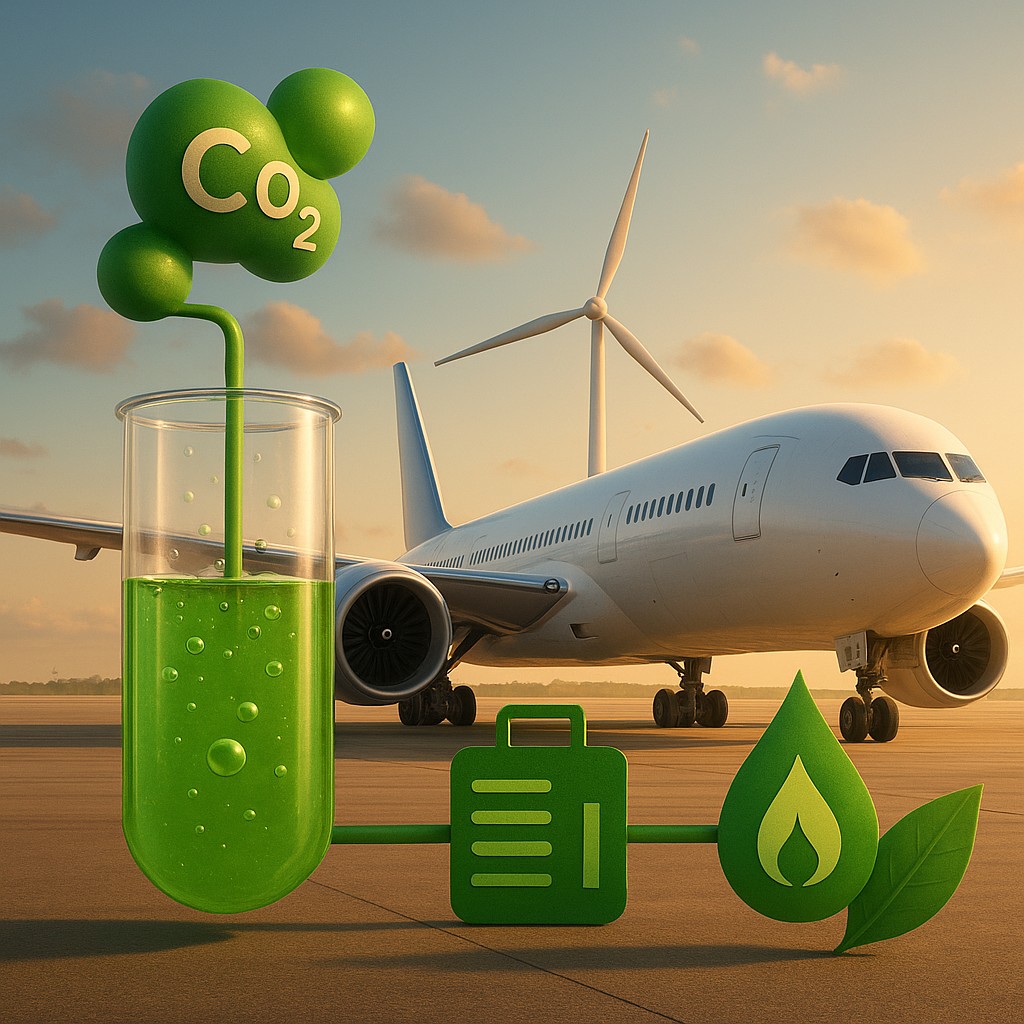
Imagine standing on the tarmac, watching a massive Boeing 787 Dreamliner prepare for an eleven-hour journey across the Atlantic. To get that metal giant into the air and keep it there, the engines will burn tens of thousands of gallons of fuel. For decades, this has been the "guilt trip" of the modern era. While we have managed to switch to electric cars and solar-powered houses, the friendly skies have remained stubbornly tied to fossil fuels. The reason is simple, if a bit frustrating: physics. Batteries are wonderful for keeping your smartphone alive or driving a sedan to the grocery store, but they are incredibly heavy. To fly a commercial jet across the ocean on battery power alone, the batteries would be so heavy that the plane could never leave the ground.
This weight problem has forced scientists to look for a "liquid" solution that does not involve digging up ancient carbon. We need something that packs the same energy punch as traditional kerosene but without the devastating carbon footprint. Enter the world of Sustainable Aviation Fuel, or SAF. Specifically, a growing technology called Power-to-Liquid is turning heads in labs and hangars from Germany to California. It sounds like something out of a science fiction novel: capturing carbon dioxide from the thin air, mixing it with water and a massive jolt of green electricity, and "growing" a fuel that can power a jet engine. It is a circular economy at thirty thousand feet, and it might just be the most important chemistry project of the twenty-first century.
The Problem With Flying on Giant Batteries
To understand why Power-to-Liquid technology is such a big deal, we first have to appreciate why we cannot just "Tesla-fy" a long-haul flight. The core of the issue is energy density. Modern jet fuel is a miracle of energy storage; a single kilogram of kerosene packs about fifty times more energy than a kilogram of the best lithium-ion batteries available today. If we tried to fuel a 747 with batteries for a long-distance flight, the battery pack would need to be roughly the size of the entire airplane. This would leave no room for passengers, luggage, or even the pilot. While small electric planes are already performing short hops and training flights, the "big leagues" of international travel require a liquid that can be burned to produce thrust.
Because we are stuck with liquid fuels for the foreseeable future, the challenge is making those liquids clean. Traditional kerosene is carbon-intensive because it takes carbon that was buried deep underground for millions of years and releases it into the atmosphere. This is a one-way street toward a warmer planet. Sustainable fuels aim to turn that into a loop. If we can take carbon that is already in the air and turn it into fuel, that fuel simply returns the carbon to where it started when it burns. This "net-zero" cycle is the holy grail of aviation, allowing us to stay globally connected without the heavy environmental toll.
Turning Thin Air and Water Into Rocket Juice
The Power-to-Liquid (PtL) process is essentially a way of bottling renewable energy. It begins with two very basic ingredients: water and carbon dioxide. First, engineers use renewable electricity, such as wind or solar power, for electrolysis. This is a process where an electric current passes through water to split it into oxygen and hydrogen. The oxygen is released (or saved for other uses), and the hydrogen becomes our "energy carrier." This hydrogen is "green" because no fossil fuels were used to create it, making it the cleanest building block in modern chemistry.
The second step is where the real magic happens. Carbon dioxide is captured, either directly from the air using giant fans and filters or from industrial chimneys. This CO2 is then combined with the green hydrogen in a chemical reactor. Through a series of complex reactions, most notably the Fischer-Tropsch process, these elements are reassembled into long chains of hydrocarbons. These hydrocarbons are chemically identical to the ones found in traditional crude oil. The result is synthetic kerosene that looks, smells, and burns exactly like the fuel we have used for a century, but with a much cleaner soul.
The Magic of Drop-In Technology
One of the most brilliant aspects of Power-to-Liquid fuel is that it is a "drop-in" solution. In engineering, a drop-in fuel is a synthetic alternative so chemically similar to the original that it requires no changes to the machinery. This is a massive advantage over other green technologies. If we wanted to switch the entire world to hydrogen-powered planes, every airline would have to buy an entirely new fleet of aircraft with specialized frozen tanks and redesigned engines. That would cost trillions of dollars and take decades to finish. With PtL kerosene, an airline can use the planes they bought yesterday, the fuel pipes already under the airport, and the engines currently hanging off the wings.
This compatibility extends to safety and reliability as well. Aviation is an industry obsessed with safety, for very good reasons. Introducing a brand-new type of engine technology is a slow, careful process that involves years of testing. Because PtL fuel is refined to meet the exact specifications of standard Jet-A1 fuel, it has already passed the industry's most rigorous tests. Pilots do not have to learn new gauges, and mechanics do not have to learn new repair steps. We are essentially swapping out the "source" of the energy without changing the "language" of the engine.
| Feature |
Conventional Jet Fuel |
Power-to-Liquid (PtL) |
Electric Battery |
| Energy Density |
Very High |
Very High |
Very Low |
| Carbon Source |
Fossil Deposits (Ancient) |
Atmospheric CO2 (Recycled) |
N/A |
| Infrastructure Change |
None |
None |
Complete Redesign |
| Commercial Readiness |
Standard |
Trial Phases |
Small Aircraft Only |
| Production Cost |
Low |
High |
Medium (for batteries) |
Scaling the Mountains of Cost and Efficiency
If Power-to-Liquid fuel is so perfect, you might wonder why every airport is not already pumping it into every plane. The "elephant in the room" is the cost. Currently, it is significantly more expensive to manufacture synthetic kerosene than it is to simply pump oil out of the ground and refine it. Traditional oil has the advantage of being a finished product created by nature over millions of years; we just have to find it and clean it up. PtL, on the other hand, requires a massive amount of work to build those molecules from scratch. It is the difference between picking a wild apple from a tree and building an apple in a laboratory using individual atoms.
Efficiency is another hurdle. To create PtL fuel, you lose energy at every step. You lose energy when you split the water, when you capture the CO2, and during the chemical assembly. By the time the fuel is in the wing of the plane, you have used much more renewable electricity than if you had just used that electricity to power something directly, like a train or a car. However, because we have no other way to get a heavy jet across the Pacific, this "efficiency tax" is one we may have to pay. As more plants are built and the technology matures, experts expect the prices to drop, much like the cost of solar panels has plummeted over the last decade.
Correcting the Myths of Green Flying
As with any emerging technology, there are plenty of misconceptions about sustainable aviation. One common myth is that "biofuels" and "Power-to-Liquid" are the same thing. While both are types of Sustainable Aviation Fuel (SAF), they are quite different. Biofuels are made from organic matter like used cooking oil, animal fats, or farm waste. While they are useful, there is a limit to how much "old fry oil" exists in the world. We simply cannot grow enough crops to fuel the global aviation industry without destroying all our forests or taking over land needed for food. Power-to-Liquid is better in the long run because it does not compete with food production; its only raw materials are air, water, and sunlight.
Another misconception is that these fuels do not actually help because CO2 still comes out of the back of the engine. It is important to remember the "net" in net-zero. Traditional fuel adds new carbon to the atmosphere. PtL fuel simply recycles the carbon that was already there. When the plane flies, it is releasing the same carbon that was captured by the fuel plant a few weeks earlier. It is like a bank account: traditional fuel is a constant series of withdrawals that drains the earth's "carbon balance," while PtL is a series of transfers that keeps the balance stable. While we also need to worry about other emissions like nitrogen oxides and the white vapor trails (contrails) planes leave behind, fixing the carbon cycle is the biggest piece of the puzzle.
The Global Laboratory of Current Trials
We are currently in a thrilling "pilot phase" of this technology. Across the globe, small-scale plants are proving that this theory works in the real world. In Germany, the Werlte plant has already successfully produced quantities of carbon-neutral kerosene. Major aircraft manufacturers like Airbus are heavily involved in these trials, ensuring that the fuel meets every safety standard. These are no longer just laboratory experiments; they are industrial-scale proofs of concept. Some airlines have already started flying commercial routes using a blend of traditional fuel and SAF, gradually increasing the percentage as the supply grows.
The goal for the next decade is to move from "liters" to "billions of gallons." This will require a massive build-out of renewable energy. To fuel the entire world's airline fleet with PtL, we would need a staggering number of wind and solar farms. This makes the transition to sustainable flight a multi-industry challenge. It is not just about the planes; it is about the power grid, the hydrogen machines, and the carbon-capture tech. We are essentially building a new global energy ecosystem from the ground up, with the aviation industry serving as the primary customer driving the demand.
A Future Where the Sky Has No Limit
The journey toward sustainable aviation is perhaps the most difficult engineering challenge of our time. It requires us to master the very building blocks of matter and to harness the elements in ways our ancestors never dreamed possible. Yet, the progress made in Power-to-Liquid technology shows us that the dream of "guilt-free" flight is not just a fantasy. We are living in the era where the carbon footprint of a flight from London to New York can finally be erased - not by stopping the flight, but by changing what powers it. It is a testament to human ingenuity that we can take the very waste product that is warming our world, CO2, and turn it into the high-performance fuel that connects us to one another.
As you look toward the horizon and see the white streaks of planes crossing the sky, realize that you are looking at an industry in the middle of a quiet revolution. We are learning how to fly with the wind and the sun, even when the sun isn't shining and the wind isn't blowing, by storing that energy in a liquid form. The high costs and technical hurdles are real, but they are not impossible to overcome. With every new trial and every gallon of synthetic fuel produced, we get closer to a world where we can explore every corner of our beautiful planet without harming it. The future of flight is not just about going faster or farther; it is about going smarter, and that is a journey worth taking.