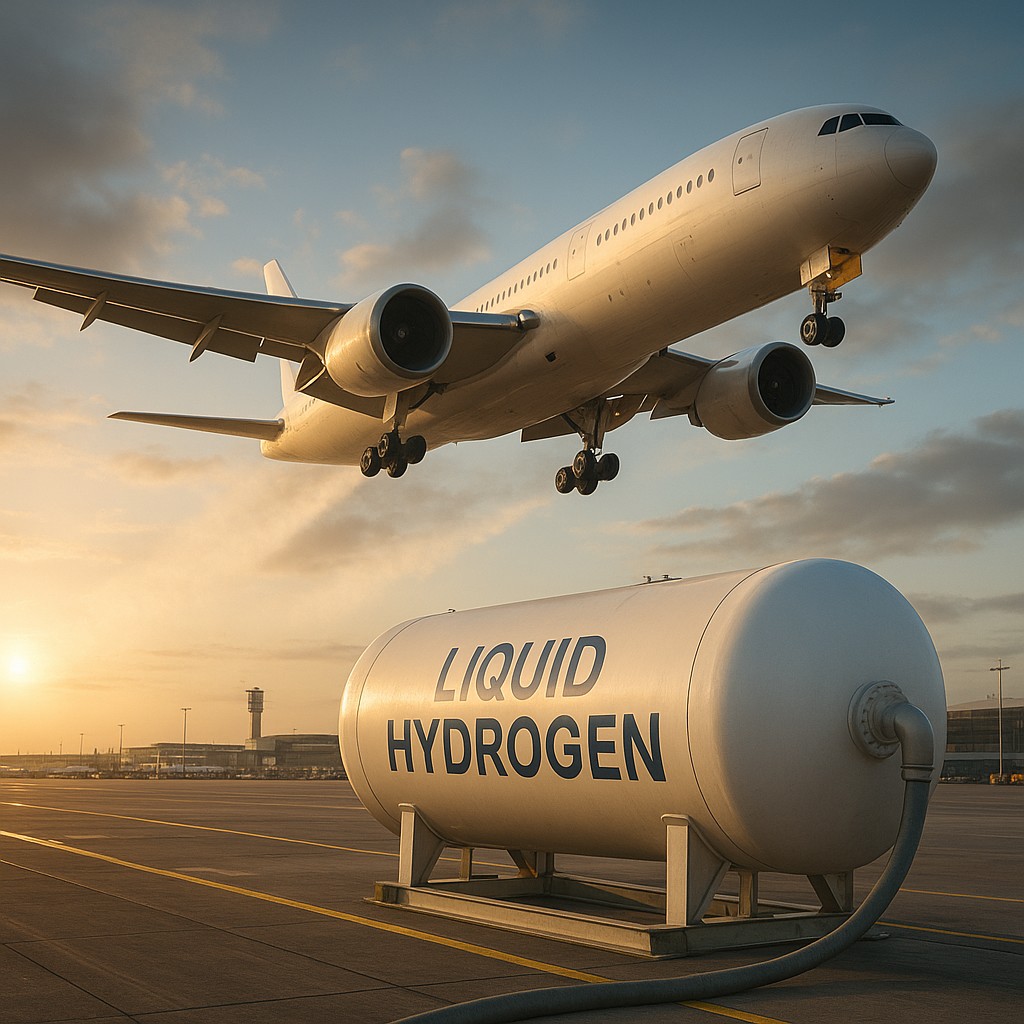
Imagine standing on the tarmac of a busy international airport, watching a massive jet roar into the sky. Behind it, you see the shimmering heat of the exhaust and, if you look at the data, a staggering trail of carbon dioxide left in its wake. Aviation is one of the toughest nuts to crack in the world of green energy because planes are "picky eaters." They require an incredible amount of energy packed into very little weight to get off the ground and stay there for ten hours. While an electric car runs beautifully on lithium-ion batteries, scaling 그 technology to a Boeing 787 would result in a plane so heavy with batteries that it would barely have room for a single passenger, let alone their luggage.
To fix this, engineers are looking toward the most abundant element in the universe: hydrogen. It is light, it is powerful, and when used correctly, the only thing coming out of the tailpipe is pure, clean water vapor. However, hydrogen is also a bit of a "handful" to manage. To make it work for long-distance travel, we have to play with the laws of physics, chilling the element down to temperatures that would make the surface of Pluto feel like a summer getaway. This transition from fossil fuels to liquid hydrogen is not just a simple engine swap; it is a total reimagining of how we build machines, how we design airports, and how we understand the chemistry of flight.
The Weighty Problem: Scaling Beyond Batteries
The primary reason we do not have long-haul electric commercial flights today comes down to a concept called energy density. Think of energy density as the "nutritional value" of a fuel for a machine. If you are a marathon runner, you want a snack that gives you the most calories for the least amount of weight so you aren't carrying a heavy backpack. Batteries, while wonderful for cars, have a very low energy density compared to liquid fuels. Even the most advanced batteries today are roughly 40 to 50 times less energy-dense than standard jet fuel. If we tried to power a jumbo jet with current battery technology, the batteries would weigh more than the airplane itself, leaving no room for the wings to actually generate lift.
Hydrogen enters the stage as a heavyweight champion in a lightweight body. In terms of "gravimetric energy density" (simply a measure of how much punch it packs per kilogram), hydrogen is the undisputed king. It carries about three times as much energy per kilogram as traditional kerosene-based jet fuel. This means that, theoretically, you could carry one-third the weight in fuel to go the same distance, or use that extra weight capacity to carry more people or cargo. This weight advantage is the "holy grail" for aerospace engineers who fight for every gram of weight reduction during the design phase.
However, science rarely gives you a free lunch. While hydrogen is amazing by weight, it is notoriously difficult by volume. In its gas form at room temperature, hydrogen atoms are incredibly spread out. To get enough of it on a plane to fly across the Atlantic, you would need a fuel tank the size of a small skyscraper. To solve this, engineers turn to "cryogenics," the science of extreme cold. By chilling hydrogen gas down to a staggering -253 degrees Celsius (-423 degrees Fahrenheit), it turns into a liquid. In this liquid state, it becomes dense enough to fit into a tank that can actually be attached to an airplane, though these tanks still look very different from the ones we use today.
Keeping it Cool at the Edge of Absolute Zero
Managing liquid hydrogen is a feat of engineering that sounds more like science fiction than traditional mechanical work. At -253 degrees Celsius, hydrogen is only 20 degrees above absolute zero, the theoretical temperature where all atomic motion stops. At these temperatures, normal materials like steel or plastic become as brittle as thin glass and would shatter under the slightest pressure. Therefore, the tanks used to hold this "cryofuel" are marvels of insulation. They are essentially giant, high-tech Thermos flasks, often featuring double-walled vacuum insulation to prevent even a tiny bit of heat from seeping in and turning the liquid back into a gas.
One of the biggest design hurdles is the shape of these tanks. Standard airplanes store their fuel in the wings. This is a brilliant use of space because the wings are mostly hollow anyway, and the weight of the fuel there helps counteract the lift pushing up on the wings during flight. But liquid hydrogen requires spherical or cylindrical tanks to maintain the high pressures and extreme temperatures needed to keep it stable. You cannot easily fit a giant cylinder inside a thin, tapered airplane wing. This means the planes of the future might look a bit "chunkier" or have longer bodies to accommodate large internal fuel tanks, representing a massive shift in how we think about aircraft silhouettes.
Beyond just holding the fuel, the plumbing of the aircraft has to change entirely. Every valve, pump, and sensor must be rated for "cryogenic service," meaning they can function in extreme cold. If a tiny bit of moisture from the air gets into the system, it will instantly turn into ice, potentially blocking a fuel line. Engineers are currently testing integrated systems that use the cooling power of the liquid hydrogen itself to help manage the heat generated by the plane's electronics. It is a complex dance of temperature control where the fuel is not just an energy source, but also the primary coolant for the entire vehicle.
Two Paths to Propulsion and the Water Vapor Trail
Once we have successfully stored this ultra-cold liquid on the plane, how do we actually turn it into forward motion? There are two main ways to do this, and both are being tested by companies like Airbus and ZeroAvia. The first is "Hydrogen Combustion." In this scenario, we take the liquid hydrogen, warm it up slightly until it becomes a gas, and then feed it directly into a modified jet engine. Hydrogen burns very intensely and very cleanly. Instead of the thick cocktail of carbon dioxide and soot produced by kerosene, the primary byproduct is water vapor. While some nitrogen oxides (NOx) are still produced due to the high heat of fire in the atmosphere, the carbon footprint is effectively erased.
The second method is "Hydrogen-Electric" flight using fuel cells. Instead of burning the hydrogen, it is passed through a fuel cell where it combines with oxygen from the outside air to create a chemical reaction. This reaction produces electricity, which then powers electric motors that turn propellers or fans. This method is incredibly efficient and produces zero NOx, making it the cleanest possible way to fly. The challenge here is that fuel cells are currently quite heavy. While they work perfectly for smaller, regional planes that carry 20 to 50 people, we are still working on making them powerful enough for the massive jets that cross oceans.
To compare how these technologies stack up against what we use today, let’s look at the basic trade-offs between traditional fuel, batteries, and liquid hydrogen.
| Feature |
Jet Fuel (Kerosene) |
Lithium-Ion Batteries |
Liquid Hydrogen |
| Energy per kg |
High (~43 MJ/kg) |
Very Low (~0.9 MJ/kg) |
Exceptional (~120 MJ/kg) |
| Storage Volume |
Compact (Fits in wings) |
Large and Heavy |
Very Large (4x fuel space) |
| Primary Exhaust |
CO2, Soot, NOx |
None (at the plane) |
Pure Water Vapor |
| Storage Temp |
Room Temperature |
Room Temperature |
Cryogenic (-253°C) |
| Infrastructure |
Existing and Global |
Charging Stations |
Needs Total Redesign |
Rebuilding the World One Airport at a Time
Even if we build the perfect hydrogen airplane tomorrow, it wouldn't be able to go anywhere without a massive overhaul of our global airport infrastructure. Currently, airports are designed around the ease of pumping liquid kerosene through underground pipes directly to the gates. Hydrogen is a different beast entirely. We cannot simply use the old pipes because hydrogen atoms are so tiny they can actually leak through materials that would be airtight for any other gas. This phenomenon, known as "hydrogen embrittlement," can weaken metals over time, making standard infrastructure dangerous if used with the new fuel.
Airports would essentially need to become mini-cryogenic processing plants. They would need massive on-site storage facilities that can maintain those near-absolute-zero temperatures. There are also questions about how you get the fuel to the airport. Do you build hydrogen pipelines from green energy plants, or do you produce the hydrogen right there on the airfield using solar panels and water "electrolyzers" (machines that use electricity to split water into hydrogen and oxygen)? The latter is an attractive "circular" idea, where an airport becomes its own energy hub, but it requires a staggering amount of electricity to pull off.
Furthermore, the "turnaround time" at the gate is a critical factor for airlines. Currently, a plane can be refueled in about 30 to 45 minutes. Refueling with a cryogenic liquid requires specialized robotic arms or highly insulated connectors and careful pressure balancing to ensure no gas escapes. If it takes three hours to refuel a hydrogen plane because of complex safety checks, the cost of flying will skyrocket. Engineers are currently working on "swappable" tank systems where a pre-filled, chilled tank is simply slotted into the plane like a giant AA battery, potentially solving the refueling speed problem while keeping the complexity on the ground.
Overcoming the Space Crunch and Safety Myths
A common concern when people hear "hydrogen" and "flight" in the same sentence is safety, often stemming from old newsreels of the Hindenburg airship. However, modern engineering has transformed hydrogen into one of the most studied and controlled fuels in existence. In many ways, hydrogen is safer than jet fuel in a crash. Because it is so light, if a tank leaks, the hydrogen rushes upward into the atmosphere at high speed rather than pooling on the ground like kerosene. This means that in the event of a leak, the fuel clears away from the passengers almost instantly.
The more pressing challenge is the "Volume Tax." As noted in the table above, liquid hydrogen takes up about four times more physical space than jet fuel for the same amount of energy. This means that to maintain the same range, a plane's fuel tanks have to be four times larger. This added volume creates more "drag," the air resistance the plane feels as it moves. To overcome this, future airplanes might look more like "Flying Wings" or "Blended Wing Bodies," where the entire plane is one big, thick triangular shape. This design provides massive internal volume for hydrogen tanks while being incredibly aerodynamic.
While these changes are daunting, they are also an invitation to a new era of human ingenuity. We are moving away from the era of "burning things we dig up" and into the era of "using chemistry we manage." The shift to hydrogen aviation represents more than just a cleaner way to get from London to New York; it represents a commitment to preserving our ability to explore the world without destroying it in the process.
The journey toward hydrogen-powered flight is a testament to our refusal to accept that some problems are simply too hard to solve. It reminds us that when we combine the rigors of physics with the boldness of human imagination, even the most difficult obstacles, like the weight of a battery or the chill of deep space, can be navigated. As you look up at the sky in the coming decades, you might see the same white streaks trailing behind a plane, but you can feel a sense of pride knowing those trails are no longer a burden on the planet, but simply a cloud of water, marking our path toward a cleaner, faster, and more sustainable future.