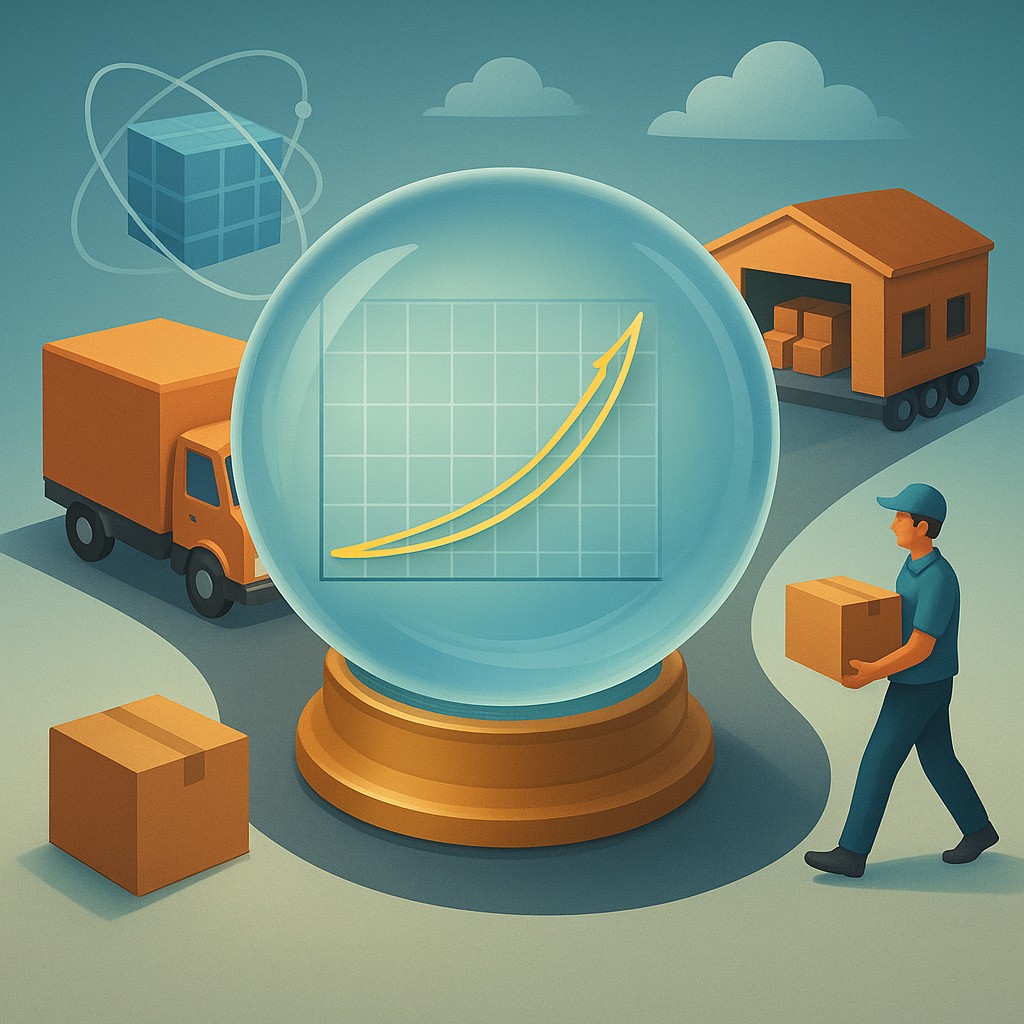
Imagine a world where you realize you need a new coffee grinder at 10:00 AM, and by 11:30 AM, a delivery driver is walking up your driveway with that exact model. You might assume the company has a fleet of supersonic jets or a psychic shipping clerk, but the reality is more subtle and mathematically complex. The package didn't start its journey when you clicked the "buy" button; it actually hit the road while you were still comparing reviews and wondering if the stainless steel finish was worth the extra cost. While you were still debating, algorithms miles away had already decided there was an 85 percent chance you would commit. They acted on that probability by putting your future grinder on a truck heading toward your zip code.
This shift from reacting to orders to predicting them is fundamentally changing how we interact with the physical world. Traditionally, the supply chain was a giant game of "Simon Says," where the customer gives a command and the entire global infrastructure rushes to fulfill it. Now, those roles have reversed. The system is attempting to read your mind, turning the global shipping network into a "rolling warehouse" that stays in constant motion. By predicting your needs before you even speak them, retailers are closing the gap between wanting something and owning it. They are effectively making the concept of "waiting for a package" a relic of the early twenty-first century.
The Mathematical Crystal Ball of Modern Retail
At the heart of this trend is a field called predictive analytics. Retailers no longer just look at what you bought last week; they track how long you hovered your mouse over a specific photo, how many times you revisited a product page, and even the weather patterns in your neighborhood. If you live in a city where a major rainstorm is forecast for Friday, the system doesn't wait for you to realize your roof is leaking or your umbrella is missing. It begins moving pallets of rain gear to local distribution centers or onto trucks circulating through high-demand areas.
These systems use machine learning to identify "clusters" of behavior. For instance, if five thousand people in one city start searching for the same obscure kitchen gadget after a viral video, the algorithm flags a surge in regional demand. Instead of shipping five thousand individual boxes from a central hub in the Midwest, the company preemptively sends the items in bulk to a nearby sorting facility. This isn't just about speed; it is about saving money through efficiency. Moving items closer to the "last mile" (the final leg of delivery) before orders are even placed allows companies to swap expensive air freight for slower, cheaper ground transport before the customer's clock even starts ticking.
The sophistication of these models allows for "speculative labeling." In some advanced systems, a package might be boxed, taped, and labeled with a partial address or a neighborhood code while it is still on a conveyor belt. It enters the shipping stream as a "probabilistic unit." As it travels toward your city, the system waits for the final "buy" signal. Once that signal arrives, the last bit of data - your specific house number - is sent to the courier who already has the box in their van. It is a high-stakes game of musical chairs where the music never stops, and there is always a seat waiting for the item the moment it needs to land.
Turning the Entire World into a Rolling Warehouse
The traditional warehouse is a static building where boxes sit on shelves gathering dust until they are summoned. In this new era, the "warehouse" is the entire network of trucks, planes, ships, and vans currently in transit. This concept, often called inventory-in-motion, treats every vehicle as a mobile storage unit. If a truck is driving from a port to a city, the items inside are technically "in stock" for anyone living along that route. The system is smart enough to redirect a van mid-route if a high-priority order pops up three streets away.
This fluidity is made possible by the "Physical Internet," a concept where shipping containers and packages are as standardized and interchangeable as data packets on the web. Just as a YouTube video is broken into tiny bits of data and sent through various server routes to reach your screen, physical products are being broken down into optimized routes. By using micro-hubs - small, automated storage lockers or local "dark stores" hidden in urban basements - retailers ensure that the most popular items are always within a ten-mile radius of most people.
| Shipping Model |
Trigger Point |
Storage Strategy |
Delivery Speed |
| Traditional |
Customer completes checkout |
Massive central warehouses |
3 to 7 business days |
| Just-in-Time |
Inventory hits a low point |
Regional distribution hubs |
1 to 2 business days |
| Anticipatory |
Predicted intent or browsing |
Vehicles and local micro-hubs |
1 to 2 hours |
| Rolling Warehouse |
Constant demand forecasting |
Moving trucks and "dark stores" |
Almost instant |
The High Cost of Guessing Wrong
Predicting the future is difficult, and when you combine human unpredictability with the high costs of logistics, the risks are significant. Anticipatory shipping is essentially a multi-billion dollar bet. If an algorithm predicts a neighborhood will obsess over a specific brand of toaster, but the residents buy air fryers instead, the retailer faces a logistical headache. They now have "trapped inventory" sitting in a local hub or on a truck that must be redirected, stored, or sent back.
The "return logistics" of a failed prediction are incredibly expensive. Shipping a product to a customer is a streamlined process, but "un-shipping" or rerouting a product that was never bought requires extra labor, fuel, and time. Furthermore, the environmental impact of moving goods that might not sell complicates the sustainability goals of large corporations. To fix this, companies often use "discounted redirection." If an item is already in your area but no one is buying it, the algorithm might trigger a "flash sale" or send a coupon to a nearby user. Essentially, they bribe a human to fulfill the algorithm’s prediction so the company doesn't have to pay to ship the item back.
There is also the "creepiness factor." When a package arrives almost immediately after you think about it, the line between helpful service and invasive surveillance feels thin. If a retailer knows you are about to run out of laundry detergent before you have even checked the bottle, it implies a level of data harvesting that makes many people uncomfortable. The industry must walk a fine line between being "magically fast" and "disturbingly psychic." If the system gets too good, it stops feeling like a service and starts feeling like an automated manipulation of your spending habits.
Managing the Chaos of Last-Mile Delivery
The "last mile" is the final trip from a local hub to your front door, and it is the most expensive and complex part of the journey. This is where anticipatory shipping proves its worth. By moving products into the neighborhood before the order is placed, companies bypass the bottlenecks of major sorting centers during peak hours. If a product is already in a delivery van making its rounds, the cost of adding one more stop to your house is much lower than sending a dedicated vehicle from a distant warehouse.
To make this work, many companies are testing "hybrid hubs." These are retail stores that double as mini-warehouses. When you walk into a big-box store, you might see employees with carts picking items off the shelves. They aren't just restocking; they are acting as the local "fingers" of the predictive network, preparing orders for people who haven't even finished their morning coffee. In some cases, these stores are becoming "dark," meaning they are closed to the public and exist only as high-speed fulfillment centers in busy residential areas.
Machine learning models also account for "event-based spikes." If a major sports championship is coming up, the system floods that city with team jerseys and party supplies days in advance. If a heatwave is moving toward the coast, air conditioners and fans are already heading to those zip codes while the air is still cool. This is a systems-level approach to commerce, where the goal is not to react to the world, but to stay exactly one step ahead of human demand.
The Psychological Shift from Owning to Accessing
As delivery times shrink toward zero, our relationship with physical goods begins to change. When you can get any item in an hour, the pressure to "stock up" or own everything yourself starts to fade. In a sense, anticipatory shipping turns the retail world into a giant, shared pantry. You don't need to keep three backup boxes of pasta in your cupboard if the logistics network is already holding them for you five miles away, ready to deliver them the moment you reach for the pot.
This transition mimics the shift we saw in digital media. We moved from owning physical CDs to having a digital library on iTunes, and finally to streaming services like Spotify where the music is "everywhere and nowhere" at once. Anticipatory shipping is the "streaming service" for physical objects. It creates a reality where the things you want are always in orbit around you, waiting for the signal to land. While the technology is driven by cold data and complex math, the result feels like a return to the neighborhood general store of a century ago, where the shopkeeper knew exactly what you needed before you even walked through the door.
Embracing this future requires us to appreciate the invisible ballet happening all around us. Every time you see a delivery van, it isn't just carrying what people bought; it is carrying the statistical probabilities of what an entire neighborhood might want next. We are moving into an era where the logistics network is an extension of our own intentions - a global system that listens to our patterns to ensure that when we finally reach out for something, it is already there, waiting to be caught. This is the ultimate triumph of the algorithm: turning the chaos of human desire into a perfectly timed and beautifully orchestrated dance of atoms and information.