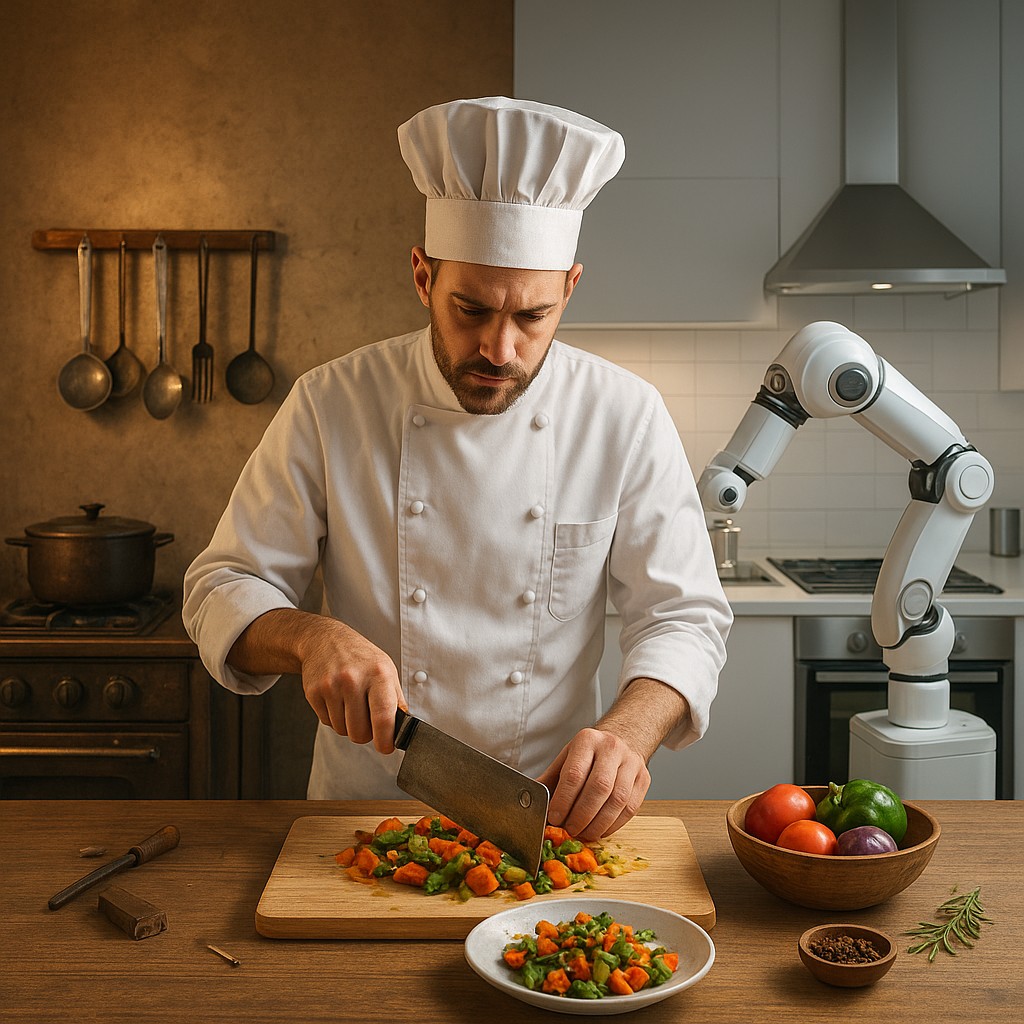
Imagine for a moment that you are a world-class chef trying to invent a brand-new signature dish. You have two kitchens at your disposal. The first is a gleaming, futuristic marvel where every knife is laser-sharpened, the pans are perfectly non-stick, and a voice-controlled robot fetches every spice you name before you can even reach for it. The second kitchen is slightly cramped, the stove requires a manual strike of a match, and you have to chop your vegetables with a heavy, old-fashioned cleaver that takes real muscle to master. Most people would instinctively pick the first kitchen, assuming that by removing all the "junk tasks," they would have more mental energy to spend on the art of cooking. Yet, history and psychology suggest that the chef in the second kitchen is far more likely to stumble upon a culinary revolution.
This paradox exists because our brains are essentially biological energy-saving machines. When a process becomes too smooth, our minds switch from active engagement to a state of cognitive autopilot. We begin to rely on muscle memory and established patterns rather than critical thought. This is the "frictionless trap," a modern phenomenon where ultra-efficient tools actually act as buffers between us and our best ideas. By removing every pebble from the path of our workflow, we stop paying attention to the scenery, and it is in that scenery where the most original insights are hidden. To be truly creative, we often need a little bit of grit in the gears to force ourselves out of the comfortable rut of "easy."
The Evolutionary Case for Gritty Thinking
Our ancestors did not evolve in a world of frictionless convenience. For thousands of years, the human brain was wired to solve problems involving physical resistance, limited resources, and environmental obstacles. When we encounter a barrier, our prefrontal cortex - the part of the brain responsible for complex planning - lights up, signaling that we need to find a way over, under, or around the problem. This state of heightened awareness is where true innovation lives. When we use tools that are "too good," such as predictive text or templates that do 70 percent of the work for us, we bypass this evolutionary trigger. We aren't solving problems anymore; we are simply selecting from a pre-set menu of options.
This concept is supported by the theory of "desirable difficulties," a term coined by psychologist Robert Bjork. The idea is simple but counter-intuitive: certain types of hurdles actually improve our ability to learn and remember information. If you read a document in a slightly blurry font, for example, your brain has to work harder to decode the letters. Because you are working harder, you pay closer attention to the meaning of the words, and you are more likely to remember the content later. In contrast, when everything is presented in a clean, high-definition, perfectly legible format, the information flows into your eyes and out of your head without leaving much of a mark.
In the realm of creativity, this means that a "clunky" tool can be a secret weapon. When you write with a pen and paper rather than a laptop, you cannot delete a sentence as quickly as you can think of it. This physical limitation forces you to pause and consider your words more carefully before committing them to the page. You become a curator of your own thoughts rather than a firehose of raw data. This slowing down is not a waste of time; it is a deepening of the creative process that allows for more complex and nuanced ideas to flourish.
When Seamless Tools Create Bland Results
The modern workspace is obsessed with "workflow optimization." We use apps that sync instantly, AI that finishes our sentences, and drag-and-drop builders that allow us to create websites or graphics in seconds. While these tools are fantastic for productivity, they are often the enemies of originality. When the path of least resistance is wide and paved, we take it every single time. This leads to a sea of "sameness" in modern design and writing. If everyone is using the same frictionless tools, everyone starts to produce work that looks and feels remarkably similar because the tools are doing the heavy lifting of decision-making.
Consider the difference between electronic music production and playing a physical instrument. In a modern digital audio workstation, you can snap every note to a perfect grid, ensuring that the rhythm is flawless. However, it is often the "imperfections" of a human drummer - the slight millisecond delays or the varying pressure of a thumb on a string - that give music its soul and character. By removing the friction of human error, we often remove the very thing that makes the work resonate with others. High friction creates a unique "signature" in the work that software simply cannot replicate.
To avoid this trap, we have to distinguish between "productive friction" and "pointless frustration." Productive friction is a hurdle that makes you think deeper about the task at hand. Pointless frustration is an obstacle that has nothing to do with the creative goal, like a computer that won't turn on or a bureaucratic form that needs three signatures. We want to eliminate the latter while intentionally inviting the former. The goal is to create a "sweet spot" of resistance where the work is challenging enough to require our full presence but not so difficult that we give up entirely.
Building Your Own Creative Obstacle Course
If you want to break out of a creative plateau, the best thing you can do is "de-optimize" part of your process. This might feel like a step backward, but it is actually a strategic pivot. By choosing a tool or a method that is less efficient, you are essentially tricking your brain into waking up. This is why many famous authors still write their first drafts by hand, or why some of the world's best designers start their projects with physical cut-and-paste mood boards rather than digital ones. They are seeking the resistance that sparks clarity.
The following table compares the characteristics of frictionless environments with those that use desirable difficulties. Understanding these differences allows you to choose the right atmosphere for the right stage of your project.
| Feature |
Frictionless Approach (Autopilot) |
Desirable Difficulty (Active Mind) |
| Primary Goal |
Speed and efficiency |
Depth and retention |
| Mental State |
Relaxed, passive "flow" state |
Alert, focused, investigative |
| Tool Choice |
AI assistants, templates, automation |
Manual tools, blank slates, physical media |
| Information Processing |
Shallow, rapid consumption |
Deep, slow digestion |
| Outcome Style |
Polished, predictable, standard |
Raw, unique, original |
| Risk Factor |
High risk of clichés |
High risk of temporary frustration |
One effective way to introduce this cognitive friction is through the use of constraints. A constraint is a self-imposed rule that limits your options. For example, a photographer might go out for a day with only a single fixed-length lens rather than a versatile zoom lens. Because they cannot zoom in or out with a dial, they are forced to move their body, change their angle, and look at their subjects in entirely new ways. The "difficulty" of not being able to zoom creates a more creative photographer. Similarly, a writer might try to write a scene without using any adjectives, forcing them to use stronger verbs and more evocative imagery.
The Science of Slowing Down the Brain
When we encounter resistance, our brain's "System 2" thinking takes over. As described by Daniel Kahneman, System 1 is fast, instinctive, and emotional; it's what we use to drive a car on an empty road. System 2 is slower, more deliberate, and logical; it's what we use when we encounter a complex math problem or a detour on that same road. Creativity actually requires a dance between both systems, but in our frictionless modern world, System 1 is often doing all the work. By adding friction, we forcibly engage System 2, which allows us to analyze our own creative choices rather than just going with our first instinct.
Research into memory has shown that we learn better when we are tested on information rather than just re-reading it. Testing is a form of friction. It is harder and more annoying to try to recall a fact from memory than it is to simply look at a highlighted sentence in a textbook. However, that "struggle to remember" is exactly what tells the brain that the information is important enough to keep. In the same vein, the struggle to find the right word when you aren't allowed to use a thesaurus, or the struggle to fit a design onto a single physical page, helps cement the creative lessons you are learning.
It is also worth noting that friction helps with the "incubation" phase of creativity. When a task is too easy, we finish it quickly and move on to the next thing. When a task has some built-in resistance, it lingers in our minds. We tend to think about it while we are in the shower or walking the dog. This is called the "Zeigarnik Effect," where the brain remembers uncompleted or interrupted tasks better than completed ones. This ensures that our subconscious stays committed to finding a breakthrough. The clunky tool or the difficult process keeps the creative oven turned on for longer.
Navigating the Spectrum of Challenge
The final piece of the puzzle is learning how to calibrate the amount of friction you need. Too much friction leads to burnout and a complete stop. If you try to write a novel using a hammer and a stone chisel, you will likely give up by page two. The goal is "optimal challenge." You want enough resistance to feel the weight of your decisions, but not so much that you feel paralyzed. This is a personal metric that changes depending on your skill level and the complexity of the project you are tackling.
- For Beginners: You actually want low friction. When you are just starting, the "difficulty" is the skill itself. Adding more hurdles will only lead to discouragement.
- For Experts: You need high friction. You have already mastered the basics, and your brain is likely running on autopilot. You need to introduce clunky tools or unusual constraints to find new growth.
- For Perfectionists: Use tools that prevent editing. A typewriter or a permanent marker is great because it stops you from obsessing over minor details and forces you to move forward.
- For the Uninspired: Change the physical environment. Move from a digital screen to a physical whiteboard. The change in scale and the physical movement of your arm can trigger different neural pathways.
In a world that is constantly selling us the dream of "effortless" success, the most radical thing you can do is embrace the effort. Don't be afraid of the clunky interface, the slow process, or the limited resources. These are not bugs in your creative system; they are features. They are the guardians that keep you from the easy, the obvious, and the boring. By choosing the harder path, you aren't just making work; you are making yourself a better thinker.
Now, take a look at your current project. Where has it become too easy? Where are you simply clicking "accept" on a suggestion rather than making a choice? Try introducing one small, intentional difficulty today. Switch to a notebook for your brainstorming, turn off your internet for two hours, or try to sketch your idea with your non-dominant hand. You might find that the very thing you thought was slowing you down is actually the engine that will propel you toward your next great breakthrough. Trust the tension, lean into the resistance, and remember that the best fires are often started with a little bit of friction.