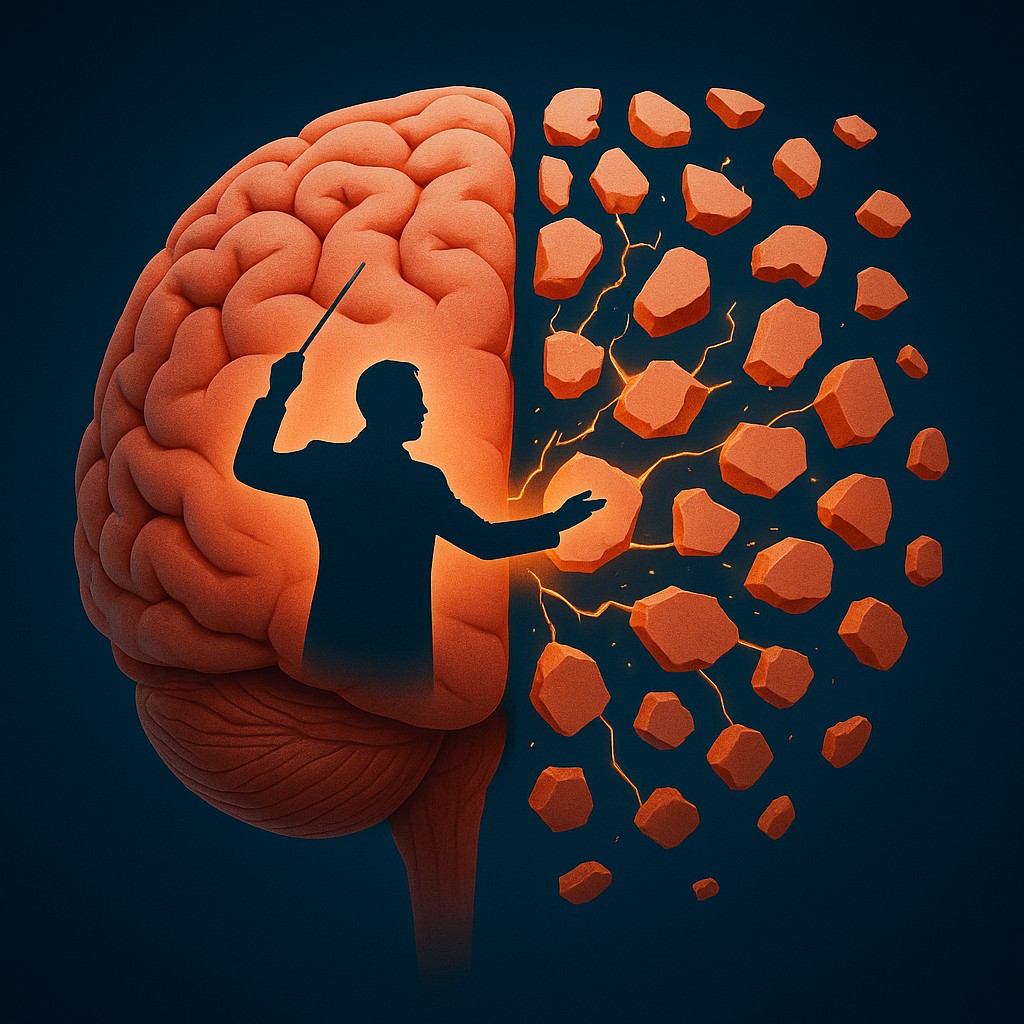
Imagine you are sitting in a theater, waiting for a world-class symphony to begin. Hundreds of musicians are tuning their instruments, creating a chaotic but energetic hum. Suddenly, the conductor walks out, raises a baton, and with a single motion, blends those hundreds of individual voices into a soaring masterpiece. This beautiful, unified wall of sound represents your conscious mind. Every instrument is a different region of your brain, and the conductor is the invisible force that binds your sight, sound, memory, and sense of self into one experience.
Now, imagine if someone didn't just tell the musicians to stop playing. Instead, they cut the wires to the conductor’s podium and built soundproof glass walls between every section of the orchestra. The violinists are still bowing and the drummers are still drumming, but they can no longer hear each other. The music doesn't just stop; it falls apart into a series of isolated, meaningless pulses.
This is the strange reality of what happens when you go under general anesthesia. For over a century, we assumed these drugs simply turned the brain "off," much like flipping a light switch or powering down a computer. We treated it as a heavy version of sleep, a biological pause button that keeps us from feeling pain during surgery. However, modern neuroscience has revealed a much more fascinating process. Under anesthesia, your brain cells are often just as active as they are when you are awake. They haven't been silenced; they have been isolated. Your "self" does not vanish because the neurons stop firing, but because the long-distance communication lines that allow the front of your brain to talk to the back have been cut. You aren't "out like a light" so much as you are "broken into pieces."
The Great Continental Drift of the Mind
To understand why breaking communication causes us to lose consciousness, we first have to understand what consciousness actually is. While philosophers have debated this for thousands of years, neuroscientists often look at it through a framework called Integrated Information Theory. This theory suggests that consciousness doesn't live in one specific "seat of the soul" in the brain. Instead, it comes from the massive amount of data being passed back and forth between specialized regions. Your visual cortex sees a red shape, your parietal lobe identifies it as a sphere, and your hippocampus reminds you that it’s an apple. In a conscious state, these regions are in a constant, high-speed conversation. They are "tightly coupled," meaning what happens in one room of the brain immediately affects what happens in the next.
When anesthesia enters the system, it acts like a digital jammer on a fiber-optic cable. Drugs like propofol or isoflurane target the receptors in our brain that handle inhibition, effectively turning up the background noise and turning down the meaningful signal. These drugs specifically target "hub" regions like the thalamus, which serves as the brain's central switchboard. When the thalamus is dampened, the long-range fibers that stretch across the brain can no longer stay in sync. The brain experiences a form of internal "continental drift." The island of "Vision" stays active, and the island of "Touch" might still flicker with life, but the bridges between them have collapsed. Without those bridges, there is no "you" there to experience the signals.
Why Anesthesia Is Not Just Deep Sleep
One of the most common myths is that anesthesia is simply the deepest possible sleep. In reality, sleep and anesthesia are as different as a quiet library and a broken radio. During natural sleep, your brain goes through distinct cycles. While you aren't very aware of the outside world, your brain remains connected as a whole. If someone whispers your name while you are asleep, the sound can still travel deep into your brain and trigger a wake-up response. The "wires" are still connected; the volume is just turned down.
Anesthesia, however, is a state of drug-induced coma. It is a systematic unlinking of the brain’s networks. Studies using brain imaging (fMRI) and electrical sensors (EEG) have shown that while a sleeping brain still displays organized waves of activity that travel from front to back, an anesthetized brain shows only "localized" activity. If you were to zap a specific part of a sleeping person's brain with a magnetic pulse, the electrical echo would travel throughout the entire organ. If you do the same to someone under anesthesia, the echo stays trapped in the small area where it started. It’s like throwing a stone into a pond and watching the water fail to ripple.
| Feature |
Natural Sleep |
General Anesthesia |
| Brain Connectivity |
Highly integrated; regions talk to each other globally. |
Locally active but globally disconnected. |
| Waking Up |
Easy to wake up with touch or sound. |
Impossible to wake up until the drug wears off. |
| Brain Waves |
Predictable cycles (REM and Non-REM). |
Erratic bursts or flat, repetitive waves. |
| Memory |
Limited but present (like dreaming). |
Completely blocked (no new memories formed). |
| Recovery |
Gradual transition through "sleep grogginess." |
Rapid "re-booting" of electrical bridges. |
The Thalamic Gatekeeper and the Information Blackout
If the brain is a city, the thalamus is the central train station. Almost every piece of sensory information, except for smell, must pass through the thalamus before it can reach the cortex, where it is processed into conscious thought. Anesthesia specializes in putting a "closed" sign on the doors of this station. Recent research has shown that anesthetic drugs specifically disrupt the "matrix" cells of the thalamus. These cells are responsible for broadcasting signals to wide areas of the brain all at once.
When these matrix cells are blocked, the brain becomes a collection of "local neighborhoods" that can no longer coordinate. This is why a surgeon can perform an operation without you feeling a thing. It isn't necessarily that the nerves in your skin stopped sending "pain" signals; it's that those signals reached the train station and found no one there to forward the message to the parts of the brain that create the sensation of suffering. The information is there, but the connection is gone. This "information blackout" is so effective that it doesn't just block pain; it deletes your sense of time. This is why, when you wake up, it feels as if no time has passed. You didn't "wait" in the darkness; the clock simply stopped because the mechanism that glues "now" to "then" was taken apart.
Common Fears About "Turning Off"
Many people fear anesthesia because they think of it as a journey toward death, a terrifying slide into a "void." However, the truth is much less scary. The brain doesn't die; it just becomes less complex. One of the most fascinating ways scientists measure this is through a "consciousness meter" called the Perturbational Complexity Index (PCI). By stimulating the brain and measuring how complex the resulting patterns are, researchers can tell if someone is conscious, dreaming, or anesthetized.
Under anesthesia, the complexity score drops. This isn't because the brain "flatlines" (which only happens in brain death), but because the response to the stimulus is incredibly simple and repetitive. It’s like saying the same word over and over again instead of telling a story. Another common myth is that we are "paralyzed" by the anesthesia itself. While doctors often give muscle relaxants to keep you still, the lack of movement is primarily because the motor cortex - the part of the brain that plans movement - has been disconnected from the rest of the system. Even if your brain "wanted" to move, the command would be lost in the static before it ever reached the spinal cord.
The Beautiful Chaos of the Reboot
The most amazing part of this process is what happens when the anesthesiologist turns off the gas or stops the IV. As the drug leaves your bloodstream, the brain doesn't just slowly "warm up." Instead, it undergoes a sudden shift, much like water turning into ice or steam. The sensors in the brain begin to recover, and suddenly, the "bridges" that were down begin to rebuild themselves. This is often called the "reboot" sequence.
During this phase, the brain often jumps through different states of consciousness. You might experience "emergence delirium," where the brain is partly connected but not yet fully coordinated. This leads to those funny videos of people talking about unicorns or their love for tacos. But within minutes, the long-range connections return to normal. The orchestra is back in the room, the conductor has taken the baton, and your "self" is put back together from the fragments. You are "you" again because your brain has regained its ability to hold a conversation with itself across the vast distances of its own geography.
Understanding anesthesia as a form of electrical disconnection helps us appreciate how fragile and magnificent our consciousness truly is. It isn't a solid object; it is a collaborative performance, a high-wire act of constant communication. Every time we wake up from surgery, we are seeing the power of connectivity. We learn that who we are depends less on the individual cells we have and more on the invisible, buzzing webs of electricity that tie them together. In the end, anesthesia teaches us that the mind is not a place, but a process of staying in touch.