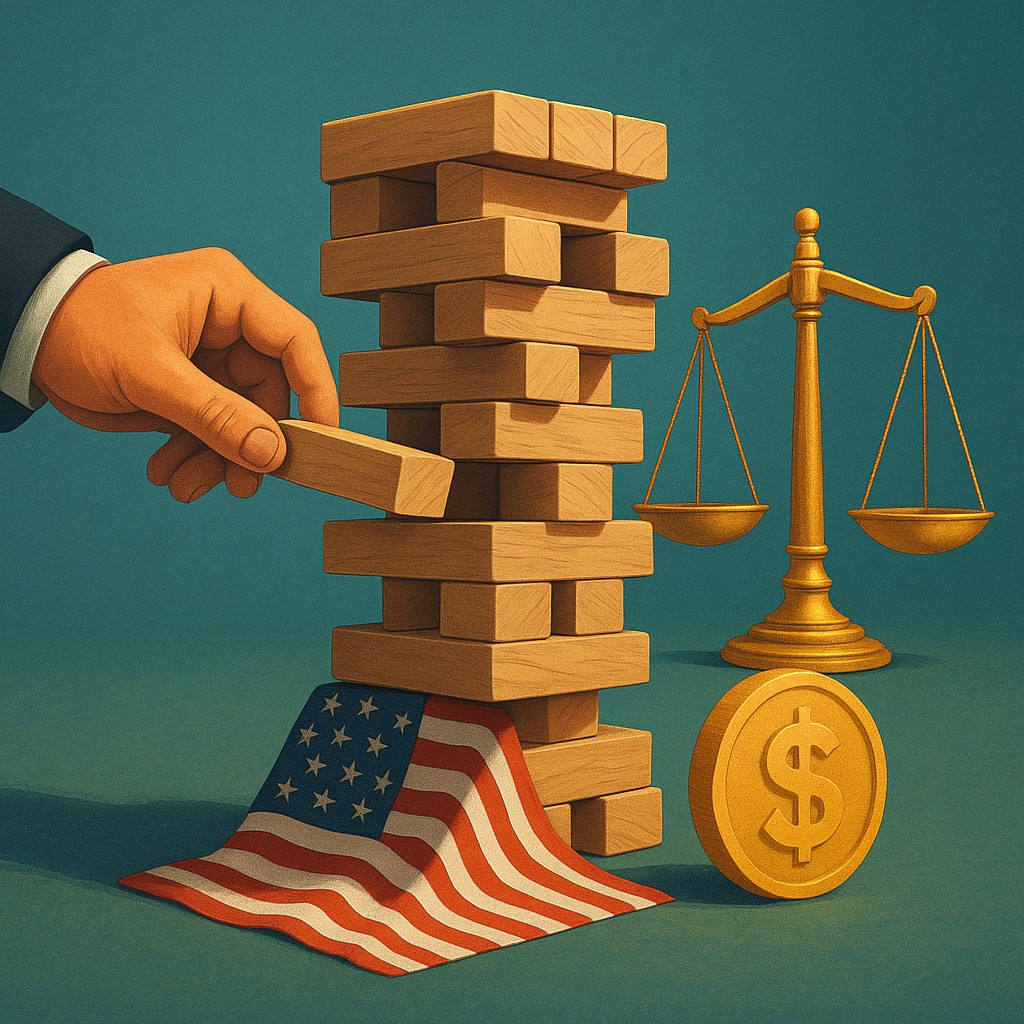
Think of the global economy as a massive, high-stakes game of Jenga. In this game, every wooden block represents a trade deal, a factory, or the price on a grocery store shelf. For decades, the United States has operated under a system where the President had significant, but limited, power to move these blocks around. Recently, however, the U.S. Supreme Court stepped in, suggesting the President may have been moving too many blocks at once. This legal drama centers on a tug-of-war between the White House and the courts over who truly controls the nation’s wallet when it comes to international trade.
The situation grew even more intense when, despite a legal defeat at the high court, the current administration moved forward with a sweeping 15 percent tariff - essentially a tax on imports - on almost everything entering the country. This is not just a dry legal dispute over paperwork; it is a massive gamble that impacts the price of your morning coffee, your next phone, and the stability of world markets. To understand why the Supreme Court said "stop" and the administration said "go anyway," we have to untangle the web of trade laws, constitutional powers, and the economic theories driving these choices.
Stripping Away the President’s Trade Authority
To understand the current tension, we must look at the International Emergency Economic Powers Act, or IEEPA. Passed in 1977, this law was intended to give the President the power to regulate business during national emergencies. For years, presidents from both parties used it like a Swiss Army knife for foreign policy, placing sanctions or tariffs on specific countries to punish bad behavior or protect national security. However, the Supreme Court recently ruled that the presidency had pushed this law too far. The Court essentially told the administration that a "national emergency" cannot be used as a permanent, global blank check to tax every single item crossing the border.
The core of the Court's ruling focused on the "separation of powers." According to the U.S. Constitution, the power to tax and regulate trade belongs to Congress, not the President. Over time, Congress handed some of that power to the White House to allow for quick responses to global crises. But the Supreme Court decided that using these emergency powers to impose broad tariffs on all countries at once went too far. They ruled that the law was meant for specific threats, not a total rewrite of the global trading system. In theory, this ruling took away the President’s most effective tool for raising import prices on his own.
The Bold Shift to a Global 15 Percent Tax
You might think a Supreme Court ruling would end the matter, but high-level politics and economics are rarely that simple. Shortly after the ruling, the administration announced a new plan: a 15 percent tariff on all imports from every corner of the globe. This was a massive shift designed to find a different legal path to the same goal. The administration argued that while the Supreme Court closed one specific legal door, other laws and the President’s own authority over foreign affairs still provided enough room to act. Essentially, they signaled they were willing to test the legal waters again with a new strategy.
The 15 percent figure was not a random choice. It is high enough to encourage companies to move manufacturing back to the United States, yet the administration hopes it is low enough to keep shoppers from stopping their spending entirely. By applying it to the whole world, the administration is trying to avoid a "whack-a-mole" problem, where companies simply move production from one taxed country to another. If everything coming in is taxed at 15 percent, there is no easy escape for importers. This move directly challenges the free-trade rules that have governed the world since the end of World War II.
Comparing the Legal and Economic Landscapes
To understand how the Court and the White House are colliding, it helps to look at exactly what changed between the old system and the new reality. One side is focused on the strict letter of the law, while the other is focused on a specific economic result.
| Feature |
Supreme Court Ruling (Focus on IEEPA) |
New 15% Global Tariff Strategy |
| Primary Authority |
Congress holds the ultimate power to tax. |
President claims power via foreign policy. |
| Scope |
Meant for specific, limited emergencies. |
Applied broadly to all countries and goods. |
| Legal Logic |
Separation of powers; the President is not a King. |
Economic nationalism; protecting local jobs. |
| Immediate Result |
Thousands of past tariffs declared illegal. |
A new, uniform tax on all imported goods. |
| Impact on You |
Potential for lower prices and trade refunds. |
Likely higher costs for daily essentials. |
This table shows the fundamental disagreement. The Court is worried about how things are done, ensuring the rules of the Constitution are followed. The administration is worried about what is done, focusing on balancing trade and boosting American factories. When these priorities clash, the result is huge uncertainty for businesses that do not know if the price they pay today will stay legal tomorrow.
The Price Tag on Your Daily Life
A "15 percent tariff" might sound like distant news, but it hits your wallet directly. A tariff is a tax paid by the company that brings goods into the country. If a company imports a thousand televisions and suddenly owes the government an extra 15 percent, they have two choices: they can take the loss and earn less profit, or they can raise the price for you. Usually, they do a bit of both, but the shopper almost always feels the pain. This is why economists often call tariffs a "consumption tax" that hits the average person hardest.
Beyond the store shelf, there is a "ripple effect" through global supply chains. A car built in the U.S. might use parts from Mexico, electronics from Taiwan, and steel from Brazil. If every one of those parts becomes 15 percent more expensive, the final price of that "American-made" car goes up significantly. This can cause inflation, where prices rise across the board, not just on foreign goods. The administration is betting that this temporary pain will force companies to build parts inside the U.S., but building a factory takes years, while a 15 percent price hike happens overnight.
Navigating the Maze of Exemptions
To keep the economy from grinding to a halt, the administration did not just flip a switch. They created a 150-day waiting period and a process for "exemptions," or special permission to skip the tax. This is where the real bargaining happens. Companies can petition the government, arguing that their specific product is essential and cannot be found in the U.S., so it should be exempt from the 15 percent fee. This creates a massive bureaucratic maze where some industries win and others lose based on how well they can lobby the government.
This window also serves as a cooling-off period and a bargaining chip. By announcing the tariff but delaying it, the U.S. is using a megaphone to tell the rest of the world: "Let's make a deal." Trading partners like the European Union, Canada, and Japan are now rushing to see what concessions they can offer to avoid the tax. It is a high-stakes form of "checkbook diplomacy" that uses the threat of tariffs to rewrite old trade agreements.
The Future of Global Trade Rules
We are currently watching the old rules of the game be torn down. For decades, the World Trade Organization (WTO) acted as the referee for global trade, based on the idea that tariffs should be low and predictable. The Supreme Court’s ruling was an attempt to bring that predictability back by making the President follow specific legal steps. However, the move to a 15 percent global tariff suggests the U.S. is moving toward a more "transactional" era. In this new world, the law may be less about long-standing treaties and more about what the current administration feels is necessary to protect the domestic economy.
The big question is how the courts will respond to this new 15 percent plan. Legal experts are already preparing to argue that if the Supreme Court said the President could not use "emergency powers" for broad tariffs, he should not be able to use vague "foreign policy" powers to do the exact same thing. We are likely headed for a second Supreme Court showdown that will define the limits of presidential power for generations.
As you watch this story unfold, remember that you are more than a spectator; you are part of a giant economic experiment. Every time you see a price change or a "Made in the USA" label, you are seeing the result of these legal and political battles. While the jargon is thick and the rulings are complex, the core idea is simple: we are deciding as a nation how we want to deal with the rest of the world. By staying informed, you can navigate this changing economy with more confidence. The future of trade is being rewritten right now, and understanding these rules is your best tool for staying ahead.