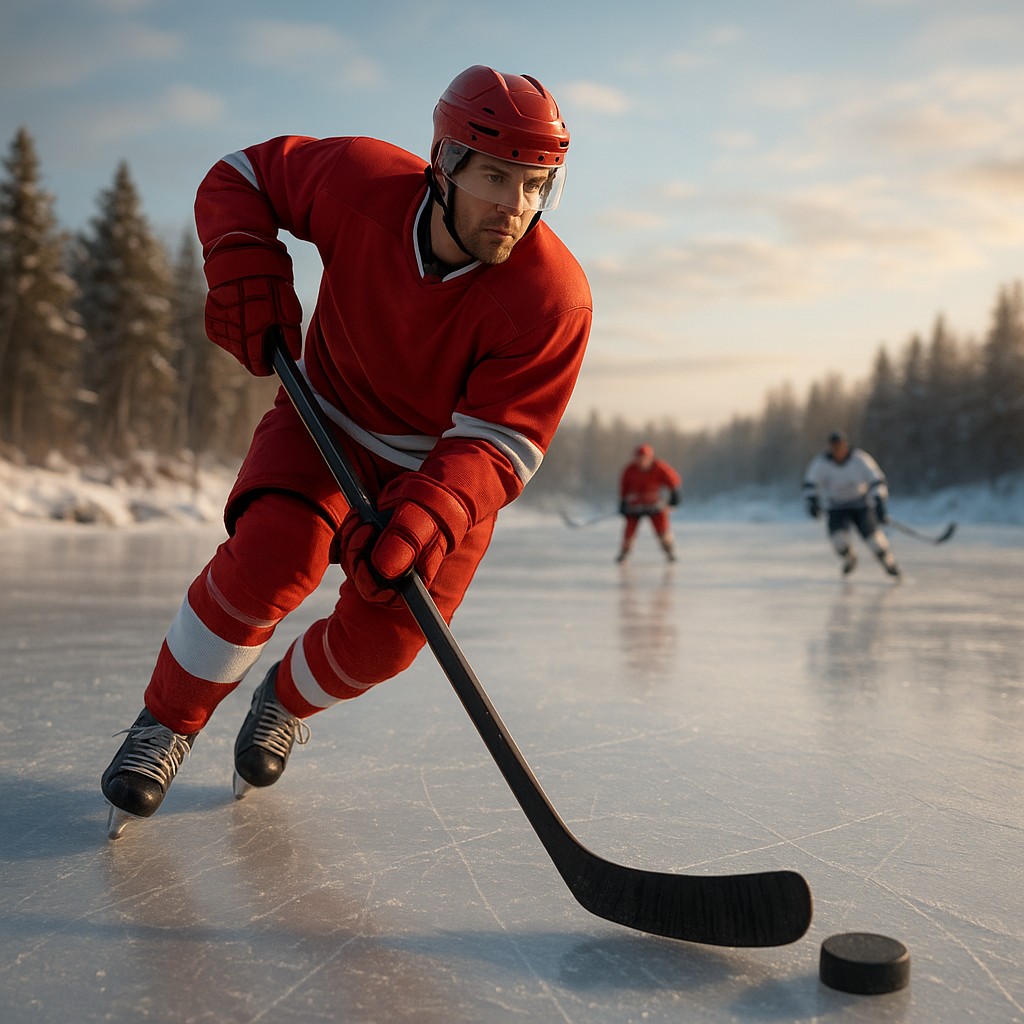
Imagine standing in the middle of a frozen pond. The air is so cold you can see your breath, and the only sound is the rhythmic scrape of steel blades against a sheet of glass. This is the birthplace of hockey, a sport often described as a chess match played at sixty miles per hour. It is a game defined by contradictions: it requires the grace of a figure skater, the toughness of a gladiator, and the strategic mind of an architect. Whether you are watching a local youth league or the high-stakes drama of the pros, the chaotic beauty of the game is governed by rules designed to keep the speed high and the danger manageable.
Learning the rules of hockey is like learning a new language where the punctuation consists of whistles and the verbs are high-speed collisions. At first glance, it might look like twelve people chasing a frozen rubber "biscuit" with sticks, but there is a deep, logical structure to the mayhem. Once you understand why the referee is signaling a certain way or why the play suddenly stops when a player crosses a line, the game transforms from a blur of motion into a story of skill and sacrifice. Let us lace up our mental skates and step onto the ice to explore the core principles that make this the fastest game on earth.
The Canvas and the Cast of Characters
Before we can talk about how the game is played, we must understand the stage. A standard hockey rink is a rounded rectangle divided into three main zones by two thick blue lines. The middle area is the "neutral zone," while the areas at either end are the "attacking" and "defending" zones, depending on which way your team is headed. At the center is a red line that cuts the rink in half, serving as a boundary for rules about passing and moving the puck. The walls, known as the boards, are not just boundaries but active parts of the play; players use them to bounce passes to themselves or to pin opponents during a battle for the puck.
On this icy stage, each team usually fields six players at a time. The centerpiece is the goaltender, a brave soul wrapped in pounds of protective foam and plastic, whose sole job is to stop the puck from crossing the goal line. In front of them are two defensemen, who protect the zone, and three forwards: a center, a left wing, and a right wing. While these roles have traditional duties, modern hockey is incredibly fluid. You will often see a defenseman rushing deep into the offensive zone to try to score, while a forward slides back to cover the empty spot. This constant movement is one of the reasons the game is so physically demanding, leading to "line changes" where fresh players jump onto the ice every 45 to 90 seconds.
Navigating the Lines: Offside and Icing
The two most common reasons a referee blows the whistle have nothing to do with hitting or tripping. Instead, they are structural rules designed to keep the game fair and prevent teams from simply "parking" a player near the opponent's net.
The first of these is the offside rule. In simple terms, the puck must enter the attacking zone before any attacking player does. Think of the blue line as a gate; the puck has to lead the way. If a player crosses that blue line with both skates before the puck goes over, they are offside, and the play stops for a face-off. This prevents "cherry-picking," where a player stays near the net waiting for a long pass, forcing the team to work together to move up the ice.
The second rule is called icing. This happens when a player shoots the puck from their own half of the red center line all the way past the opponent's goal line without anyone touching it. In the old days, teams would do this just to catch their breath when they were under pressure. To keep the game exciting, the rules now say that if you "ice" the puck, the play is whistled dead and the next face-off happens back in your own defensive zone. Furthermore, in most professional leagues, the team that committed the icing is not allowed to swap out their tired players for fresh ones. This creates a high-stakes punishment for being lazy with the puck.
The Art of the Face-Off and Game Timing
Every time the whistle blows, the game restarts with a face-off. This is one of the most unique parts of hockey: two opposing players stand nose-to-nose at one of the nine designated "dots" on the ice. The official drops the puck between them, and a miniature battle of strength and timing begins. It is a game within a game, where centers use their sticks, bodies, and even their skates to win the puck for their team. Winning a face-off near the opponent's goal can lead to an immediate score, while losing one in your own end can put your team in instant danger.
A standard game is divided into three periods of 20 minutes each, with breaks in between. Unlike many sports that use a running clock, the hockey clock stops every time the whistle blows. This means a 20-minute period can actually take about 40 minutes of real time to play. If the score is tied at the end of three periods, the game usually goes into "overtime." In the modern professional era, overtime is often played "three-on-three," which opens up massive amounts of ice for incredible breakaway goals. If no one scores in overtime, many leagues settle the match with a shootout - a dramatic one-on-one showdown between a single shooter and a goalie.
| Rule Concept |
Primary Purpose |
Result of Violation |
| Offside |
Prevents "cherry-picking" near the net. |
Face-off in the neutral zone. |
| Icing |
Discourages desperate, long-distance clearing. |
Face-off in the offending team's zone. |
| Crease Interference |
Protects the goalie from being bumped or blocked. |
Goal disallowed or minor penalty. |
| High-Sticking |
Ensures safety by keeping sticks below the shoulder. |
Face-off or 2 to 4-minute penalty. |
| Delay of Game |
Prevents stalling (e.g., shooting puck over glass). |
2-minute minor penalty. |
Keeping the Peace: Penalties and Power Plays
Hockey is a contact sport, but it is not a free-for-all. There are specific limits on how you can interact with an opponent. Legal contact, known as "body checking," involves using your shoulder or hip to bump an opponent who has the puck. It must be done from the front or side, never from behind. If a player uses their stick as a weapon or a tool to slow someone down, the referee will signal a penalty. Common fouls include "hooking" (using the stick blade like a fishing hook to pull someone back), "tripping," or "slashing" (hitting an opponent with a swinging motion of the stick).
When a penalty is called, the offending player must go to the "penalty box," a small glass enclosure that serves as a time-out for adults. Most minor penalties last for two minutes. This results in a power play, where the penalized team must play with one fewer person (five skaters against four). This is the most dangerous time in a hockey game; the team with the advantage will surround the net and whip the puck around, looking for a hole in the defense. If the team on the power play scores, the penalty ends immediately and the player is released from the box. However, if the penalty is a "major" (usually five minutes for dangerous acts like fighting), the player stays in the box for the full time, no matter how many goals are scored.
Correcting Common Myths
One of the biggest misconceptions for newcomers is that hockey is a lawless wasteland where fighting is the main event. In reality, while fighting is sometimes tolerated in North American pro leagues as a way for players to "police" themselves, it results in a five-minute penalty and is non-existent in Olympic or European hockey.
Another myth is that the "crease" (the blue semi-circle in front of the net) is a magical barrier that players can never enter. While you cannot interfere with the goalie’s movement, players can enter the crease to battle for rebounds, as long as they do not physically block the goalie from doing their job.
There is also confusion regarding "hand passes." You can bat the puck out of the air with your hand, but you cannot "pass" it to a teammate with your hand unless you are both in your own defensive zone. Similarly, you cannot use your hand to push the puck into the net. The same goes for your skates; while you can use your feet to block a pass or move the puck to your own stick, you cannot "distinctly kick" the puck into the goal. Officials look for a clear kicking motion; if the puck just happens to bounce off your skate and go in, it counts, but a soccer-style kick will be disallowed.
The Secret Language of the Officials
If you watch a game closely, you will see a crew of officials: usually two referees (wearing orange armbands) and two linesmen. The referees are the "judges of the soul" - they call penalties and decide if a goal is valid. The linesmen are the "masters of geography" - they call offside and icing, and they handle most of the face-offs. They communicate through hand signals. A referee pointing aggressively at the goal means the score counts, while a horizontal "washing" motion with both arms means "no goal" or "no penalty."
Understanding these signals helps you stay ahead of the broadcast. When a referee raises one arm straight in the air while the play is still moving, he is signaling a delayed penalty. This means a foul occurred, but because the other team still has the puck, the play continues until the penalized team touches it. During this time, the team with the puck will often pull their goalie off the ice to put an extra attacker on, knowing that as soon as the other team touches the puck, the whistle will blow - meaning no goal can be scored against their empty net. It is a moment of strategic risk that happens several times a game.
Embracing the Speed and the Spirit
As you can see, hockey’s rules are not meant to slow the game down, but to channel its energy into a structured competition. Every line on the ice has a purpose, every whistle has a reason, and every penalty is a lesson in discipline. When you watch the puck move from skate to stick to the back of the net in a matter of seconds, you are seeing the result of years of practice and a deep respect for these rules. Hockey is a game of incredible intensity, but it is also one of immense respect - shown by the tradition where teams shake hands at the end of a hard-fought playoff series.
Now that the mystery of the blue lines, the rules of the power play, and the logic of the face-off are clear, the game becomes a much more rewarding experience. You are no longer just a spectator watching a blur of color; you are an informed observer who can see a play coming before it happens. So, the next time you hear the roar of the crowd and the thud of a puck hitting the boards, you will know exactly why the players are moving the way they are. Go out, find a game, and let the speed and strategy of hockey capture your imagination.