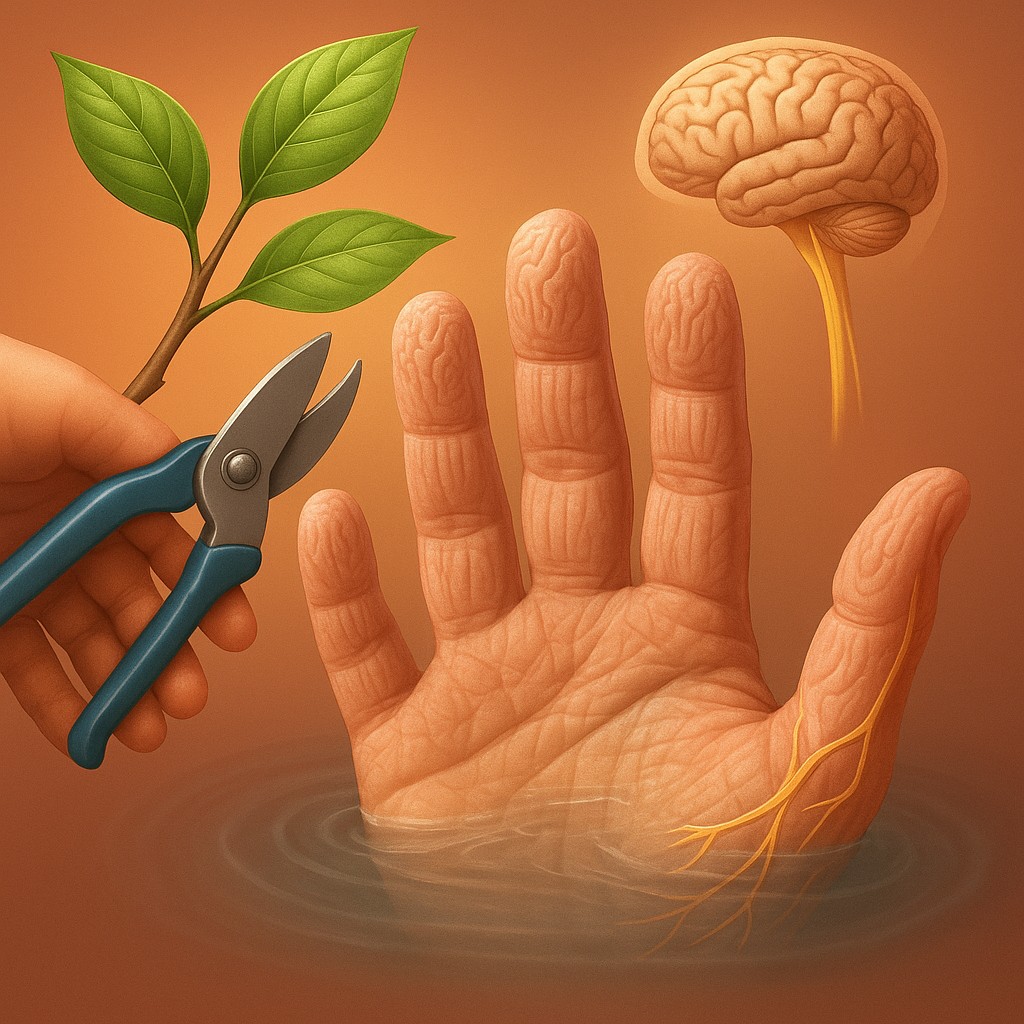
Imagine taking a long, luxurious soak in a bathtub or spending an afternoon at the local pool. After twenty minutes or so, you glance down at your hands and notice something odd. Your once smooth fingertips have transformed into shriveled, prune-like textures, looking decades older than the rest of your body. For nearly a century, the common explanation for this was simple physics. We were told that our skin acted like a sponge, absorbing water until the outer layers expanded and buckled into folds. It seemed like a straightforward case of osmosis, a side effect of being a porous biological creature submerged in water.
However, if you look closer at the rest of your body, the "sponge" theory begins to fall apart. Why don't your stomach, your forearms, or your back wrinkle in the same way? If it were truly just water soaking into the skin, we should emerge from a bath looking like giant raisins from head to toe. Instead, the wrinkling is localized specifically to our fingers and toes. This biological mystery remained unsolved until surgeons noticed something fascinating: patients with certain types of nerve damage in their hands didn't wrinkle at all, no matter how long they stayed in the water. This discovery flipped our understanding on its head, revealing that those wrinkles aren't a physical accident, but a high-tech response from your internal wiring.
The Invisible Command of the Sympathetic Nervous System
The transformation of your skin is actually a performance orchestrated by your sympathetic nervous system, the same system responsible for your "fight or flight" response. While we usually associate this system with racing hearts and sweaty palms during a stressful presentation, it also manages hundreds of quiet, involuntary background tasks. When your hands and feet stay underwater for a specific amount of time, your nervous system essentially decides that the environment has changed and it is time to shift into a different "operating mode." Specifically, it sends a signal to the tiny blood vessels beneath the surface of your fingertips.
Instead of the skin expanding outward due to moisture, your blood vessels actually begin to shrink. As these vessels tighten and pull inward, they create a vacuum-like effect on the layers of skin above them. Because the skin is anchored to the tissue underneath at certain points but flexible at others, this inward pull creates deep, uniform ridges. It is a controlled collapse of the surface area, driven entirely by neurology. If the nerves in a finger are severed or severely damaged, the signal to shrink never arrives, and the skin remains stubbornly smooth. This is so consistent that doctors sometimes use the "wrinkle test" as a quick bedside tool to check if a patient’s nervous system is functioning correctly after an injury.
Designing a Biological Rain Tire
To understand why our bodies would bother with such a complex reaction, we can look at the world of mechanical engineering. If you look at the tires on a high-end sports car, you will notice deep grooves carved into the rubber. These aren't just for looks. When a car drives over a wet road, a thin layer of water can get trapped between the tire and the pavement. This leads to a dangerous loss of traction known as hydroplaning, where the car slides on the water's surface. The treads on a tire provide a drainage path, allowing the water to be squeezed out and diverted away so that the rubber can make direct contact with the solid ground.
Our ancestors faced a similar problem. Whether they were foraging for calorie-dense tubers (starchy roots) in damp soil, trekking through rain-slicked forests, or attempting to snatch a slippery fish from a stream, grip was a matter of survival. Evolution "designed" our fingers and toes to mimic those rain tires. By creating deep channels on our gripping surfaces, our bodies developed a way to shed water rapidly upon contact with an object. This ensures that when you reach for a wet stone or a mossy branch, the water is pushed into the "valleys" of the wrinkles, leaving the "peaks" of your skin free to create friction and maintain a firm hold.
| Feature |
The Old Myth (Osmosis) |
The New Reality (Neurology) |
| Primary Cause |
Water soaking into the skin |
Blood vessels tightening (Vasoconstriction) |
| Control Mechanism |
Passive physical process |
Active nervous system response |
| Biological Purpose |
None, it was seen as a side effect |
Better grip and traction in wet conditions |
| Key Observation |
Skin should swell everywhere |
Only occurs where specific nerve pathways exist |
| Medical Indicator |
Shows how porous the skin is |
Shows how healthy the nervous system is |
The Evolutionary Edge of the Prune Finger
When we think about evolution, we often focus on "big" changes like walking upright or developing larger brains, but the wrinkly finger is a perfect example of how small, specialized adaptations helped us thrive. Research has shown that people with wrinkled fingers are significantly faster at moving wet objects, such as marbles or lead weights, from one container to another compared to those with smooth fingers. Interestingly, the wrinkles don't offer any advantage or disadvantage when handling dry objects. This suggests that wrinkling is a highly specialized "wet-weather" mode that only activates when the benefit is worth the energy it costs the body.
This adaptation was likely a game-changer for early humans living by riverbanks or coastal regions. Imagine a group of early humans trying to gather shellfish in a tidal pool. Without this nervous system response, their hands would be as slick as greased glass. With the "tread" system activated, they gained the dexterity needed to handle complex tools and food sources in the rain or underwater. This gave our ancestors a wider range of environments to live in, turning potentially hazardous, slippery terrain into a reliable pantry. It is proof that our bodies are constantly sensing the environment and changing their own shape to keep us at the top of the food chain.
Practicality Over Appearance in Human Design
One might wonder why, if wrinkly skin is so great for grip, we don't just have wrinkled fingers all the time. The answer lies in the trade-offs of biological engineering. Smooth skin is generally more durable and less likely to snag or tear during the thousand dry tasks we perform every day. Furthermore, the shrinking of blood vessels required to create the wrinkles reduces blood flow to the fingers. While this is perfectly safe for a limited time, it isn't an efficient way to keep a limb healthy in the long run. Your body is a master of "just-in-time" manufacturing; it only builds the tools it needs when it realizes you are actually in the water.
This neurological trigger also explains the delay. It takes about five to ten minutes for the wrinkling to become noticeable. Your nervous system is essentially waiting to make sure you aren't just dealing with a momentary splash or a brief rain shower. It requires staying underwater to confirm that you are truly working in a wet environment. Once that confirmation is reached, the sympathetic system kicks in, the vessels tighten, and your hands transform into the ultimate high-precision, all-terrain gripping tools. This delay prevents your body from constantly shifting gears for every minor change, ensuring it only commits to the transformation when it is truly necessary.
The Body as an Intuitive Machine
Understanding the science of wrinkly skin changes the way we see our own bodies. We are not just static inhabitants of a physical form; we live in a highly responsive machine that is constantly communicating with itself. Every time you step into a pool or wash the dishes, a complex dialogue is happening between your skin, your blood vessels, and your brain. It is an elegant system that has been refined over millions of years, turning a simple bath into a showcase of evolutionary engineering.
The next time you look down at your "pruned" fingers, don't see them as a sign of being soggy. Instead, look at them as a specialized piece of survival gear. You are witnessing a legacy of ancestors who survived because they could hold on tighter, climb better, and find food more effectively than those who couldn't. It is a reminder that even in the most mundane moments, our biology is working tirelessly behind the scenes, adjusting its very shape to ensure we can navigate the world with precision. You aren't just soaking; you are adapting.