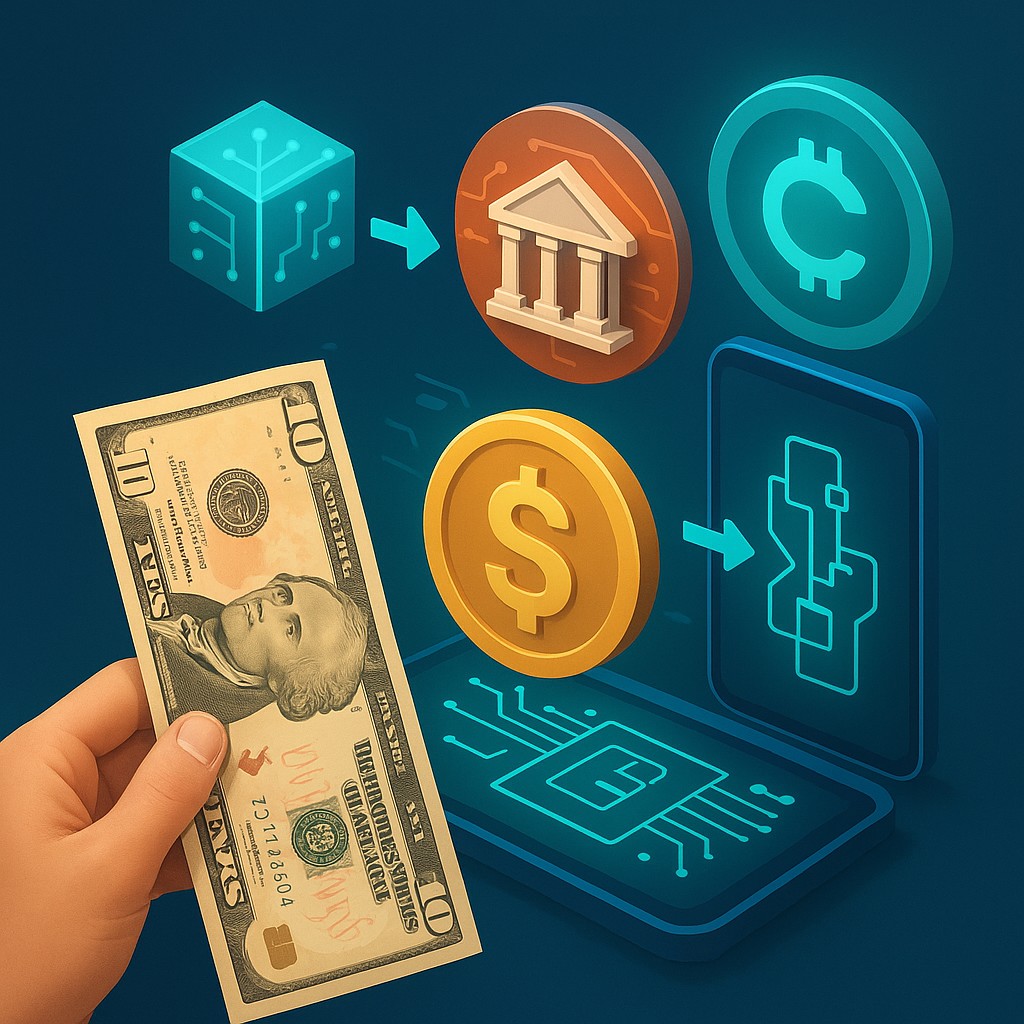
Imagine you are holding a ten dollar bill. That piece of paper is a remarkably passive object. It doesn't know where it has been, it doesn't care what you buy with it, and it certainly has no opinion on whether you have paid your taxes or finished your chores. It is a "dumb" instrument, a simple placeholder for value that waits for a person to hand it over before it does anything at all. For centuries, this has been the fundamental nature of money: a quiet, obedient tool for trade that sits in your wallet until you decide to give it a job.
But the nature of that ten dollar bill is undergoing a radical change. Around the world, central banks are experimenting with Central Bank Digital Currencies, or CBDCs. These move money from the world of paper and simple bank records into the world of computer code. This isn’t just about making money digital, as we already have credit cards and payment apps like Venmo for that. This is about making money "programmable." It is the difference between a paper letter sitting in a mailbox and a computer program that only sends itself when certain conditions are met. Under this new model, money becomes an active participant in the economy, capable of making its own decisions based on a set of pre-programmed rules.
The Logic Gate in Your Wallet
To understand programmable money, we have to look at the "smart contract," which is the engine driving this change. In traditional banking, if you want to buy a house, you need a small army of middlemen, including lawyers, escrow agents, and bank officers, to ensure the money only moves when the deed is signed. It is a slow, manual process prone to human error and delays. A smart contract replaces these people with a simple "if-then" instruction embedded directly into the currency. If the digital deed is uploaded to the record, then the funds are instantly released to the seller. If not, the money stays put.
This mechanism turns the currency itself into a trusted referee. Because the logic is written into the code of the CBDC, the transaction doesn't require a third party to confirm that the rules were followed. This is often called "conditional payment" logic. In a world of programmable money, your paycheck could be set to automatically split the moment it hits your account: thirty percent to a savings vault, twenty percent to a tax account, and the rest to your spending balance. There is no manual transfer, no risk of forgetting to save, and no waiting. The money simply follows its instructions like a loyal, extremely fast robot.
Beyond the Digital Ledger
The impact of this shift goes far beyond personal convenience. When a nation’s central bank issues a programmable currency, it gains a set of high-precision tools for managing the economy that were previously impossible. Consider how governments currently hand out subsidies or disaster relief. They often mail checks or deposit lump sums, hoping the money is used as intended and struggling to see if it actually helps the local economy. With programmable CBDCs, a government could issue "purpose-bound" money.
For instance, during a local economic slump, the government could distribute digital tokens that are only valid at small businesses within a specific zip code and must be spent within sixty days. If the money isn't used by the deadline, it could automatically return to the treasury, preventing people from "hoarding" stimulus funds during a crisis. While this sounds like science fiction, it is exactly the kind of precision-guided policy that officials in various countries are now testing. The goal is to move away from "blunt instruments" like interest rate hikes toward a more surgical, real-time approach to managing the flow of money.
The Tradeoff Between Efficiency and Freedom
Every leap in technology usually comes at a cost to privacy or independence, and programmable money is no exception. Because every unit of a CBDC is essentially a piece of data on a central record, the central bank, and by extension the government, can theoretically see every transaction as it happens. In our current system, if you buy a coffee with cash, that transaction is a private matter between you and the barista. In a CBDC world, that purchase leaves a permanent, traceable digital footprint visible to the organization that issued the money.
This creates a tension between the benefits of "smart" money and the democratic value of financial privacy. If the government can program money to be spent only on healthy food or to block it from being spent on "vices," the currency stops being a neutral tool and becomes a way to control behavior. While this could lead to better public health or higher tax collections, it also grants the state a level of control over individual choices that history suggests can be easily abused. The challenge for the creators of these systems is to build in "privacy-preserving tools," such as zero-knowledge proofs, which allow the bank to verify a transaction is valid without actually seeing what was bought or who bought it.
Comparing the Old Guard and the New Wave
To see how profound this shift is, it helps to compare our current electronic banking system with the proposed CBDC framework. We often mistake our banking apps for "programmable money," but they are really just digital screens for old-fashioned accounting.
| Feature |
Physical Cash |
Current Digital Banking |
Programmable CBDC |
| Medium |
Paper and Metal |
Commercial Bank Records |
Digital Computer Code |
| Speed |
Instant (In-person) |
1-3 Days (Processing lag) |
Near-Instant (Real-time) |
| Programmability |
None |
Limited (Scheduled transfers) |
High (Built-in Smart Contracts) |
| Control |
Held by the user |
Managed by the bank |
State-designed and Code-driven |
| Privacy |
High (Anonymous) |
Medium (Bank sees data) |
Low to Medium (State visibility) |
| Innovation |
Static |
Depends on bank software |
Open for new digital protocols |
As the table shows, the jump to CBDCs isn't just a slight improvement in speed; it is a fundamental shift in who holds the "logic" of the transaction. In traditional banking, the bank holds the logic. In a CBDC system, the money itself holds the logic. This allows for "atomic settlement," where the exchange of an asset and the payment happen at the exact same moment. This removes the risk that one person will fail to deliver after the other has already paid.
Automating the Tax Man and the Social Safety Net
One of the most practical, if controversial, uses for programmable money is automating tax collection. Currently, paying taxes is a massive headache for both citizens and the government. Businesses have to calculate and send in sales tax, while individuals have to track income and file annual returns. In a programmable system, tax could be collected in real-time. When you buy a pair of shoes, the portion of the price for sales tax could be instantly sent to the government's digital wallet the microsecond the sale happens.
Similarly, distributing social benefits could be transformed. Instead of a complex application process for food stamps or housing vouchers, a programmable CBDC could automatically verify a person's eligibility based on their income and drop "smart tokens" into their digital wallet. These tokens would manage themselves, ensuring they are only used for their intended purpose without needing a massive bureaucracy to check the spending later. The "friction" in the economy, the billions of hours spent on accounting and auditing, could potentially disappear, replaced by a self-clearing digital system.
Navigating the Frontier of Financial Control
We are currently in the early stages of programmable money. Central banks in Europe, China, and the United Kingdom are running tests to see how these systems handle high volumes of activity and how they work with existing commercial banks. There is a delicate balance to strike: if a CBDC is too "good," people might pull all their money out of traditional banks, which could collapse the private lending market. To prevent this, many central banks are looking at "two-tier" systems where the state provides the digital pipes, but private banks still handle the customer relationships.
The most exciting, and perhaps concerning, part of this transition is that we are rewriting the social contract of money. For the first time, the "rules" of how we spend, save, and pay taxes are moving from law books directly into the source code of our currency. This ensures the rules are followed perfectly, but it also means those who write the code have more power than any treasurer in history. As we move toward this automated future, the conversation will likely shift from "How do we make money faster?" to "How do we ensure the money we use serves our freedom as much as it serves our efficiency?"
The evolution of money is a journey from things we can touch to abstract ideas, and finally to intelligent systems. We began with gold coins that had value in themselves, moved to paper bills that represented value, and then to digital records that tracked value. Now, we are entering the era of "active value." Our money will not only buy our groceries but also check the expiration date, calculate the tip, and ensure the farmer gets paid instantly. It is a world of immense possibility that requires us to be more watchful than ever about how these tools are designed. If we get it right, we may unlock an era of incredible economic flow; if we get it wrong, we risk turning our money into a tool for control. The code is being written now, and understanding how it works is the first step in making sure it works for us.