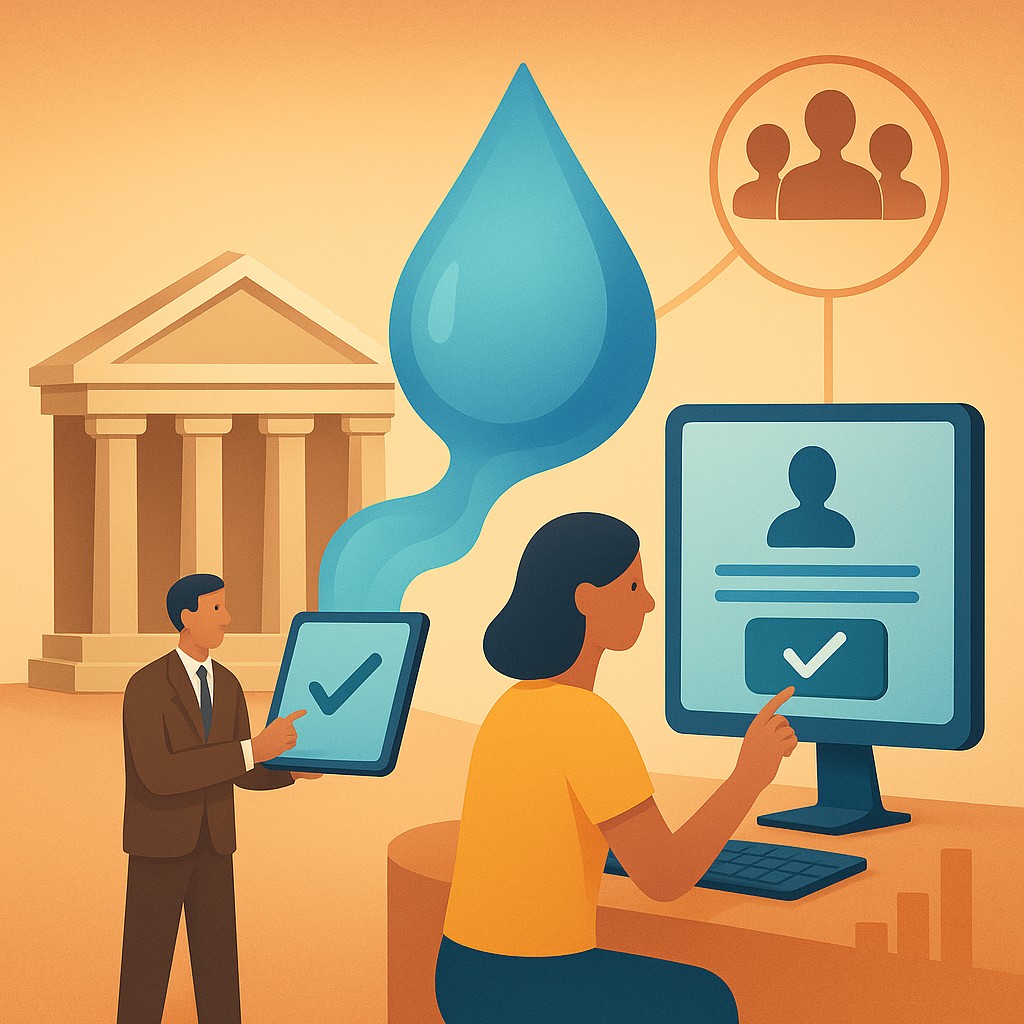
Imagine for a moment that you are asked to vote on a national policy for funding subatomic particle research. Unless you are a high-energy physicist, you would likely feel a flash of panic or, at the very least, completely out of your depth. Most of us want to be "good citizens," but modern life is so complicated that it is physically and mentally impossible to be an expert on everything from farm subsidies to cybersecurity. Currently, we are stuck with a binary choice: we either spend forty hours a week researching every niche bill to vote on them ourselves, or we hand a "blank check" to a single representative who might be great on healthcare but makes no sense when it comes to environmental science.
This tension is exactly why political thinkers and tech experts are experimenting with a "third way" that feels more natural in our digital age. It is a system designed to treat our votes not as heavy, immovable stones we cast once every four years, but as a fluid substance. Your influence can flow toward experts and back to you at the click of a button. By combining the personal control of a direct democracy with the specialized efficiency of a representative one, we are seeing the rise of a framework that grows with human knowledge rather than burying us under it.
The Spectrum of Participation
To understand why liquid democracy is gaining ground, we first have to look at the rigid walls of our current systems. In a pure direct democracy, every citizen acts as a lawmaker. While this sounds perfectly fair, it quickly becomes an administrative nightmare. If you had to vote on the specific fuel grades for cargo ship engines before you could even eat breakfast, society would grind to a halt. On the other end of the spectrum is representative democracy, which most of us use today. It solves the "time" problem by letting us pick a person to sit in the room for us. However, it creates a "fidelity" problem. Your representative is a package deal; you might love their economic plans but hate their foreign policy, yet you are stuck with the whole person for their entire term.
Liquid democracy, often called delegative democracy, offers a dynamic middle ground. In this model, every citizen has one vote for every issue, but they have the power to "outsource" that vote on a case-by-case basis. If a law about school projects comes up, you might choose to vote yourself because you are a parent with strong views. However, when that subatomic research bill appears, you can pass your vote to your cousin who is a physics professor. This isn't a permanent hand-off. It works like a digital proxy that stays active only as long as you want it to.
This creates a self-organizing network of influence. Instead of 535 people in a building making every single decision, you have thousands of small hubs of expertise. A local farmer might become a "super-delegate" on agricultural policy because hundreds of neighbors trust their judgment on soil health, even if that farmer has no interest in city planning. The "liquid" part of the name refers to this flow; your vote moves from person to person, and you can "un-delegate" or take your vote back instantly if you see your proxy making a choice you dislike.
The Plumbing of Digital Trust
A system this fluid would have been impossible when we used paper ballots and town hall meetings. Managing millions of shifting delegations in real time requires a strong technical base, which is why modern versions of liquid democracy are often built on digital ledgers, or blockchains. The goal is not necessarily to use cryptocurrency, but to use the "unbreakable" record-keeping of a ledger. When you pass your vote to an expert, that move is recorded in a way that is transparent but secure, making sure votes aren't double-counted or lost.
This setup allows for "transitive delegation," which is where the real power lies. If you give your vote to Sarah because you trust her general scientific knowledge, but Sarah decides she isn't an expert on climate change specifically, she can pass her vote (and yours) to Dr. Aris, a climate specialist. Your vote has traveled through a chain of trust to reach the most informed person possible. Because the system is digital, you can see exactly where your vote is and how it is being used.
Some critics worry this could turn into a "popularity contest" where famous people hoard all the votes. However, the ability to take back a vote instantly acts as a powerful check. In our current system, if a politician breaks a promise, you have to wait years to fire them at the next election. In a liquid system, if a delegate behaves poorly, they might lose 50,000 votes in a single afternoon as people pull back their support. This creates a high-stakes environment where expertise and honesty are the only ways to stay influential.
Contrasting Decision Models
It is easy to confuse liquid democracy with other modern voting reforms, but they work quite differently. Let’s look at how liquid democracy compares to the systems we know or those currently being debated.
| Feature |
Direct Democracy |
Representative Democracy |
Liquid Democracy |
| Who Votes? |
Every citizen on every issue. |
Elected officials only. |
You, or someone you trust. |
| Expertise |
Diluted by the general public. |
Limited to "generalist" politicians. |
Targeted through specialized experts. |
| Flexibility |
High (issue by issue). |
Low (set terms and packages). |
Very High (instant changes). |
| Complexity |
High (voter burnout). |
Low for the citizen. |
Medium (requires some monitoring). |
| Tools |
Physical or basic digital. |
Ballots and booths. |
Digital ledgers and apps. |
As the table shows, liquid democracy is the only model that treats expertise as an issue-specific resource rather than a broad personality trait. It recognizes that a person can be brilliant at one thing and totally uninformed about another. This sharpens our civic participation, turning it from a blunt instrument into a precision tool.
The "Expertise Monopoly" and Other Misconceptions
One common mistake people make is confusing liquid democracy with Ranked-Choice Voting (RCV). While both are modern ideas, they solve different problems. RCV is a way of counting votes to see which candidate is most liked by the most people. Liquid democracy, however, is a way of distributing power. It doesn't care how you count the votes as much as it cares about who is "holding the remote" for those votes at any given second.
Another fear is that liquid democracy will lead to a "technocracy" where only people with PhDs have a say. In reality, the system is deeply democratic because power always starts with the individual. You aren't forced to pick an expert; you can delegate to your neighbor, an activist group, or your favorite journalist. You can also choose to never delegate at all and vote on everything yourself. The power stays in your pocket; you simply choose when to lend it out.
There is also the "lurker" concern, where people worry that passive citizens will simply "set it and forget it," allowing a few delegates to grab massive power. While this is a risk, data from experiments in groups like the Pirate Party in Germany suggest that voters are surprisingly active when they feel their vote actually matters. When people realize they can influence a specific policy they care about without having to care about everything else, they tend to get more involved, not less.
From Software Code to Social Code
We are already seeing small-scale tests of this logic. Decentralized Autonomous Organizations (DAOs) in the tech world use liquid voting to manage millions of dollars. Some political parties have used platforms like "Liquid Feedback" to let members propose and vote on party goals. In these settings, we see the rise of "organic leaders" - people who might not have the money or charisma to win a traditional election, but who provide such high-quality analysis that people naturally want to follow them.
The jump from these digital sandboxes to city halls or national parliaments is the next big challenge. It requires more than just better apps; it requires a change in how we view leadership. In a liquid system, a leader doesn’t have a mandate for four years; they have a mandate only as long as their logic holds up. This would turn governing into a continuous conversation rather than a series of high-stakes battles every few years. It would also lead citizens to recognize their own knowledge gaps, encouraging us to seek out mentors rather than just shouting slogans.
The potential to reduce political polarization is perhaps the most exciting part. In our current "Winner-Take-All" systems, we are pushed to find a "tribe" and stick with it. In a liquid system, I might give my healthcare vote to a progressive doctor and my economic vote to a conservative expert. We start to see issues as individual problems to be solved rather than battle lines in a culture war. By breaking the "package deal" of the politician, we allow for a more nuanced way to build a society.
Navigating the Challenges of Fluidity
Of course, no system is a magic wand. Liquid democracy faces big hurdles, especially regarding digital security and the "digital divide." If the voting platform is hacked, or if older people cannot access the app, the system fails the basic test of fairness. There is also the risk of special interest groups "buying" delegates. If one person holds 10,000 delegated votes, they become a huge target for lobbyists. Designers are looking into "weight caps" to prevent any single person from holding too much power, keeping the network balanced.
Furthermore, there is a psychological adjustment. We are used to blaming the "person in charge" when things go wrong. In a liquid democracy, responsibility is shared. If you give your vote to someone who makes a terrible choice, you own a tiny slice of that mistake. It requires the average person to be more civically "fit." It asks us to be intentional about who we trust and why. This might feel exhausting at first, but it is the same kind of growth that happened when society moved from kings to early democracies.
Despite these challenges, the experiment is worth the effort. Our current systems were designed when information traveled at the speed of a horse; they are struggling to keep up with a world that moves at the speed of light. By letting our government be as dynamic and connected as we are, we aren't just changing how we vote. We are moving toward a world where we value expertise over ego and real contributions over campaign promises.
The journey toward a more fluid democracy is an invitation to rediscover the power of collective intelligence. It suggests that none of us are as smart as all of us, provided we have the right "plumbing" to let that wisdom flow where it is needed most. As we refine these digital tools, we are essentially building a brain for our society - one that can learn, adapt, and focus on thousands of things at once, while always letting the individual have the final say.