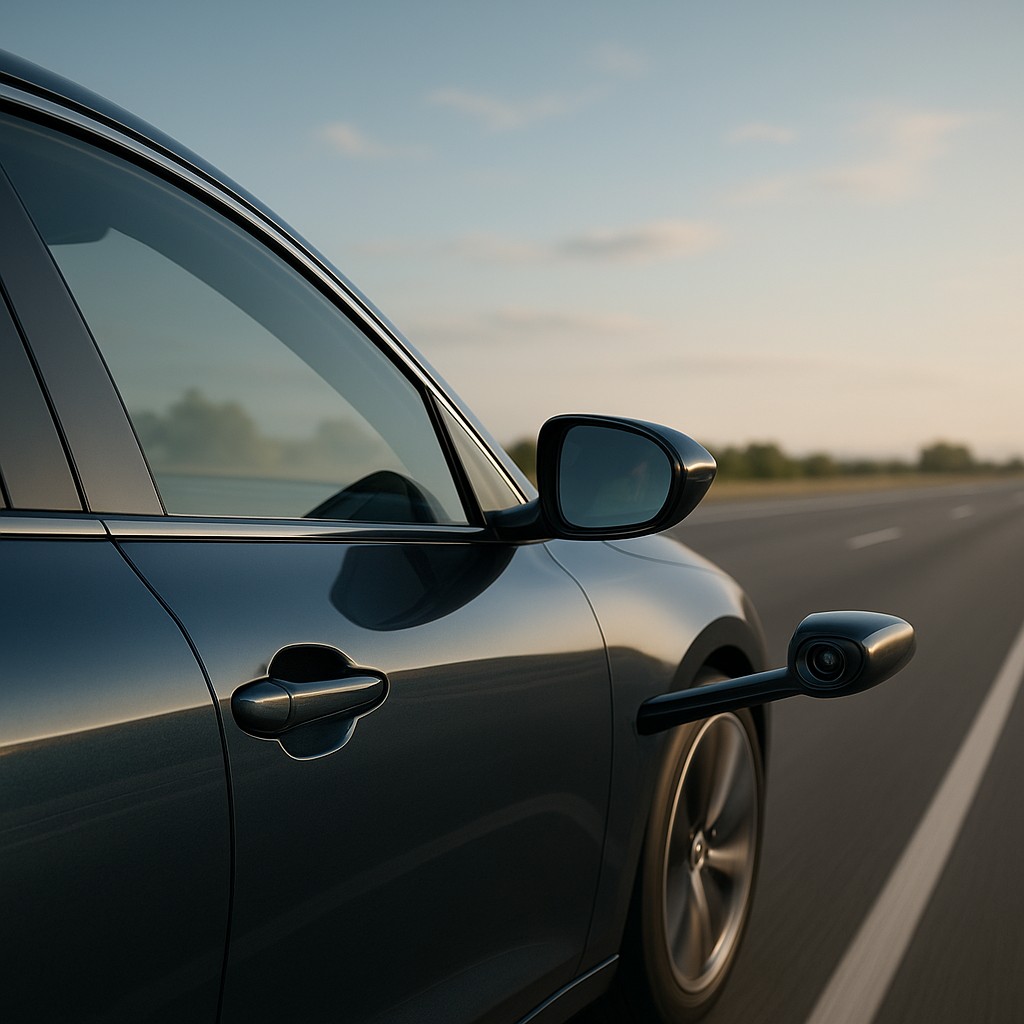
Imagine you are driving at sixty miles per hour on a wide, open highway. To your left and right, two rectangular slabs of glass and plastic stick out from your car's sleek frame, stubbornly punching holes in the air. These side mirrors have been our faithful companions for over a century, serving as our literal eyes in the back of our heads. Yet, as automotive engineers strive for the perfect balance of efficiency and quiet, they have realized that these iconic "ears" are actually aerodynamic anchors. They are bulky, they are loud, and they steal miles of range from your tank or battery every time you hit cruising speed.
The solution moving from futuristic concept cars to showroom floors is the digital camera pod. By replacing those oversized mirrors with slender, high-definition camera stalks, designers are fundamentally changing how air moves around a modern vehicle. This shift is not just a high-tech gimmick for the sake of looks; it is a calculated strike against the invisible wall of air resistance. As we enter an era where every watt of energy counts, the traditional glass mirror is facing a digital sunset.
The Invisible Wall and the Penalty of Protrusion
To understand why a tiny piece of glass matters so much, we have to look at how air moves around a car. At low speeds, air is relatively polite, flowing around objects with ease. However, as you speed up, air becomes "thicker" and more resistant, a phenomenon known as aerodynamic drag. Traditional side mirrors are a problem because they sit exactly where the air is trying to stay attached to the car's body. Because they stick out at a right angle, they act like small parachutes, catching the wind and forcing it to break apart into a chaotic mess of swirls and eddies.
This chaos is known as turbulent flow, and it creates a "wake" behind the mirror that pulls the car backward. Engineers measure this resistance using a number called the coefficient of drag (Cd). Even though a mirror looks small compared to the rest of the car, its position at the widest point of the vehicle means it can cause up to seven percent of a car’s total air resistance. For an electric vehicle (EV) trying to squeeze every possible mile out of a battery charge, that loss represents a massive waste which can be solved by simply slimming down the side-view equipment.
Smoothing the Airflow Through Digital Vision
When a car designer replaces a mirror with a camera pod, the vehicle's silhouette change is dramatic. These pods, often called Camera Monitoring Systems (CMS), are roughly the size of a finger or a small cigar. Compare that to the dinner-plate-sized housing of a traditional mirror. This reduction in the "frontal area" allows the air to remain "laminar," which is the scientific term for air that stays in smooth, orderly layers as it slides down the side of the car. Rather than smashing into a flat wall of glass, the wind whispers past a needle-like stalk, significantly shrinking the wake left behind.
The benefits of this smoothing effect go beyond just fuel economy. If you have ever noticed a high-pitched whistle or a low thrum while driving on a windy day, you are hearing the mirrors struggle against the atmosphere. Traditional mirrors create aeroacoustic noise, which is the sound of turbulent air flapping against the side windows. By streamlining the exterior with sensors, that wind whistle is almost entirely silenced. This makes the cabin feel more like a luxury lounge than a cockpit, allowing passengers to speak more softly and reducing driver fatigue on long trips.
Intelligence Beyond the Glass
Moving the "reflective" surface inside the car changes the fundamental way we see our surroundings. In a traditional setup, you have to tilt your head or lean forward to adjust your view. With a digital camera system, you look at high-resolution screens mounted at the base of the windshield pillars or built into the dashboard. These screens do not just copy a mirror; they improve it. Because the cameras are digital, they use software to instantly adjust for different lighting. This means you will never be blinded by another car's high beams or struggle to see through a dark rainstorm.
Furthermore, these systems offer smart views. When you shift the car into reverse, the digital "mirrors" can automatically zoom out to show a wider angle of the curb. When you use your turn signal, the software can highlight a vehicle in your blind spot with a glowing red warning on the screen. This provides a level of active safety that a simple piece of glass cannot match. It transforms the side view from a passive reflection into an active data stream that helps the driver make better decisions in real-time.
Comparing the Old Guard to the New Digital Stalks
While the transition to cameras seems like an obvious win, there are clear trade-offs between the two technologies. The car industry is currently in a middle ground where regulations, cost, and driver habits are clashing with the undeniable physics of air efficiency.
| Feature |
Traditional Glass Mirrors |
Digital Camera Pods (CMS) |
| Energy Efficiency |
High drag; reduces range by 2-5%. |
Low drag; improves range and efficiency. |
| Visibility |
Limited by weather and glare. |
Better sight with night vision and software. |
| Reliability |
Low tech; never suffers a "system crash." |
High tech; requires power and software. |
| Acoustics |
Significant wind noise and whistling. |
Near-silent operation at high speeds. |
| Cost |
Cheap to make and replace. |
Expensive sensors, screens, and wiring. |
| Legal Status |
Legal everywhere in the world. |
Legal in Europe and Japan; restricted in the US. |
Navigating the Red Tape of Innovation
If camera pods are so much better, you might wonder why every car on the road isn't already using them. The answer lies in a complex web of international safety rules. For decades, laws such as the Federal Motor Vehicle Safety Standards in the United States have specifically required "mirrors" by name, often saying they must be made of glass. These laws were written long before high-definition digital video existed. They were intended to ensure a driver could always see behind them, even if the car's electrical system failed.
In regions like Europe and Japan, regulators have been quicker to change, allowing companies like Audi, Honda, and Mercedes-Benz to use camera-only systems on certain models. In North America, the shift has been slower. Organizations like the National Highway Traffic Safety Administration (NHTSA) have begun extensive testing to ensure that digital screens don't cause eye strain or make it hard for drivers to judge depth. The challenge is mostly psychological; humans have spent a century learning to judge distance through a reflection, and our brains need time to get used to a 2D screen representing a 3D space.
The Myth of the Unreliable Screen
One of the most common worries about digital mirrors is that they are a safety risk because they rely on electricity. Critics often point out that if a fuse blows, the driver is effectively blind. However, modern engineering uses "functional safety," which means the system has backup parts to prevent failure. The cameras and screens are typically connected to dedicated computers that prioritize mirror video over anything else in the car. This ensures that even if the radio or navigation system crashes, the "mirrors" stay on.
Additionally, digital mirrors solve a very physical reliability issue: the weather. Traditional mirrors are famous for fogging up, freezing over, or getting covered in raindrops. Most camera pods are built with internal heaters and special coatings that repel water. Since the lens is so small, it is much easier to keep clean and clear. In many ways, the low-tech glass mirror is actually more fragile in a winter storm or a salty coastal breeze, as it requires the driver to manually wipe it down to see.
Embracing a More Efficient Horizon
As we look toward a future dominated by electric vehicles and self-driving technology, removing the side mirror feels like a natural step in the car's evolution. We are moving away from a world of "bolted-on" accessories and toward smart, integrated systems. While it may feel strange at first to look at a small screen instead of a piece of glass, the rewards are real: a quieter ride, a longer range, and a better way to see the hazards that the wind used to hide.
The end of the side mirror is not just a win for electronics; it is a celebration of our ability to improve the things we take for granted. By looking closely at the invisible air flowing around us, we have found a way to make our journeys smoother, faster, and more sustainable. When you see these slim sensors begin to appear on the highway, you are watching the moment car design stopped fighting the wind and finally learned to dance with it. You aren't just seeing a new gadget; you are seeing the future of travel becoming more elegant, one pixel at a time.