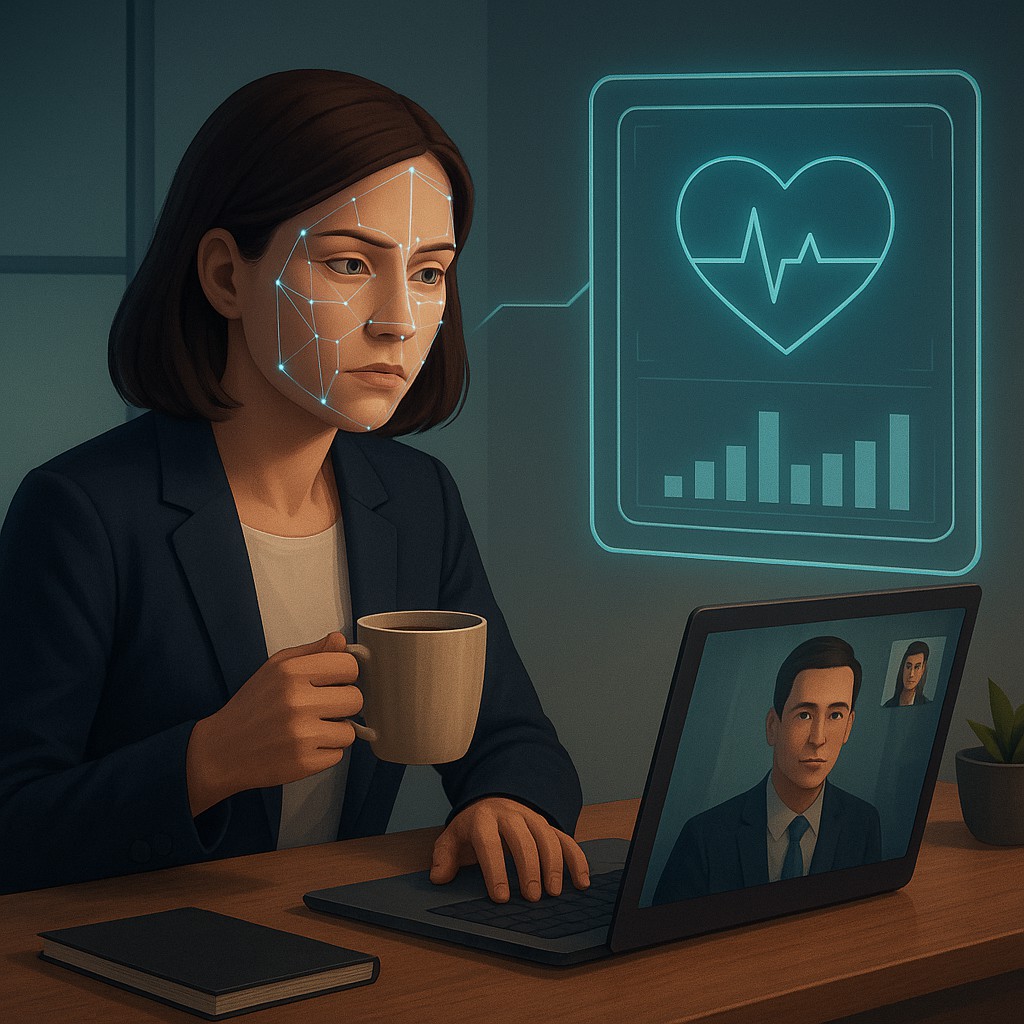
Imagine you are sitting in a Monday morning meeting, sipping lukewarm coffee and trying your best to look engaged while your manager drones on about quarterly spreadsheets. To the naked eye, you look professional, focused, and perhaps even mildly enthusiastic. However, tucked away in your webcam’s software, an invisible algorithm is noticing that your pupils have dilated slightly, your heart rate has ticked up by three beats per minute, and your facial muscles are twitching in a micro-pattern that suggests deep-seated boredom or frustration. This isn't science fiction; it is a rapidly expanding sector of the tech industry known as emotion recognition software. While we have spent the last decade arguing about facial recognition and whether a computer can pick our name out of a crowd, a much stranger battle is brewing over whether a computer has the right to guess how we feel.
The real magic, or perhaps the real mischief, lies in what legal experts call "inferred data." For years, privacy laws focused on the basics, such as your Social Security number, your fingerprint, or your home address. These are static facts that identify who you are. But emotion recognition tools do something entirely different: they take the "leakage" from your body, like the sweat on your palms or the way your eyes dart across a screen, and turn it into a high-stakes guessing game. They aren't just identifying you; they are interpreting you. This shift from identifying our bodies to auditing our minds is forcing lawmakers and tech companies into a tense standoff. We are beginning to ask ourselves if our inner thoughts, as guessed by a machine, should be protected with the same ferocity as our bank account passwords.
The Invisible Audit of Human Sentiment
At the heart of this technology is the concept of a "baseline." When a company installs emotion-monitoring software, the system first spends time learning what you look like when you are "normal." It maps your neutral face, your standard blink rate, and the rhythm of your typing. Once this baseline is established, any deviation becomes a data point. If you start typing faster and staring more intensely at the screen, the software might flag you as "highly engaged." Conversely, if your posture slumps and your eye contact with the monitor wavers, the system might report to your supervisor that you are "at risk of burnout" or, more cynically, simply "slacking off."
The problem with these systems is that they rely on a very narrow definition of human expression. They assume that a smile always means happiness and a furrowed brow always means anger or confusion. In reality, humans are far more complex. You might furrow your brow because you are thinking deeply and doing your best work, or you might be smiling because you are nervous. When a machine makes an inference about your internal state, it is essentially creating a digital rumor about your personality. If that rumor is used to decide who gets a promotion or who gets fired, the stakes for "biometric privacy" - the right to keep your biological data private - suddenly become very personal and very high.
When Your Physiology Becomes a Legal Battleground
Lawmakers are currently scrambling to decide if these machine-generated guesses count as "biometric identifiers." Historically, laws like the Biometric Information Privacy Act (BIPA) in Illinois were designed to stop companies from taking your fingerprint without asking. They were concerned about identity theft. However, inferred data poses a different kind of risk. If a computer "infers" that you are stressed or depressed based on your heart rate and facial movements, that information is technically a medical or psychological profile. In many jurisdictions, the debate is shifting toward whether companies must get explicit, written permission before they can even begin "guessing" your emotions.
This isn't just about big companies and their employees; it is about the fundamental right to have a "poker face" in the digital age. If every micro-expression is recorded and categorized, the social contract of the workplace changes. We move from a world where we are judged by our output, such as the reports we write or the code we produce, to a world where we are judged by our "internal compliance." In legal terms, this is a move toward protecting "mental privacy." The argument is that your body signals are your own, and just because a camera can see them doesn't mean a company has the right to translate them into a psychological report.
Comparing Traditional and Inferred Privacy Standards
To understand why this is such a headache for lawyers and HR departments, it helps to see how the privacy landscape is shifting. We are moving from a world of "hard facts" to a world of "soft guesses," and the rules for one don't necessarily fit the other.
| Feature |
Traditional Biometric Data |
Inferred Emotion Data |
| Primary Goal |
Identification (Who are you?) |
Interpretation (How do you feel?) |
| Data Type |
Static (Fingerprints, Retinas) |
Dynamic (Pulse, Micro-expressions) |
| Accuracy |
Extremely High / Objective |
Variable / Subjective |
| Legal Status |
Heavily regulated in many regions |
Emerging / Gray Area |
| Main Concern |
Identity Theft |
Behavioral Profiling and Bias |
| Worker Control |
You choose to scan your finger |
The camera watches you passively |
As the table shows, the transition is from clear-cut data to "fuzzy" data. While a fingerprint is binary (it either matches or it doesn't), an emotion inference is a percentage of probability. A system might be 70% sure you are frustrated, which is just enough to get you in trouble with a boss but not enough to be considered a scientific fact. This lack of certainty is exactly why privacy advocates are so worried.
The Risk of the Algorithmic Average
One of the most dangerous myths about emotion recognition is that it is "objective" because it uses math. In truth, these systems are often trained on datasets that don't account for cultural or neurological diversity. For example, people from different cultures express intensity or respect in very different ways. Furthermore, individuals who are neurodivergent, such as those on the autism spectrum, may have facial expressions or eye-contact patterns that don't fit the "baseline" of the software. To an emotion-recognition tool, a person who doesn't make "enough" eye contact might be labeled as "untrustworthy" or "distracted," when in reality, they are simply processing information differently.
This creates a hidden tax on anyone who doesn't fit the "behavioral norm." If the software is tuned to reward a specific type of upbeat, high-energy presence, it creates a workplace where everyone feels pressured to perform a digital version of happiness. We risk creating a feedback loop where employees spend more energy "managing" their biometrics for the camera than they do actually doing their jobs. Legal debates are now focusing on whether this constitutes a form of discrimination. If an algorithm is biased against your natural way of moving or looking, then using that algorithm to monitor you could be a violation of labor rights.
Navigating the New Frontier of Digital Consent
The path forward likely involves much stricter rules on transparency. In the past, you might have signed a general handbook that said the company monitors its computer systems. In the future, you may see specific "Emotion Recognition Consent Forms" that look more like medical waivers. These forms would have to explain exactly what is being measured, what the "baseline" is, and most importantly, how those inferences will be used. Will they be deleted after 24 hours? Will they be used in your annual performance review? These are the questions that will define the next decade of employment law.
The shift toward protecting inferred data represents a growing realization that our privacy is not just about our names, but about our "inner lives." As we spend more of our lives behind screens and in front of cameras, the boundary between our private thoughts and our professional personas is blurring. By fighting for the right to our own emotional data, we are essentially fighting for the right to be human, with all the messiness, inconsistency, and privacy that entails.
As you navigate this brave new world of digital surveillance, remember that your value as a human being cannot be boiled down to a heart rate monitor or a facial muscle map. While technology continues to get better at "guessing" what we think, it can never truly understand the depth of human experience or the nuance of our intentions. Staying informed about your digital rights is the first step in ensuring that while the machines may be watching, they don't get the final word on who you are. Embrace your right to a private inner world, for that is where true creativity and individuality live.