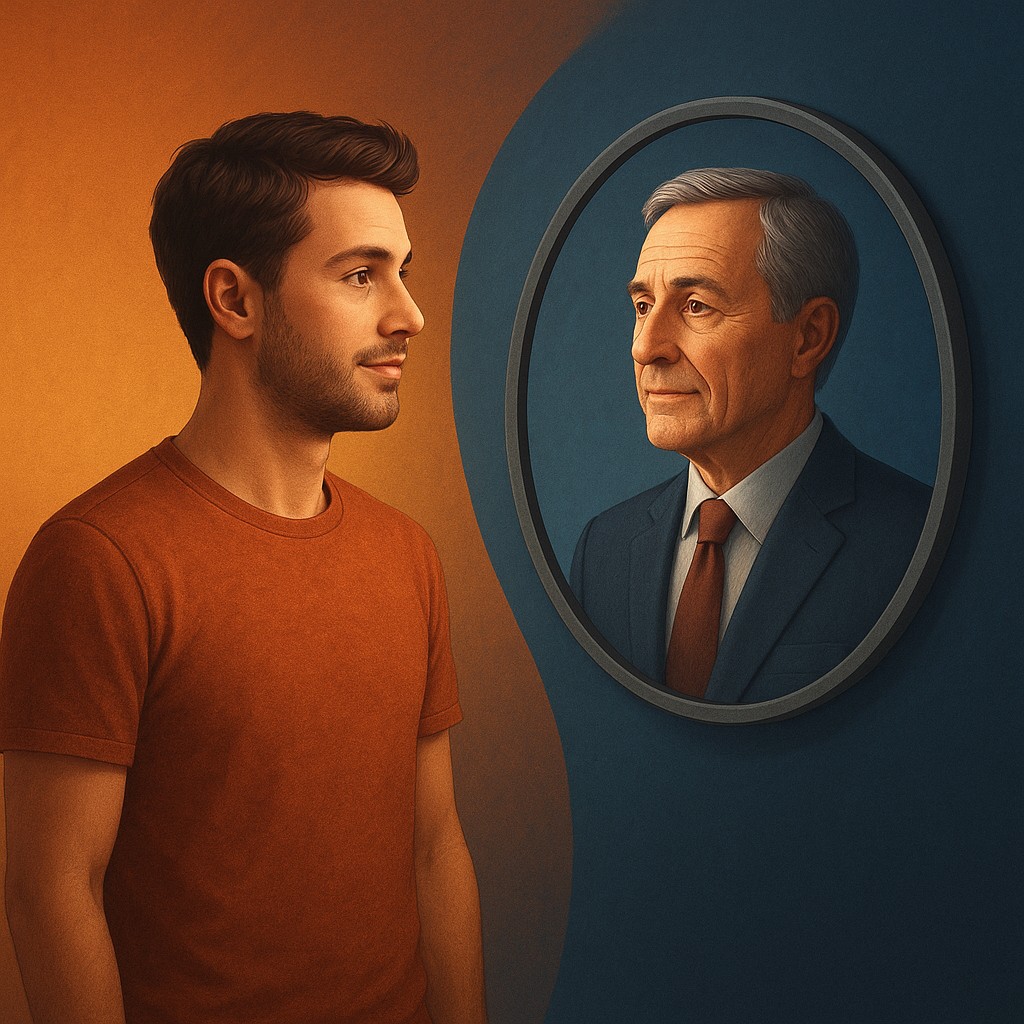
Imagine for a moment that you could travel back ten years to meet your younger self. Think about the music you couldn't stop playing, the clothes you thought were the height of fashion, and the specific worries that kept you up at night. For most of us, that version of ourselves feels like a stranger, or at the least, a rough first draft. We look back and see a total transformation in our tastes, our politics, our goals, and even our basic personality. We can easily admit that the person we were at twenty is vastly different from the person we became at thirty.
Now, try the opposite. Picture yourself ten years from today. If you are like most people, you probably imagine your future self as almost exactly the same person you see in the mirror right now. You might see a few more wrinkles or a new job title, but you likely believe your fundamental "essence" has finally settled. You assume the music you love today is what you will love forever, and that your current values are the final stop on your moral journey. This strange mental glitch - where we recognize how much we have changed in the past but predict we will stay the same in the future - is a psychological phenomenon known as the End-of-History Illusion.
The Mental Trap of the Permanent Present
The term "End-of-History Illusion" was created by researchers Jordi Quoidbach, Daniel Gilbert, and Timothy Wilson. Their work shows that whether you are eighteen or sixty-eight, you likely believe you have just finished your personal growth. We tend to see the present as a unique turning point where we have finally become a "finished product." It is as if we have been hiking through a thick, winding forest and have just stepped out into a permanent clearing where the view will never change again.
This illusion happens because of a basic imbalance in how our brains work. It is easy to look backward because memory gives us a library of facts. We can remember the exact day we gave up an old hobby or the moment we changed our minds about a political issue. However, looking forward requires us to build a vision from scratch rather than just remembering it. Creating a picture of a future self takes a lot of mental energy and creativity. Because it is hard to imagine how we might change, our brains take a shortcut and decide that change simply won't happen. We mistake the difficulty of the task for the impossibility of the result.
The Price of Doubting Your Future Growth
This illusion is more than just a quirky fact; it has real consequences for how we run our lives. When we believe our current preferences will never change, we make long-term commitments that our future selves might find a burden. This is why people spend thousands of dollars to laser off tattoos they once thought were perfect expressions of their soul. It is also why we sometimes feel trapped in careers or marriages chosen by a "past self" who had very different needs than the person we are now. We treat our current desires as if they are carved in stone, forgetting they are actually written in sand.
This bias also hits our wallets. In various studies, researchers asked people how much they would pay today to see their current favorite band play in ten years. People offered high prices, assuming they would be fans forever. But when asked how much they would pay today to see their favorite band from ten years ago, they were much less excited. We consistently overpay for the version of ourselves that exists right now, failing to account for "preference volatility" - the natural way our likes and dislikes shift over time. By spotting this illusion, we can build more flexibility into our long-term plans, leaving room for the person we haven't yet become.
Tracking the Gap Between Memory and Imagination
To see how this illusion works over a lifetime, it helps to look at how different age groups view their own growth. The illusion does not go away as we get older, even though we actually do change a bit more slowly as we age. The gap between how much we think we will change and how much we actually changed in the past stays the same. Whether you are a teenager or a retiree, you will likely underestimate your future self.
| Age Group |
Looking Back (The Last 10 Years) |
Looking Forward (The Next 10 Years) |
The Reality Gap |
| Young Adults (18-25) |
See massive shifts in personality, values, and friends. |
Predict they will stay the same, having "found themselves." |
High: They change the most but expect it the least. |
| Middle Age (35-50) |
Recognize big shifts in priorities, jobs, and moods. |
Assume they have hit a stable plateau in their tastes. |
Moderate: Change slows down but still happens more than they think. |
| Older Adults (65+) |
See slow but steady shifts in their outlook and lifestyle. |
Believe their character is fully set for the rest of their lives. |
Consistent: Even small changes surprise the "fixed" mindset. |
This table shows that while we get wiser with age, we don't necessarily get better at seeing our own potential to change. We are constantly convinced we have finally reached the peak of our personal growth. This "peak" is a moving target that follows us throughout our lives, making us feel like we are at the end of the road even as the path continues to roll out beneath our feet.
Why We Struggle to Build a Future Identity
One of the most interesting parts of this illusion is that it comes from a "simulation error" in the brain. When we try to imagine our future, we use the same mental tools we use to remember the past. But the future is a blank canvas. Without specific facts to guide us, the brain goes with the easiest information it can find: the present. If I ask what you will want for dinner ten years from tonight, your brain looks at what you want for dinner right now and projects that feeling forward. It is a failure of imagination, not a lack of potential.
We also fall for the "ease of processing" bias. We tend to believe that if something is hard to think about, it is less likely to be true. Since it is mentally draining to imagine a version of ourselves with different values, a different religion, or different tastes, we subconsciously decide those changes won't happen. We prefer the comfort of a stable identity over the "mental tax" of imagining a changing one. This creates a sense of "identity stasis" - a feeling of being stuck in place - that can make us too confident in our current worldview.
The Myth of the "Finished" Human
Society often feeds this illusion by telling us to "find ourselves," as if our identity is a hidden treasure we just need to dig up and keep forever. This story suggests there is a final, static version of you that will never change again once you find it. In reality, the "self" is more of a process than a product. We are always reacting to new places, new people, and new information. The person you are today is a temporary state of transition, not a final destination.
Misunderstanding this can make us judge our past selves too harshly and leave us unprepared for the future. We look back at our younger selves and wonder how we could have been so "wrong," while remaining certain that we are "right" about everything now. Accepting that we are a work-in-progress makes us more humble. It reminds us that "Current Me" is just one episode in a long-running series, and the writers are famous for introducing plot twists in the later seasons.
Strategies for a More Flexible Future
If we know we are biased toward seeing ourselves as finished, how can we make better decisions? One smart path is to practice "future-self empathy." Instead of seeing your future self as a clone of who you are now, try to see them as a different person entirely - someone you have a duty to look out for. If you were making a choice for a stranger, you would likely leave them more options. Applying this to your own life means avoiding "irreversible" decisions when you can and keeping a "growth mindset" that welcomes change.
Another practical tip is to look for experiences that challenge your current tastes. Since we tend to think our preferences are permanent, we should test that theory on purpose. By trying new music, different cultural views, or new hobbies, we give our brains more "raw material" to imagine change. This makes it easier to project ourselves into a different future, as we have proof that our boundaries are more flexible than we thought.
Embracing a Fluid Life
Understanding this illusion is like realizing the person you are today is just one frame in a long movie. It is an invitation to let go of the pressure to have everything figured out once and for all. You are not a statue; you are a river. The water flowing through you today is different from the water that flowed yesterday, and it will be different again tomorrow. This realization brings a deep sense of freedom. If you aren't happy with who you are right now, you can take comfort in the fact that change is not just possible - it is guaranteed to happen.
In the end, accepting that your history hasn't ended allows you to live with more curiosity and less rigidity. You can look forward to the person you will become with wonder rather than certainty. By admitting your imagination has limits, you open up space for a future that is wider and more vibrant than anything your current mind could build. The journey of discovering who you are is never really over, and that is the most exciting part of being human.