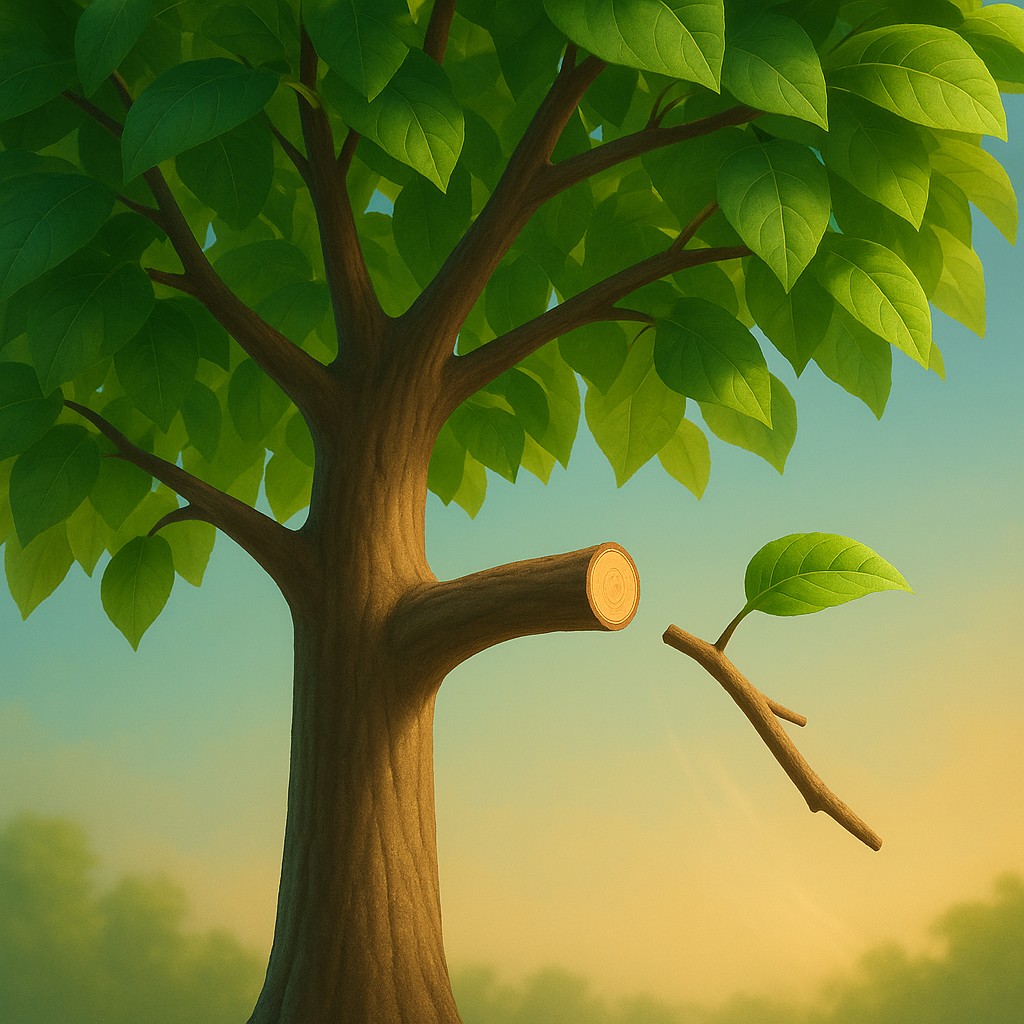
Think of yourself as a high-stakes accountant for a multi-billion dollar corporation where the only currency is sunlight. Every leaf on your body is a solar panel, and every branch is a heavy-duty power cable that costs a fortune to maintain. If a cable drains more power than its panels generate, it isn't just a nuisance; it is a liability that could lead to bankruptcy. In the world of plants, bankruptcy isn't a legal filing. It is the slow, agonizing process of being outgrown by your neighbors and dying in their shadow. To avoid this, trees have evolved a ruthless and efficient way to cut their losses, showing us that sometimes the best way to grow up is to let go.
We often see trees as still, passive parts of the landscape, but they are actually active plumbing systems. They move hundreds of gallons of water against the pull of gravity every day. To do this, they rely on energy gathered through photosynthesis, the process of turning light into food. When a tree lives in a thick forest, competition for space in the sky is fierce. As the upper leaves grow thick, the lower branches are trapped in a constant twilight. These limbs become "sinks," meaning they burn more sugar to stay alive than they produce. Rather than wasting resources on these "lazy" limbs, the tree performs a calculated biological sacrifice called cladoptosis.
The Botanical Pink Slip: How Trees Fire Their Branches
When a tree decides a branch is no longer profitable, it doesn't just wait for it to rot and fall off. That would be dangerous; an open wound is an open door for fungi and bacteria to attack the main trunk. Instead, the tree starts a controlled "self-pruning" sequence at the cellular level. This process begins at the base of the branch in a spot called the branch collar. The tree grows a specialized layer of cells known as the abscission zone. Think of this as a severance package, but instead of a check, the tree uses a chemical barrier to literally choke the life out of the limb.
This zone consists of two layers: a soft layer that acts as a physical breaking point and a protective layer of cells that act like cork. As these cells develop, they slowly cut off the flow of water and nutrients to the branch. It is a slow-motion execution. Without water, the branch cells die and the wood weakens. Meanwhile, on the trunk side, the protective layer seals off the tree’s internal plumbing. By the time the branch finally snaps under its own weight or a gust of wind, the tree has already capped the exit point. This biological manhole cover prevents sap leaks and keeps out pests.
Managing the Internal Water Budget
To understand why a tree is so eager to shed its limbs, we have to look at how it drinks. Trees do not "suck" water up through their roots like we use a straw. Instead, water is pulled from the top through a process called transpiration. As water evaporates from the leaves, it pulls the entire column of water upward because water molecules naturally stick together. This requires high pressure and a perfectly sealed system. If a branch is damaged, it can let in air bubbles called embolisms. These bubbles act like a clog in a fuel line, potentially killing every part of the tree above the break.
By self-pruning, the tree keeps its plumbing efficient. It ensures that its limited supply of nutrients, like nitrogen and phosphorus, goes to the "high-performance" branches at the very top. These are the limbs winning the war for sunlight. In a crowded forest, the strategy is "get tall or die." Every bit of energy spent keeping a shaded limb alive is energy not spent outgrowing the neighbor who is trying to shade you out. This internal management turns the tree into a lean machine that prioritizes the future over the sentimental value of its oldest, lowest arms.
The Timber Economy and the Beauty of a Clean Trunk
This biological ruthlessness has a massive impact on our world, especially in building and forestry. If you have ever seen a high-quality piece of wood and noticed it was almost free of knots, you are seeing the result of successful self-pruning. Knots are actually the "shadows" of old branches. When a branch stays on a tree for a long time, the trunk grows around it, trapping the base of the limb inside the wood. If a branch dies but doesn't fall off, it creates a "dead knot," which can easily fall out of a dried board and leave a hole.
Forest managers use this natural behavior by planting trees very close together. This forces them to compete for light immediately, triggering the self-pruning response early. As the trees race toward the sun, they drop their lower branches while they are still tiny twigs. This creates a long, straight, clear trunk with very small knots only at the very center. The table below compares how different conditions change the quality of the wood.
| Growth Factor |
Open Field (Lone Tree) |
Dense Managed Forest |
| Keeping Branches |
Low branches stay alive for decades |
Lower branches are dropped quickly |
| Trunk Shape |
Wide at the bottom and tapered |
Straight, tall, and like a cylinder |
| Wood Quality |
Many knots; wavy grain |
Clear, strong, knot-free lumber |
| Growth Energy |
Spreads out sideways and up |
Focused almost entirely on height |
| Risk of Infection |
Lower (fewer pruning wounds) |
Managed (natural sealing is fast) |
Moving Past the Myth of the Healing Tree
A common mistake is thinking that trees "heal" wounds like humans do. When we get a cut, our bodies make new tissue to bridge the gap and replace the damage with a scar or new skin. Trees cannot do this because their cells are locked inside rigid walls. Instead of healing, trees "compartmentalize." They build a wall around the damage and grow entirely new wood over the top of it, burying the injury inside their own history.
When a tree self-prunes, it uses the most advanced version of this defense. Because the tree starts the break itself, it can prepare the "wall" in advance. When a person prunes a tree incorrectly by cutting too close to the trunk (a flush cut), they remove the branch collar. This removes the cells needed for the sealing process and leaves the heart of the tree exposed. Natural self-pruning is almost always better than human cutting because the tree knows exactly where its "sealant zone" is. This results in "clear wood," the gold standard for building because the wood grain is continuous and strong.
The Cost of Indecision
If a tree fails to prune itself, the results can be a disaster. In some species that are "poor self-pruners," like certain landscape maples, the lower branches die but stay attached. These dead limbs become "vampire structures." They don't take nutrients, but they provide a perfect highway for wood-eating insects and fungi to enter the main trunk. Over time, rot from a single stuck branch can hollow out the tree. In a forest, a hollow tree is one that will snap during the next ice storm or high wind.
Cladoptosis is therefore a vital survival skill. It is a form of biological intelligence where the tree recognizes its old shape no longer fits its environment. The tree does not mourn the branches that helped it grow when it was a sapling. It knows those branches have done their job and are now a threat. This "calculated sacrifice" keeps the tree structurally sound and keeps it profitable in the currency of light, even as the forest grows darker and more crowded.
Scaling the Heights of Biological Wisdom
The next time you walk through a pine grove or a dense forest and notice those tall, telephone-pole-like trunks, look at the ground. You are walking over the discarded remains of a tree’s past selves. Those rotting sticks on the forest floor were once the primary power stations for the giants standing above you. Losing them wasn't a failure; it was a requirement. By shedding what no longer serves the mission of reaching the light, the tree keeps its health and its place in the sky.
We can learn a lot from how a tree manages its internal economy. It reminds us that growth is not just about gaining more; it is also about having the courage to cut away the parts of our lives that are draining our energy. Efficiency in nature is rarely about doing more; it is often about doing less, but with more focus. As you navigate your own life, remember the wisdom of the tree: seal the wound, drop the weight, and keep your eyes on the sun.